
SEO in 2026 isn’t harder than it used to be — it’s different. The same cluster of avoidable mistakes shows up across almost every business. Fix these, and results usually follow.
Quick answer
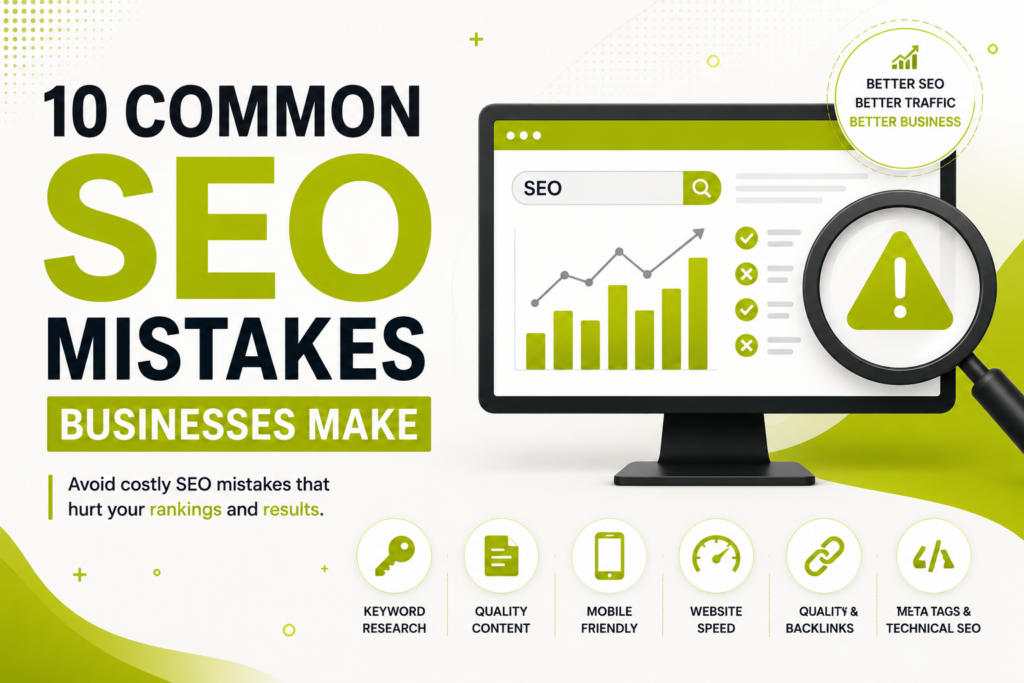
The most common SEO mistakes businesses make are: chasing keywords instead of search intent, publishing thin or generic AI content, keyword stuffing and over-optimization, ignoring technical basics (crawl, indexing, duplicate content), neglecting site speed and mobile, weak internal linking, chasing low-quality backlinks and vanity metrics, neglecting local SEO, measuring the wrong things, and optimizing only for Google while ignoring AI search. Most aren’t technical tricks anymore — they’re strategic oversights. The biggest one, by far, is content that targets a keyword without answering the purpose behind the search.
Most businesses don’t lose at SEO because they missed some clever tactic. They lose because of a handful of predictable mistakes repeated across their whole site. Google’s systems have gotten dramatically better at separating genuinely useful content from content that only looks useful, and AI-powered search now surfaces answers instead of just links — so old tricks don’t just stop working, some actively backfire. Here are the ten that cost businesses the most, and how to fix each. (For the deeper strategic version of why SEO stalls, see our pillar guide on why SEO isn’t working.)
The 10 most common SEO mistakes
- Chasing keywords instead of search intent
The single biggest mistake. Google ranks pages by how well they satisfy the purpose behind a query, not keyword placement. Writing a sales page for an informational search, or a 3,000-word guide when users want a one-line answer, means people bounce and rankings slip. Fix it by checking what already ranks for your target term — that’s what Google thinks the intent is — and matching that format and depth. - Publishing thin, generic content with no real expertise
The web is flooded with generic AI-written articles that say what everyone else says. Google’s guidance on helpful content asks whether a page shows real expertise, original information and clear sourcing. Thin, me-too pages fail to rank and get ignored by AI answer engines alike. Depth beats volume: add real examples, original data, and first-hand insight. AI tools are fine for drafting — publishing their output unedited is the mistake. - Keyword stuffing and over-optimization
In 2026 this rarely means repeating a phrase ten times; it shows up as forced variations and unnatural phrasing added for ranking, not readers. Keyword stuffing is listed in Google’s spam policies, so it can work against you. Write for humans, cover the topic naturally, and let related terms appear on their own. - Ignoring technical SEO basics
Crawl errors, broken internal links, pages accidentally blocked inrobots.txtor set to noindex, and the same content sitting on several URLs can quietly hold rankings back, even for great content. Google says duplicate content isn’t a spam violation, but it can waste crawling on URLs you don’t care about. If search engines can’t crawl and index a page, nothing else matters. Work through our technical SEO checklist for 2026, and see why businesses need technical SEO for the full case. - Neglecting site speed and mobile experience
Google uses the mobile version of your content for indexing and ranking, so a slow or clunky mobile site hurts you twice. Google highly recommends good Core Web Vitals and says they line up with what its ranking systems reward. See how speed impacts rankings and why your website is slow for the fixes. - Weak internal linking and site structure
Orphan pages with no internal links, generic “click here” anchors, and random linking waste one of your easiest ranking levers. Strong internal linking improves crawlability, distributes authority to key pages, and keeps users engaged. Link with descriptive anchor text, and make sure every important page is reachable. - Chasing backlink quantity and vanity metrics
Backlinks still matter, but quality and relevance now far outweigh quantity — and buying links, private blog networks, and irrelevant links can actively hurt you. Equally, Domain Rating and Authority Score are third-party estimates, not Google ranking signals; chasing a higher number doesn’t move rankings. Earn links through genuinely useful content and real relationships instead. - Neglecting local SEO
For any location-based business this is a big miss. Many businesses treat their Google Business Profile as an afterthought, leave fields incomplete, or run inconsistent NAP (name, address, phone) across directories. Complete your profile, keep NAP identical everywhere, earn reviews, and build location-specific pages rather than one generic “service areas” page. - Measuring the wrong things — or flying blind
Many businesses judge SEO by keyword position or Domain Rating and never connect it to revenue. Rankings and impressions can rise while leads stay flat. Track what actually matters:
| Misleading metric | Track instead |
|---|---|
| Keyword position alone | Organic conversions (leads, calls, sales) |
| Domain Rating / Authority Score | Relevance & quality of referring sites |
| Impressions | Clicks + engaged sessions |
| Total traffic | Traffic from buying-intent queries |
Set up proper analytics, and separate the growing slice of AI-referred visitors using this GA4 guide.
10. Optimizing only for Google — ignoring AI searchBuyers increasingly get answers from AI Overviews, ChatGPT, and Perplexity before clicking anything. Google says the same SEO fundamentals apply to its AI features, with no extra technical requirements, so the fix isn’t a trick: be indexable, be helpful and answer the question clearly. Learn to earn placement in Google’s AI Overviews and shape how assistants describe you (optimizing for ChatGPT); our GEO and LLM SEO services are built for exactly this.
The mistake behind the mistakes
One meta-error underlies most of the list: treating SEO as a one-time project and expecting overnight results. SEO compounds over months — Google says changes can take anywhere from a few hours to several months to show up, and suggests waiting a few weeks before you judge the results. Businesses that publish a batch of pages, see little immediately, and give up abandon the channel right before it pays off. Treat SEO as ongoing infrastructure: audit quarterly, refresh content every few months, and let consistency do the work.
How to fix your SEO (in priority order)
- Fix technical blockers first — crawl, indexing, speed, mobile. Nothing else works if these are broken.
- Realign content to intent and deepen thin pages with genuine expertise.
- Strengthen internal linking and consolidate cannibalizing pages.
- Fix local signals (GBP, NAP, reviews) if you serve a location.
- Earn quality links and build topical authority — no shortcuts.
- Optimize for AI search and measure against revenue, not vanity metrics.
If you run an online store, the store-specific version of this list is in common eCommerce SEO mistakes. And remember that traffic only matters if it converts — pair this with why your website isn’t generating leads, and build on a solid SEO foundation.
What are the most common SEO mistakes small businesses make?
Small businesses most often target keywords without matching intent, publish thin pages, leave their Google Business Profile half filled, ignore technical basics such as blocked or duplicate pages, and quit before SEO has had time to work. Google’s own guide says changes can take from hours to months, so judge results over weeks, not days.
That last point trips up more owners than any tactic. Google’s SEO starter guide is blunt that there are no secrets that automatically rank a site first, and it suggests waiting a few weeks before deciding whether a change helped. If you’re asking what mistakes small business owners make when using SEO, these are the ones to check first:
- Judging too early. Check a change after a few weeks, not after a few days, and keep a note of what you changed and when.
- Never opening Search Console. It’s where you see which queries bring impressions and clicks, and the URL Inspection tool shows how Google sees a page.
- Hiding the page from Google. If CSS or JavaScript files are blocked, Google may not understand the page the way a visitor does.
- Copying competitors. Google’s guide says to create your own content based on what you know rather than rehashing what’s already published.
- Weak titles and descriptions. Google says a good title is unique to the page, clear and concise, and describes what’s on it. A good meta description is short and unique to the page.
- Leaving a Business Profile incomplete. Google says businesses with complete, accurate information are more likely to show up in local results. Our local SEO services start with this fix.
If you can only fix one thing this month, fix the page that already gets impressions but few clicks. It’s the cheapest win you have, and you don’t need a new article to get it.
What SEO mistakes do company websites make in content production?
The big content mistakes are publishing many near-identical pages, rewriting what competitors already said, leaving pages out of date, and shipping AI drafts nobody edited. Google’s spam policies target large amounts of unoriginal content that adds little value, however it’s made, and its helpful-content questions reward original information, clear sourcing and an identifiable author.
Google’s people-first content guidance reads like a pre-publish checklist. Here’s how I’d turn its questions into steps your content team can actually run:
| Before you publish | The question to ask | The mistake it catches |
|---|---|---|
| Originality | Does this add original information or analysis beyond the obvious? | Rewriting the top five results in different words |
| Value versus rivals | Does it give more value than the other pages in search results? | Me-too pages that add nothing new |
| Title | Does the title describe the page without exaggerating? | Shock or clickbait headlines |
| Care | Does it look produced with care, or hastily? | Unedited drafts, typos, sloppy structure |
| Trust | Is there clear sourcing and information about who wrote it? | Anonymous pages with no evidence behind the claims |
| Accuracy | Are there easily checked factual errors? | Stale numbers that nobody rechecked |
Scale is where companies get into real trouble. Google’s spam policies describe scaled content abuse as generating many pages mainly to manipulate rankings, including using generative AI tools to produce many pages without adding value. So the mistake isn’t using AI. It’s publishing volume with no editing, no expertise and no reason to exist. We look at that line in more detail in can Google tell AI-written content.
Two smaller content mistakes are worth a mention. Google’s guide says content length alone doesn’t matter for ranking, so padding a page to hit a word count is wasted effort. It also says to check older content and update or delete what’s no longer relevant, which is why a refresh routine beats a publishing treadmill. If you want help building one, see our content marketing services and SEO copywriting services, or read how to automate content refreshes.
Which SEO mistakes does Google’s own documentation warn about?
Google’s documentation warns against keyword stuffing, buying or exchanging links for ranking, mass-producing low-value pages, and relying on robots.txt to hide pages. It also says duplicate content isn’t a spam violation, and that several popular worries, such as meta keywords and word count, don’t matter for ranking. Here’s the quick map.
| Mistake | What Google’s documentation says | What to do instead |
|---|---|---|
| Keyword stuffing | Repeating words or phrases until the text sounds unnatural is against the spam policies. | Write naturally and cover the topic fully. |
| Buying or swapping links | Link spam includes buying or selling links for ranking, excessive link exchanges and automated link creation. | Earn links with content people want to cite. |
| Mass-producing thin pages | Scaled content abuse covers many pages made mainly to manipulate rankings, however they’re generated. | Publish fewer, better pages. |
| Hiding pages with robots.txt | A blocked URL can still be indexed without a description. Use noindex or password protection instead. | Use robots.txt for crawl control, not secrecy. |
| Letting duplicates pile up | Not a spam violation, but it can waste crawling. Use a redirect or rel=”canonical”. | Keep one URL per piece of content. |
| Ignoring Core Web Vitals | Google highly recommends good scores. Its targets are LCP within 2.5 seconds, INP under 200 milliseconds and CLS under 0.1. | Check the Core Web Vitals report in Search Console. |
| No mobile version | Google uses the mobile version of your content for indexing and ranking. | Use responsive design. |
| Vague link text | Anchor text should tell people and Google about the page; links need to be a elements with an href to be crawled. | Use descriptive anchors and real links. |
Sources: Google’s SEO starter guide, spam policies, robots.txt introduction, Core Web Vitals page, mobile-first indexing guide and link best practices. If you’ve already crossed one of these lines and lost traffic, our Google penalty recovery services are the place to start.
Which SEO myths waste your time?
Several things people obsess over don’t move rankings. Google’s starter guide says it doesn’t use the keywords meta tag, that content length alone doesn’t matter, that keywords in a domain or URL have hardly any effect beyond breadcrumbs, and that heading order doesn’t matter for ranking. Spend that time on content, crawlability and users instead.
The same guide says E-E-A-T isn’t a ranking factor, though Google’s systems use a mix of signals that point toward helpful, trustworthy content. In plain terms, don’t chase a badge. Show your sources, name the author and be accurate, because that’s good for readers anyway. It also notes that duplicate content doesn’t trigger a manual action, which is worth knowing before you panic over a few repeated paragraphs. Copying other sites’ content is a different matter.
What SEO mistakes do Kenyan businesses make?
We haven’t found Kenya-specific mistake data from Google, so treat this as a checklist built on its general guidance. The ones that matter most for local firms are an incomplete Google Business Profile, a site that isn’t mobile friendly, and unclear country targeting. Google says a country domain only matters when you target a specific country’s users, and even then it’s a low-impact signal.
Put into practice, that means four checks:
- Complete the profile. Google lists full address, business hours, category and other details as things that help local results. It also says there’s no way to request or pay for a better local ranking, which is why complete information and good reviews matter. See the Business Profile ranking tips.
- Test on a phone. Google indexes and ranks using the mobile version of your content.
- Write the words your customers use. Google’s guide notes that people search with different words for the same thing, so match your customers’ language, not your internal jargon. If customers search in more than one language, our vernacular SEO services cover that.
- Pick the right domain setup. Choose a domain that suits your business and your audience, and don’t expect keywords in the domain to rank you.
What SEO mistakes show up in iGaming SEO?
Mostly the same ones in this list, with higher stakes. Link buying and mass-produced pages sit squarely inside Google’s spam policies, and tough competition tempts shortcuts. Regulated niches also carry local legal and advertising rules that this guide doesn’t cover, so check them with a qualified adviser before you publish anything.
The safe version of iGaming SEO is the boring one: pages that give players something original, links earned rather than bought, and clean technical basics. If you want a second pair of eyes on the technical side, our technical SEO services cover crawl, indexing and speed.
Is optimizing for AI search a mistake, or do you need a separate strategy?
You don’t need a separate strategy for Google’s AI features. Google’s guide says SEO best practices still apply to AI Overviews and AI Mode, with no additional requirements and no special optimizations. A page must be indexed and eligible to show with a snippet. Other assistants are separate products, so check their own publisher guidance.
So the real mistake is chasing AI tricks while the basics are broken. If a page isn’t indexed, nothing downstream works. Once the basics are sound, it’s sensible to write clear, direct answers, which also helps readers. Our guides on ranking in Google AI Overviews, answer engine optimization and whether SEO is dead in 2026 go further.
What is the 80/20 rule in SEO?
It’s a rule of thumb, not a Google guideline: the idea that roughly 20% of your pages, keywords or fixes bring about 80% of your results. Use it to prioritise. Find the few pages that already earn clicks in Search Console and improve those before you write anything new.
Applied to this article, that means fixing intent, technical blockers and your best-performing pages before you worry about the smaller items. Want a prioritised list for your own site? Run our free website analysis and start with whatever it flags first.
Last verified: 12 October 2026. Google’s documentation changes over time, so check the linked pages for the latest wording.
Frequently asked questions
What is the most common SEO mistake businesses make?
Targeting keywords without matching search intent. Google aims to show pages that are helpful and people-first, not pages that just repeat a phrase. A sales page for an informational search, or a long guide when people want a quick answer, rarely holds rankings however well it’s “optimized”.
Do SEO mistakes really hurt rankings, or just slow growth?
Both, depending on the mistake. Blocking pages from crawling or indexing can remove them from results. Spam-policy violations such as link buying or keyword stuffing can work against you. Most others, like weak titles or thin content, simply slow growth and waste effort.
Is keyword stuffing still a problem in 2026?
Yes. Google’s spam policies list keyword stuffing, including repeating words or phrases until the text sounds unnatural. Today it often looks like forced variations in headings and body copy. Write for readers, cover the topic naturally, and let related terms appear on their own.
How often should a business audit its SEO?
Google gives no fixed schedule. A quarterly review is a sensible rhythm for most sites: check crawl and indexing, Core Web Vitals, top pages and conversions. Review sooner after a redesign, migration or sharp traffic drop, and refresh older content as it goes stale.
Is SEO dead now with AI?
No. Google says SEO best practices still apply to AI Overviews and AI Mode, with no additional requirements. A page must be indexed and eligible to show with a snippet. AI changes where answers appear, so clear, helpful, well-structured pages matter more, not less.
What is the biggest mistake small businesses make with SEO?
Expecting fast results and quitting early, often with a half-finished Business Profile and unclear page intent. Google says changes can take hours to months and suggests waiting a few weeks before judging. Complete your profile, match intent, and track progress in Search Console.
What is the 80/20 rule in SEO?
It’s a rule of thumb, not a Google guideline: roughly 20% of your pages or fixes drive about 80% of results. Use it to prioritise. Improve the pages that already earn clicks in Search Console before you publish new ones.
What are the top 5 SEO strategies?
Google’s starter guide points to these: create helpful, original content; make sure Google can crawl and see your pages; write unique, clear titles and descriptions; link to relevant resources with good anchor text; and promote your site. Start with whichever your audit shows is weakest.
How long does SEO take to show results?
Google says some changes show up within hours and others can take several months, and it suggests waiting a few weeks before judging whether your work helped. Not every change produces a visible effect. Iterate if you’re not satisfied, and measure in Search Console.
Most of these are invisible until someone looks. Get a free SEO audit and we’ll pinpoint which mistakes are capping your rankings — intent, technical, local, links, or AI visibility — and hand you a prioritized plan to fix them.

Riya Bhardwaj
Leading content and growth initiatives with a focus on search visibility, audience engagement, and measurable business outcomes. Specialised in SEO, Generative Engine Optimization (GEO), AI search optimisation, and performance-driven content marketing. Passionate about transforming market insights into scalable content strategies that strengthen brand authority and drive sustainable digital growth.