
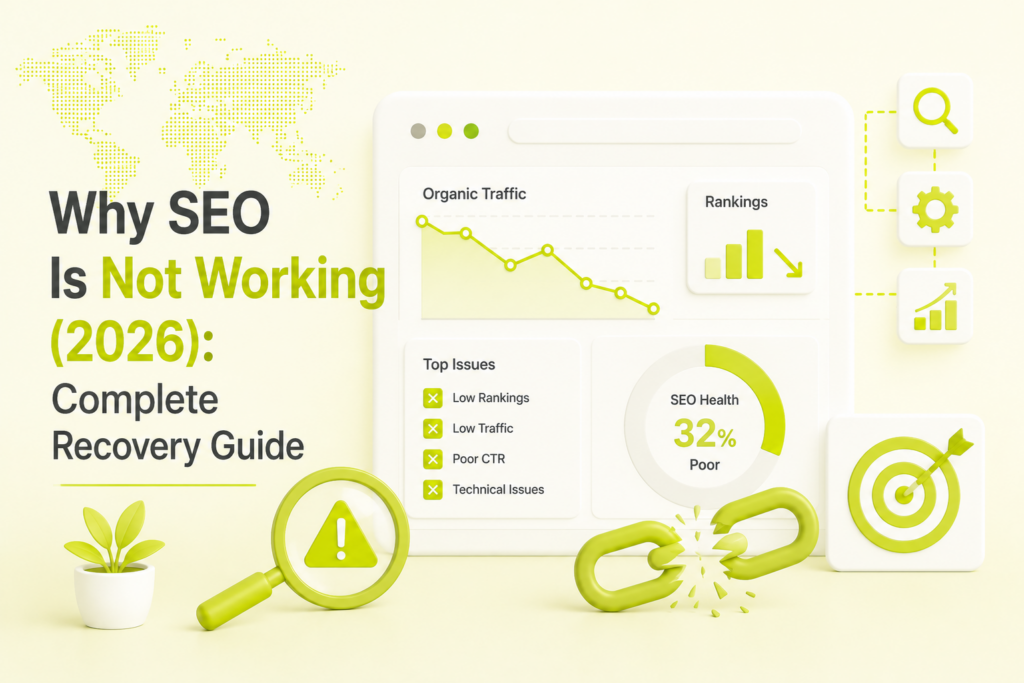
If months of SEO have produced nothing, the problem is almost never that “SEO is dead.” It’s that search changed — and your strategy didn’t. Here’s how to find the real cause and fix it.
Quick answer
SEO usually “isn’t working” for one of six systemic reasons:
(1) you’re measuring the wrong thing — rankings and traffic instead of leads and revenue;
(2) your keywords have no buying intent;
(3) search itself changed — AI Overviews now appear on 20–25%+ of searches and can cut the top result’s clicks by up to ~58%, while roughly 60% (and by some 2026 measurements ~68%) of Google searches end with no click at all;
(4) technical or crawl issues are blocking you;
(5) your content lacks depth, topical authority, and demonstrated expertise; or
(6) you quit before SEO’s natural 6–12 month curve. Fix measurement first, then search intent, then the specific systemic cause.
“I’ve been doing SEO for months and nothing is happening.” It’s one of the most common frustrations in digital marketing — and one of the most misdiagnosed. The instinct is to conclude that SEO no longer works. The reality, in almost every audit we run at Nowoka Digital, is that SEO is working exactly as designed; the strategy pointed at the wrong target.
That said, something genuinely did change. Between 2024 and 2026, search behavior shifted structurally. By SparkToro’s clickstream data, roughly 60% of US Google searches now end without a click — and their early-2026 measurement puts it around 68%. AI Overviews appear on more than 20% of searches, and when they do, Ahrefs found the top organic result can lose up to about 58% of its clicks. So the honest answer is: your SEO isn’t working because part of it broke against a new landscape, and part of it was probably never pointed at revenue in the first place. Let’s separate the two.
Is SEO dead, or is my SEO just not working?
SEO isn’t dead — it fragmented. The tactic of publishing keyword-stuffed pages to farm informational clicks is dying, but visibility in search (across blue links, AI Overviews, and AI assistants) matters more than ever. Confusing the two is why so many businesses give up on a channel that’s actually still their highest-intent source of customers. We unpack this fully in is SEO dead in 2026 — the short version is that the fundamentals got more important, not less.
How do I know my SEO isn't working? (the symptoms)
Different symptoms point to different root causes. Match yours before you spend a single hour “fixing” SEO:
| Symptom | Most likely cause |
|---|---|
| Traffic is fine, but no leads or sales | Wrong keyword intent, or a conversion problem |
| Impressions steady/up, clicks falling | Zero-click search & AI Overviews |
| Rankings stuck on page 2–3 | Thin content, weak authority, or technical blocks |
| Rankings dropped after a Google update | Helpful-content / core update; quality or E-E-A-T gap |
| Nothing indexed or crawled | Technical SEO (crawlability, indexing) |
| Nothing has moved in 3 months | Unrealistic timeline — too early to judge |
The 6 real reasons your SEO isn't working
- You’re measuring the wrong thing
Rankings, sessions, and bounce rate are activity metrics — they tell you SEO is happening, not that it’s working. If you can’t say how many demos, calls, or sales each page drove last month, you don’t actually know your SEO is failing; you just can’t see it. Worse, part of your SEO’s real impact now hides in Direct and AI-assistant traffic. Fix measurement first: define revenue-linked KPIs, track conversions, and separate out AI-referred visits (here’s how to track AI referral traffic in GA4). If leads are the missing link, see why your website isn’t generating leads. - Your keywords have the wrong intent
This is the single most common reason SEO “doesn’t work.” Teams sort keywords by search volume and target broad informational terms — “what is X,” “how to Y” — that attract readers who will never buy. High buying-intent keywords convert many times better than top-of-funnel informational ones. Realign your priority pages around commercial and transactional intent, and write one focused page per intent rather than stuffing five keywords into one article. Our SEO services start here because it’s where the revenue is. - Search itself changed — AI Overviews and zero-click
This is the 2026 shift that blindsides most businesses. AI Overviews now answer a growing share of informational queries directly on the results page. Pew Research found that when an AI Overview appears, users click a cited source only about 1% of the time, and in Google’s AI Mode the zero-click rate reaches roughly 93%. If your content strategy was built to earn informational clicks, that traffic is falling and largely won’t return. The new game is being cited and capturing intent that AI can’t resolve. Learn to rank inside Google’s AI Overviews and to shape how assistants describe you in optimizing your website for ChatGPT. For end-to-end help, our GEO services and LLM SEO services exist specifically for this. - Technical problems are blocking you
Great content can’t rank if search engines can’t crawl or index it, and visitors won’t wait for a slow page. In 2026, technical health is also an AI-visibility prerequisite — AI systems lean on structured, crawlable, fast content. Audit indexing, site architecture, and Core Web Vitals. Speed is a frequent silent killer: see why your website is slow, and consider dedicated technical SEO services to clear the blockers. - Your content lacks depth, authority, and experience
Google shifted from evaluating pages to evaluating topical ecosystems and demonstrated expertise (E-E-A-T). Scattered, thin, or generic AI-written posts that say what everyone else says give search engines no reason to prefer you. Winning sites build focused topic clusters, add first-hand experience, original data, and clear answers. Anyone can generate a summary; the differentiator is proof you’ve actually done the thing. - You gave up before the timeline
SEO compounds. Most sites see early movement in 4–6 months and meaningful results in 6–12, depending on competition and authority. Businesses that quit at month three abandon the channel right before it pays off. Consistency and iteration — not intensity for a few weeks — are what move rankings.
Other common culprits worth checking
- Weak meta titles and descriptions. You may rank fine but write listings no one clicks. Your title and description are ad copy for the SERP.
- Poor internal linking and orphan pages. Pages with no internal links struggle to rank; a strong internal structure (like the one connecting these guides) distributes authority and intent.
- Keyword cannibalization. Multiple pages targeting the same term compete with each other, and none win.
- Spammy or lost backlinks. Low-quality link building no longer props up mediocre content and can actively hurt after spam updates.
- Missing local SEO. For location-based businesses, an unoptimized Google Business Profile quietly forfeits the highest-intent local searches.
- An algorithm hit. A sudden drop that lines up with a known core or helpful-content update points to a quality or trust gap, not a technical bug.
The 2026 SEO recovery plan (in priority order)
Don’t fix everything at once. Work the constraint with the biggest payoff first:
- Fix measurement. Define revenue KPIs, set up conversion tracking, and isolate AI-referred traffic so you can see what’s actually working.
- Repair the technical foundation. Indexing, crawlability, mobile, and Core Web Vitals — the base everything else stands on.
- Realign to buying intent. Rebuild priority pages around commercial and transactional queries that lead to revenue.
- Deepen content and build topical authority. Clusters, first-hand experience, original data, and E-E-A-T signals.
- Go multi-surface. Optimize to be cited in AI Overviews and AI assistants, not just to rank in blue links.
- Give it time and iterate. Review the data monthly, double down on winners, and let the compounding curve do its work.
Frequently asked questions
Why is my SEO not working even though I'm doing everything right?
Usually the individual tasks are fine but the strategy is misaligned — targeting keywords with no buying intent, measuring rankings instead of leads, or ignoring how AI Overviews and zero-click search changed which queries send traffic. It can also simply be too early; SEO typically takes 4 to 12 months to show meaningful results.
Is SEO worth it in 2026 with AI Overviews?
Yes, but the goal shifted from clicks to visibility and citations. Informational traffic is falling because AI answers many queries on the results page, but transactional and branded searches still convert, and being cited in AI answers drives high-intent visits. SEO now feeds multiple surfaces, not just blue links.
How long before SEO starts working?
Most sites see early movement in 4 to 6 months and meaningful results in 6 to 12, depending on competition, authority, and how aggressively technical and content issues are fixed. Quitting at month three usually means abandoning SEO right before it compounds.
Why are my impressions up but my clicks down?
That’s the classic signature of zero-click search and AI Overviews: your pages still appear (impressions hold or rise) but users get the answer on the results page without clicking. Ahrefs found the top organic result can lose up to about 58% of its clicks when an AI Overview sits above it.
Can I fix declining SEO myself?
Some fixes are DIY-friendly — better meta titles, refreshing thin content, tightening internal links. Others, like crawl and indexing issues, Core Web Vitals, intent realignment, and topical authority, usually need expertise to fix without burning months on the wrong work.
Guessing wastes months. Get a free audit and we’ll pinpoint whether your problem is measurement, intent, technical health, content, or the AI-search shift — then hand you a prioritized plan to fix it.

Riya Bhardwaj
Leading content and growth initiatives with a focus on search visibility, audience engagement, and measurable business outcomes. Specialised in SEO, Generative Engine Optimization (GEO), AI search optimisation, and performance-driven content marketing. Passionate about transforming market insights into scalable content strategies that strengthen brand authority and drive sustainable digital growth.