
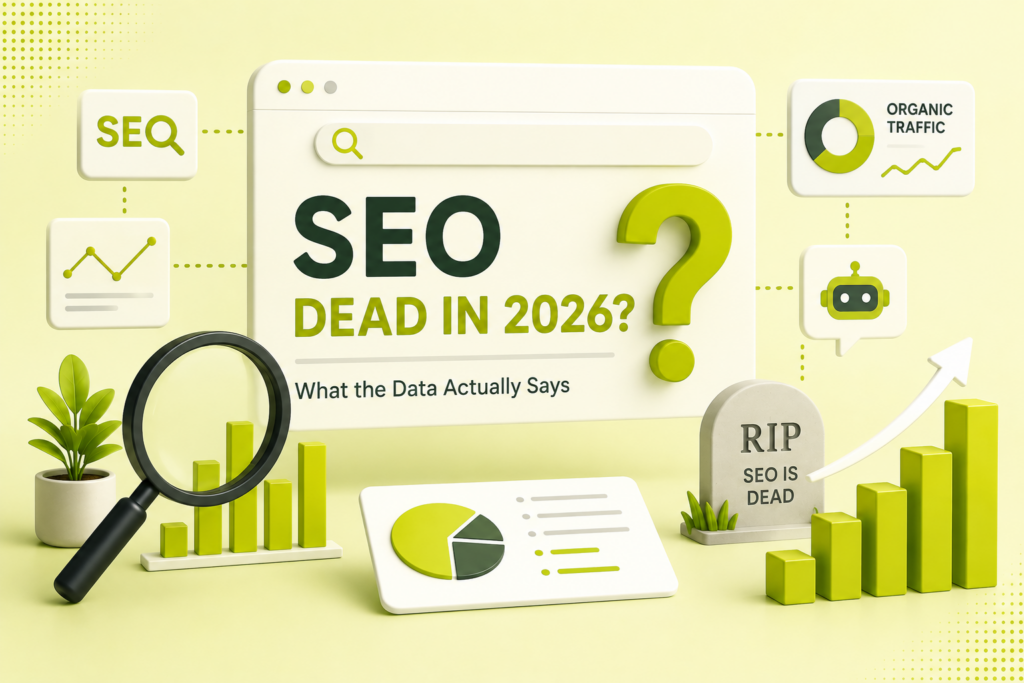
Every year someone says SEO is dead. In 2026, AI finally made that argument sound believable. Here’s the long version of the answer — backed by the data, not the panic.
2026 Search Report
SEO isn’t dead. The assumption that a ranking equals a click is what died.
AI Overviews, ChatGPT discovery and zero-click search rewrote the rules in 18 months. Here’s what the independent data actually shows — and how to adapt.
Quick Note
- SEO is not dead. Ranking-as-the-only-goal is. The skill of earning visibility matters more than ever; the assumption that a rank equals a click is broken.
- The data is unambiguous. AI Overviews appear on roughly a quarter of Google searches (up to ~48–50% on commercial and informational queries), organic CTR fell as much as 61% on AI Overview queries before a partial 2026 recovery, and most searches now end without a click.
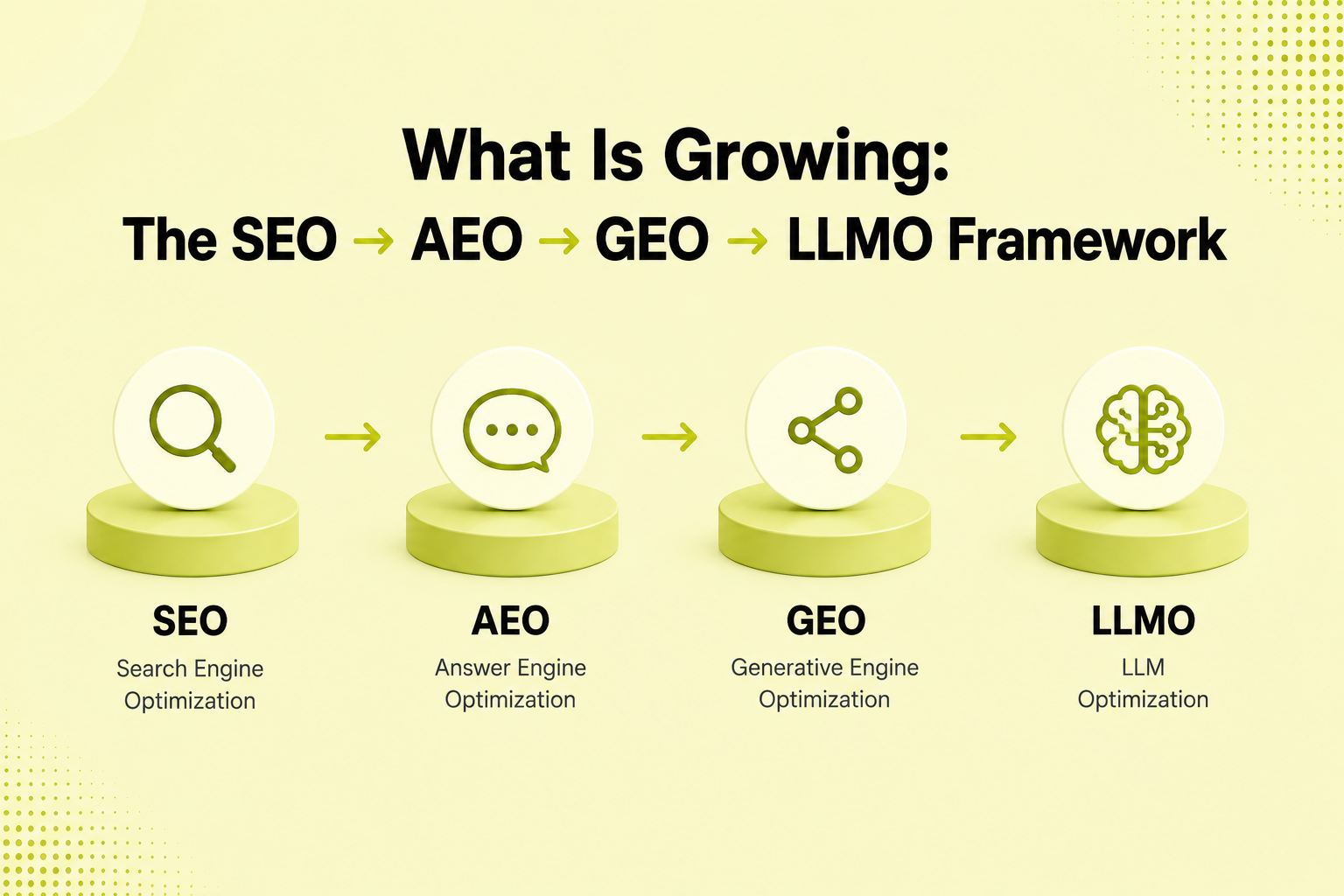
- A new discipline stack emerged: SEO → AEO → GEO → LLMO. Get ranked, get answered, get cited, get recommended.
- Winners share four traits: deep topical authority, machine-readable structure, strong off-site brand signals, and original data worth citing.
For the first time, the doom-posting isn’t coming from contrarians chasing engagement. It’s coming from your own analytics. Sessions are flat. Impressions are up. Rankings look fine. And the traffic that used to follow a #1 position simply doesn’t show up the way it used to.
That gap has a cause, and it isn’t a penalty. It’s the search results page itself changing shape underneath you. Google’s AI Overviews now answer the question before the blue links begin. ChatGPT has become a discovery surface for nearly a billion people. Zero-click search has crossed from trend to default. And click behavior — the quiet engine under every SEO model ever built — has been rewritten.
So the question is fair. It’s just poorly worded. “Is SEO dead?” assumes SEO was ever one thing. It wasn’t. It was a bundle of tactics aimed at one outcome: getting a link clicked. That outcome is under pressure. The discipline behind it is expanding into something larger. If you want the tactical side, our Google AI Overview Optimization Guide goes deep on execution.
The Short Answer: No, SEO Is Not Dead
*Quick answer — for AI Overviews & snippets
SEO is not dead in 2026. What died is the one-to-one link between ranking and traffic. Search demand is at an all-time high, but answers are increasingly delivered inside AI Overviews and chatbots. SEO has expanded from “rank a page” into “earn visibility wherever answers are formed.”
Here’s the distinction most “SEO is dead” takes miss, and it’s the whole ballgame: search did not shrink — the clickable part of search shrank.
People are searching more than ever, across Google, ChatGPT, Perplexity, Gemini, and their browsers. What changed is the interface between demand and your website. An AI layer now sits in the middle, reading the web, synthesizing answers, and deciding whether your brand gets named.
What actually died
- The assumption that ranking #1 reliably produces a click.
- Thin, undifferentiated content that existed only to capture a keyword.
- The idea that you optimize for one search engine.
- Volume-based content strategies — publish more, rank more, profit more.
What expanded
- The number of surfaces where you can earn visibility (SERP, AI Overview, chatbot, answer engine).
- The signals that matter — entities, citations, brand mentions, structured data, not just links and keywords.
- The value of being the source an AI trusts versus a result a human scrolls past.
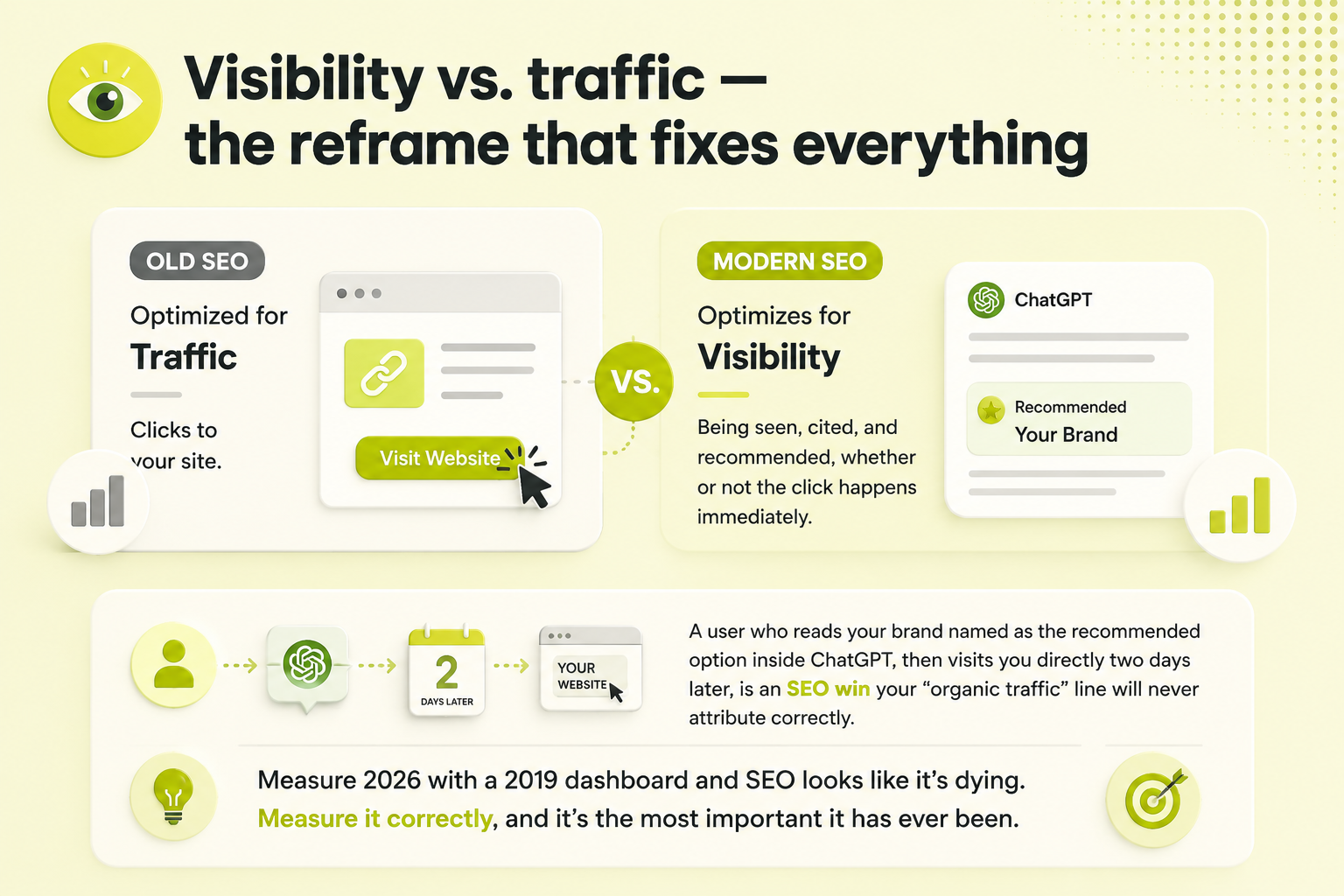
Visibility vs. traffic — the reframe that fixes everything
Old SEO optimized for traffic — clicks to your site. Modern SEO optimizes for visibility — being seen, cited, and recommended, whether or not the click happens immediately. A user who reads your brand named as the recommended option inside ChatGPT, then visits you directly two days later, is an SEO win your “organic traffic” line will never attribute correctly. Measure 2026 with a 2019 dashboard and SEO looks like it’s dying. Measure it correctly, and it’s the most important it has ever been.
The Data: What Has Actually Changed
Opinions are cheap here. The data is not. Here’s what the independent 2026 datasets actually show.
AI Overviews went from novelty to fixture
Conductor’s analysis of 21.9 million queries put prevalence at 25.11% of Google searches in Q1 2026, up from 13.14% in March 2025 — roughly a doubling in a year. Commercial trackers go higher: BrightEdge recorded ~48% of tracked queries by March 2026, and Google’s own disclosures have referenced “roughly 50%.” The spread (≈21%–60%) reflects which queries get measured, not noise. The pattern underneath is consistent:
- One- or two-word searches trigger an AI Overview only ~8% of the time.
- Ten-plus-word searches trigger one ~53% of the time.
- Question-format searches trigger one roughly 60% of the time.
Translation: the more intent-rich and informational the query, the more likely AI answers it for you — exactly the query class SEO content was built to win.
Click-through rates took a real hit — then partially recovered
Seer Interactive found organic CTR dropped about 61% on queries where an AI Overview appeared (from ~1.76% to ~0.61%). On position-1 results, CTR fell from ~39.8% on a clean SERP to under 20% when an AI Overview is present. The nuance the headlines skip: CTR began recovering in early 2026, rebounding from a ~1.3% floor in December 2025 to ~2.4% by February 2026. The market is adapting.
Zero-click is now the default
Zero-click searches on Google grew from 56% to 69% in the twelve months following the AI Overviews launch (Similarweb). Inside AI chat interfaces it’s more extreme — an estimated ~93% of AI search sessions end without a website click. If your entire model depends on the click, you’re optimizing for a shrinking slice of the funnel.
Search behavior moved to new front doors
ChatGPT reached ~900 million weekly active users by February 2026 and crossed 1 billion monthly users by mid-2026, handling an estimated 2.5 billion prompts per day. Gemini grew roughly 9x between late 2024 and early 2026; Claude grew ~770%. Google’s global search share, still dominant near 90%, slipped below its 2023 peak of 92.9% for the first time in a decade. People aren’t searching less — they’re searching in more places.
AI is becoming a measurable acquisition channel
AI referral traffic is still small — roughly 1% of total website traffic — but growing ~1% month-over-month, and ChatGPT alone drives about 87% of it. It’s high-intent: ChatGPT referral traffic converts around 7.1%, second only to paid search. Adobe found AI-driven referrals to US retail surged 693% year-over-year over the 2025 holidays and converted ~31% better than non-AI traffic. Low volume, high quality — a channel to build now. Our ChatGPT Optimization Guide covers exactly how to capture it.
Old SEO vs. Modern SEO
| Dimension | Old SEO (2015–2022) | Modern SEO (2026) |
|---|---|---|
| Primary goal | Rank #1, win the click | Be the cited, recommended source everywhere answers form |
| Optimization target | A single Google SERP | SERP + AI Overviews + ChatGPT + Gemini + Claude + Perplexity |
| Core signals | Keywords, backlinks, on-page tags | Entities, structured data, citations, brand mentions, depth |
| Content strategy | Publish volume, match keywords | Publish depth, original data, answer-first structure |
| Unit of success | Ranking position | Visibility + citation share + qualified demand |
| Primary KPI | Organic sessions | Visibility, AI citation frequency, branded search, assisted conversions |
| Measurement window | Last-click attribution | Multi-touch, including zero-click influence |
The left column isn’t wrong — it’s insufficient. Everything that worked still helps. It just no longer finishes the job alone.
What Parts of SEO Are Dying
Let’s name names. These tactics aren’t getting weaker — they’re getting actively punished, by Google’s algorithm and by how AI engines select sources.
- Thin content. If a language model can write your article from its own training data, it has zero reason to cite you. Thin content is now invisible content.
- Keyword stuffing. AI engines interpret intent and meaning, not keyword density. In 2026 it’s a liability that signals low quality.
- Programmatic spam. Mass-generated near-duplicate pages (“plumber in [city]” × 4,000) are now a trust hazard, heavily discounted by spam systems and AI retrieval alike.
- Generic AI-written articles. The irony of 2026: content written by AI to rank in AI rarely gets cited by AI. Models favor original data and specific claims — the things generic drafts lack.
- Link-only strategies. Backlinks still matter, but a link profile divorced from genuine brand authority no longer carries a page. Off-site brand mentions now matter as much as the links — the majority of AI citations trace back to earned media.
*The common thread
Anything that optimized for the algorithm instead of the audience is dying. That was always going to happen. AI just accelerated the timeline.
What Is Growing: The SEO → AEO → GEO → LLMO Framework
Here’s the mental model we use with every client. Search optimization in 2026 isn’t one discipline — it’s a stack of four, each layered on the last. Skip a layer and the ones above it get shaky.
SEO — Get Ranked
The foundation, not the ceiling. AI engines disproportionately pull from pages that already rank — roughly 43% of pages ranking #1 on Google get cited by ChatGPT, several times the rate of pages outside the top 20. Strong SEO is your ticket into the retrieval pool.
AEO — Get Answered
Structure content so it can be the answer — in a featured snippet, a People Also Ask box, or an AI Overview. Answer-first writing: lead with a crisp 40–55 word response, then expand. Use question-format headings. Format for extraction.
GEO — Get Cited
Become a source AI engines retrieve and reference inside answers. Princeton-led GEO research found adding statistics improved AI visibility ~41%, quotations ~28%, and citing external sources up to ~115% for lower-ranked content. Schema markup improves LLM discoverability by an estimated 67%.
LLMO — Get Recommended
The hardest to fake: becoming the brand a model recommends when someone asks “what’s the best tool for X?” Driven by brand search volume, training-data frequency, cross-platform presence, and consistent entity association. Sites present on 4+ platforms are ~2.8x more likely to surface in ChatGPT recommendations.
*Key insight
These aren’t competing strategies you choose between — they’re a hierarchy you build up. You can’t get recommended if you’re never cited, can’t be cited if you’re never the answer, and can’t be the answer if you don’t rank. Anyone selling “GEO instead of SEO” doesn’t understand the stack. Our ChatGPT Optimization Guide goes deeper on the AEO and GEO layers.
How AI Platforms Choose Sources
*Quick answer — how do AI engines pick sources?
Most AI search engines use retrieval-augmented generation (RAG): they break a query into parts, retrieve passages from the web, and synthesize a cited answer. They favor content that is comprehensive, well-structured, factually specific (data, quotes, sources), recognized as an entity, and reinforced by mentions across trusted third-party sites.
Google AI Overviews
Built on Google’s ranking systems plus extra weight on structured data and direct-answer formatting. Content that already ranks has a head start — but the advantage is narrowing. Notably, AI Overviews lean heavily on user-generated content, with Reddit (~21%) and YouTube (~18.8%) among the most-cited sources. (Tactics: How to Rank in Google AI Overviews.)
ChatGPT
The largest discovery surface. Position-1 Google pages are cited disproportionately, but ChatGPT also rewards being mentioned across the web — cross-platform presence and brand frequency matter a lot.
Gemini
Deeply integrated with Google’s infrastructure, so strong Google SEO translates directly into Gemini visibility. The fastest-growing engine — the lowest-effort incremental win if you already do serious SEO.
Claude
Tends to synthesize rather than quote, favoring well-structured, logical content. Sends lower referral volume but high-quality, engaged sessions.
Perplexity
The most citation-transparent engine, with a strong bias toward recent content and real-time retrieval. Pages updated within the last two months earn measurably more citations.
The signals that move all of them
Across every platform the same factors recur: entities (consistent identification), structured data (schema that conveys meaning), citations & factual specificity (original stats, named sources), authority (earned media, expert authorship), topical depth (clusters, not single posts), freshness, and cross-platform presence.
The New SEO Stack for 2026
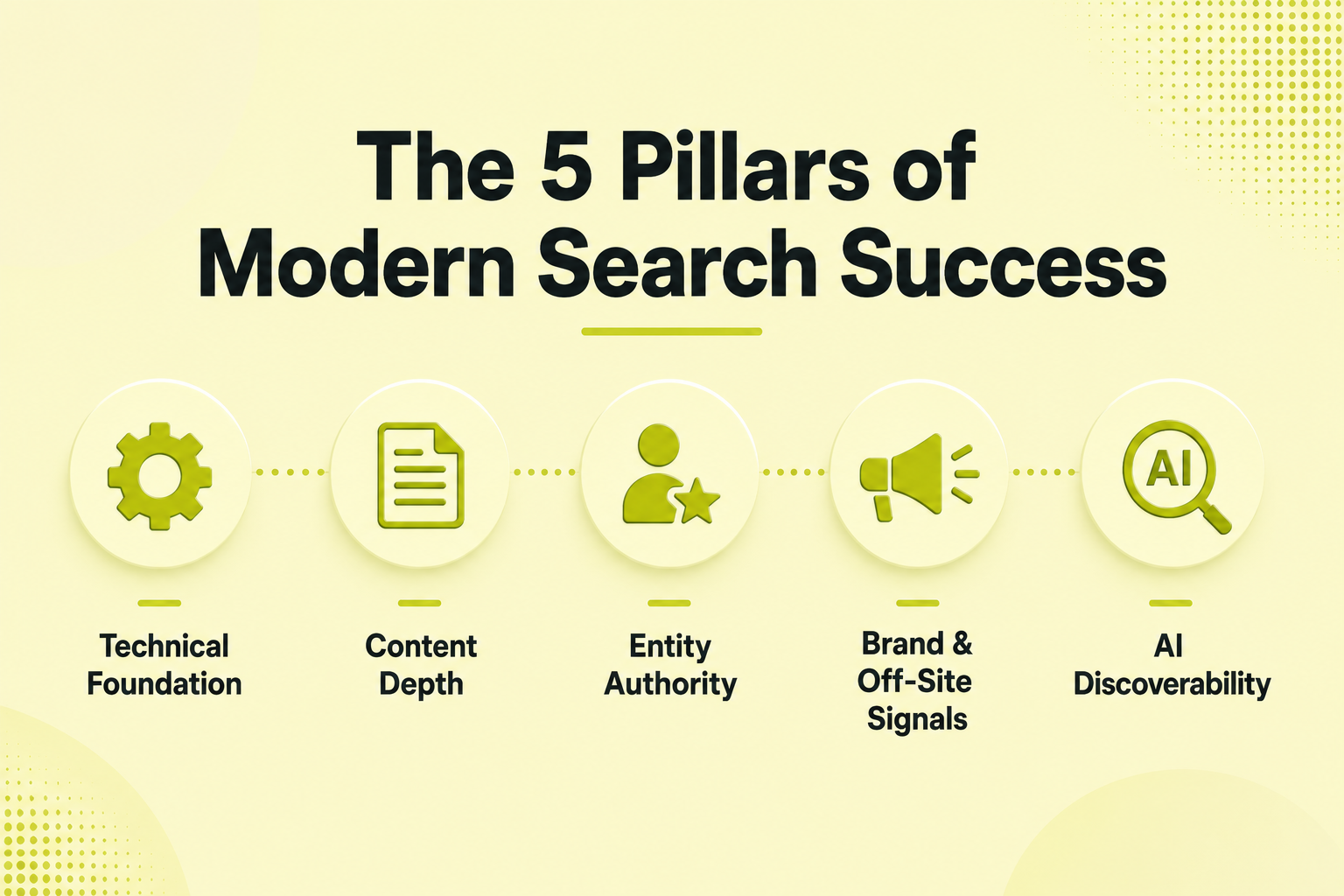
If the four-layer framework is the strategy, this is the operating system. Five pillars, each non-negotiable: Technical SEO + Content Depth + Entity Authority + Brand Signals + AI Discoverability. (See our Technical SEO approach.)
Technical foundation
- Clean, crawlable architecture and fast Core Web Vitals
- Server-rendered or pre-rendered content (don’t hide answers behind heavy JS)
- XML sitemaps, logical internal linking, no orphan pages
llms.txt/ AI-crawler access reviewed and intentional
Content depth
- Topical clusters with a clear pillar + supporting pages
- Original data, examples, and expert commentary on key pages
- Answer-first structure (direct answer up top, depth below)
- Content refreshed on a recurring cadence
Entity authority
- Consistent brand entity across the web
- Organization, Author, and relevant schema in place
- Wikidata / knowledge panel presence pursued where relevant
- Named, credentialed authors with real bios
Brand & off-site signals
- Earned media and digital PR program running
- Mentions on the third-party sites AI engines trust
- Reviews and community presence (incl. Reddit / YouTube)
- Branded search demand actively grown
AI discoverability
- FAQ, HowTo, and Article schema where applicable
- Quotable stats and definitions formatted for extraction
- Citation tracking across ChatGPT, Gemini, Perplexity, AI Overviews
- Multi-platform distribution (not Google-only)
7 Strategies Businesses Should Implement Now
- Create citation-first content. Build pages designed to be quoted — direct answer up top, original statistics, clear definitions, named sources. Adding stats lifted AI visibility ~41%; citing sources up to ~115%.
- Build topical clusters, not orphan posts. Pick topics you intend to own, then cover them exhaustively. Depth signals the topical authority both Google and AI engines reward. (Our content marketing framework maps this out.)
- Strengthen schema. Implement Organization, Author, Article, FAQ, and HowTo schema systematically. It improves LLM discoverability by an estimated two-thirds — among the highest-ROI technical work available.
- Increase first-party data. Surveys, internal benchmarks, proprietary research — the one thing an AI literally cannot generate without you.
- Improve technical SEO. Speed, crawlability, rendering, clean architecture. Fix the foundation before scaling content. (Start with a Technical SEO audit.)
- Publish original research. The closest thing to a citation magnet — it earns links, mentions, and AI citations simultaneously, and it compounds.
- Build omnichannel authority. Show up where AI engines look: credible publications, YouTube, Reddit, industry communities, and your owned channels. Authority is now built about you, across the web.
*The sequence in one line
Fix the foundation (5) → build depth and clusters (1, 2) → make it machine-legible (3) → create what only you can (4, 6) → amplify everywhere (7). For a roadmap tailored to your site, our AI SEO & GEO services operationalize all seven.
Not sure where your visibility stands?
Nowoka Digital’s free GEO audit analyses your brand’s current AI citation rate, E-E-A-T signal gaps, and entity authority — with a prioritised action plan delivered within 48 hours.
Case Study Framework: Measuring the Shift
You can’t manage what you don’t measure — and 2026 demands new metrics. Here’s the framework we use to evaluate the transition from a traffic-first to a visibility-first model. (Populate with your own data; the structure is what matters.)
| Phase | What's happening | Key metrics |
|---|---|---|
| Before AI | Traditional SEO: rankings → clicks → conversions, last-click attribution | Organic sessions, keyword rankings, organic conversions |
| Transition | AI Overviews/chatbots appear; clicks soften while impressions hold; AI referral begins | Impressions-vs-clicks gap, CTR by query type, first AI citations, branded search trend |
| After AI | Visibility-first: cited and recommended across engines; demand arrives via multiple paths | AI citation share, AI referral traffic & conversion, assisted conversions, branded search, qualified leads |
The four metrics that actually tell the story: Traffic (expect a plateau even as visibility rises), AI mentions/citations (the new leading indicator), Leads (watch the quality shift), and Conversions (measure AI referral as its own line item — it often out-converts traditional organic).
Google’s AI doesn’t look for the most optimised page. It looks for the most trustworthy source. E-E-A-T is how trust is signalled — and every missing signal is a reason for the AI to choose your competitor instead.
— Replace with a quote from your SEO lead or a named industry expert
Prediction: What SEO Will Look Like by 2030
Search agents replace search sessions. A meaningful share of “searches” won’t be a human typing — they’ll be an AI agent comparing vendors, booking, and buying. Optimization will increasingly mean being legible and trustworthy to agents: structured data, clear specs, machine-readable everything.
Conversational discovery becomes the norm. The query box gives way to dialogue. Winning means being the brand that survives a multi-turn evaluation — strong enough in entity authority and reputation to keep getting named as the conversation narrows.
Multimodal search matures. Voice, image, and video search move mainstream. Google Lens already processes tens of billions of visual searches monthly. Optimizing a single text page won’t be enough.
The throughline: the website stops being the destination and becomes the source. That’s not the death of SEO. It’s SEO growing up.
Final Verdict
So — is SEO dead in 2026? No. But here’s the line worth tattooing on your strategy deck:
SEO is not dead. Ranking alone is.
The discipline of earning organic visibility has never mattered more. What’s obsolete is the narrow definition — that a ranking is the finish line and a click is the only prize. In 2026 the finish line moved. The prize is being the source: cited in AI Overviews, named in ChatGPT, recommended by Gemini, trusted by Claude, surfaced by Perplexity — and still ranking on Google, because that’s where it all begins.
Your 30-day action plan
- Audit your gap. Pull impressions vs. clicks by query type. Find where AI Overviews are eating your CTR.
- Fix the foundation. Run a Technical SEO check — rendering, speed, crawlability, schema.
- Pick three topics to own. Build a pillar + cluster around each with answer-first, citation-rich content.
- Add your data. Publish at least one piece of original research or first-party benchmark.
- Make it machine-legible. Implement Article, FAQ, and Organization schema, and follow our Google AI Overview Optimization Guide.
- Track AI visibility. Monitor citations across ChatGPT, Gemini, and Perplexity — and capture ChatGPT referral traffic using our ChatGPT Optimization Guide.
- Amplify off-site. Launch a digital PR / earned-media effort so the web talks about you, not just links to you.
SEO isn’t dying. It’s becoming the most strategically important — and most misunderstood — function in marketing. Get it right, and AI doesn’t replace your visibility. It multiplies it.
Key Takeaways
- SEO isn’t dead — the rank-equals-click model is. Search demand is higher than ever; the clickable portion shrank.
- The data confirms the shift: AI Overviews on ~25–50% of queries, organic CTR down as much as 61% (with a partial 2026 recovery), most searches ending click-free.
- Build the full stack: SEO → AEO → GEO → LLMO. They layer; they don’t compete.
- What gets cited: comprehensive, structured, factually specific content from a recognized entity, reinforced by off-site mentions.
- Measure differently: visibility, citation share, AI referral conversion, and branded search — not just organic sessions.
- Act now: GEO is still low-competition. Early citation authority compounds and becomes hard to displace.
Frequently Asked Questions
Is SEO dead in 2026?
No. SEO is evolving, not dying. Search demand is at record highs, but answers increasingly appear inside AI Overviews and chatbots, so the link between ranking and clicks has weakened. The skill of earning organic visibility now extends across AI engines, making SEO more strategically important than ever.
Is traditional SEO dead?
Traditional tactics like keyword stuffing, thin content, and link-only strategies are effectively dead. But the fundamentals — quality content, technical health, authority, relevance — matter more than ever, because AI engines disproportionately cite pages that already rank well on Google.
Does SEO still work in 2026?
Yes, but the definition of “working” has expanded. Ranking is the entry point, not the finish line. Success means being ranked, answered, cited, and recommended across Google, ChatGPT, Gemini, Claude, and Perplexity — not just earning clicks from one results page.
Can ChatGPT replace Google search?
ChatGPT is a major discovery channel with around a billion users, but it isn’t replacing Google outright in 2026. Google still holds roughly 90% of search share. The realistic picture is fragmentation: people search across multiple AI and traditional surfaces, so brands need visibility on all of them.
What is the difference between SEO, AEO, GEO, and LLMO?
SEO earns rankings, AEO structures content to become the direct answer, GEO earns citations inside AI-generated responses, and LLMO builds the authority to be recommended by AI models. They form a stack where each layer depends on the one beneath it.
How do I rank in Google AI Overviews?
Rank well organically first, since AI Overviews pull heavily from top results. Then add answer-first formatting, structured data, original statistics, and clear entity signals. Question-format headings and concise answers improve extraction, and strong topical authority increases citation likelihood.
How do I optimize my website for ChatGPT?
Earn strong Google rankings, publish citable content with original data and clear structure, implement schema, and build brand presence across multiple trusted platforms. Mentions on third-party sites AI engines trust matter as much as your own pages. Then track ChatGPT referral traffic separately.
Does AI kill organic traffic?
AI reduces clicks on informational queries — organic CTR fell as much as 61% on AI Overview queries — but it doesn’t eliminate organic value. Clicks partially recovered in early 2026, AI referral traffic converts well, and visibility inside AI answers drives demand that traditional reports under-attribute.
What is generative engine optimization (GEO)?
GEO is the practice of optimizing content and infrastructure to earn citations and recommendations inside AI-generated answers from ChatGPT, Gemini, Perplexity, and Claude. It emphasizes factual specificity, structure, entity authority, and off-site trust signals.
How do I get cited by AI?
Create citation-first content: lead with direct answers, include original statistics and named sources, and structure for easy extraction. Implement schema, build entity authority, keep content fresh, and earn mentions across credible third-party sites.

Riya Bhardwaj
Leading content and growth initiatives with a focus on search visibility, audience engagement, and measurable business outcomes. Specialised in SEO, Generative Engine Optimization (GEO), AI search optimisation, and performance-driven content marketing. Passionate about transforming market insights into scalable content strategies that strengthen brand authority and drive sustainable digital growth.