
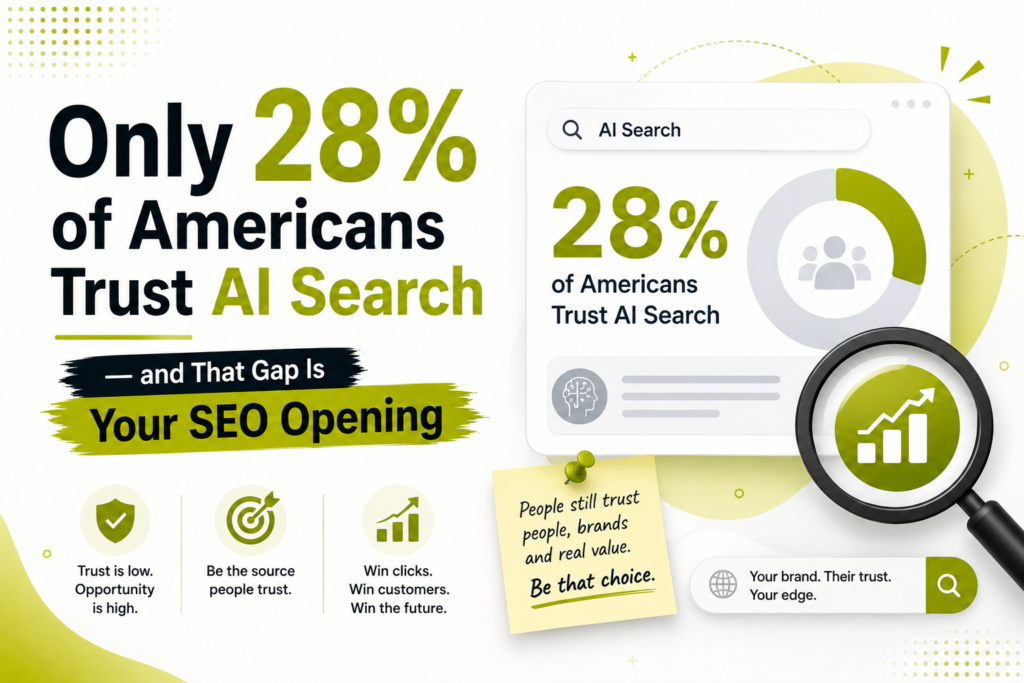
The first half of 2026 was spent panicking that AI would eat search. New YouGov data tells a more useful story: traditional search is winning the trust war by 40+ points — and the gap is an opportunity, if you read it right.
Quick answer
A 2026 YouGov survey across 19 markets found that only about 28% of Americans trust AI search, and that traditional search engines still win the trust contest by more than 40 points. The US had the lowest AI-assisted search rate of any market surveyed (48%), while India, Indonesia, and the UAE sat near the top at 89%. Crucially, 86% of online searchers still used a traditional search engine in the past 30 days, and it remained the default starting point for every task. The takeaway: don’t abandon SEO fundamentals for “AI visibility.” AI searchers verify against primary sources — so the opening is to be the credible, clearly-sourced destination people trust enough to act on.
For six months, the SEO industry treated AI assistants like a rival channel to defend against. A new YouGov study — presented in a mid-2026 livestream on how AI is changing online discovery — complicates that panic with data. The headline number is stark, but the more important story is what it says about behavior, and about geography.
What the data actually says
Across 19 markets, YouGov measured how consumers use search engines versus AI assistants and how much they trust each. Three findings stand out:
- Trust favors search by a wide margin. Only around 28% of Americans trust AI search; traditional search engines win the trust contest by more than 40 points — and that margin is widest in the US.
- The US is a global outlier on adoption, not a leader. It had the lowest AI-assisted search rate of any of the 19 markets.
- Traditional search is still the default. 86% of online searchers used a traditional engine in the past 30 days, across every task category tested — including the ones AI is supposedly best at.
| Market | AI-assisted search rate |
|---|---|
| India, Indonesia, UAE | ~89% (highest) |
| Great Britain | 54% |
| United States | 48% (lowest of 19) |
This tracks with a broader 2026 pattern several studies have flagged: consumers are adopting AI search faster than they’re trusting it, and enthusiasm has cooled as hallucinations became better known. People are using a tool they trust less, more — the signature of convenience-driven habit, not growing confidence.
The behavior behind the trust gap: people verify
The trust gap isn’t abstract — it shows up in clicks. Among AI searchers, only a minority stop at the AI’s answer; a comparable or larger share click through to the linked sources to check the work. In other words, being cited in an AI response is not the finish line. The verification instinct that has always driven traffic back to primary sources is still intact.
And the signals that actually move AI searchers to act are revealing: clear source links and official-source framing topped the list. What doesn’t work is trying to convert the roughly half of people who say nothing would make them trust an AI answer — that fight isn’t winnable with a UX tweak, so don’t spend budget on it.
A citation gets you mentioned. Being the source people click to verify is what gets you the session.
Why this is an SEO opening, not a threat
Read correctly, the data is a mandate to double down, not retreat. Three moves:
- Don’t abandon SEO fundamentals for “AI visibility”
If your 2026 plan quietly deprioritized on-page SEO, schema, or technical crawlability to chase AI, reverse it. Traditional search is still the trusted default, and the fundamentals are what make you eligible everywhere — the case we make in why businesses need technical SEO and the steps in our technical SEO checklist. - Win the click-through moment, not just the citation moment
Structure pages so that whoever clicks through from an AI answer lands on something more detailed, more current, and more clearly sourced than the summary they just read. That’s what turns a citation into a session — and a session into a customer, which is where converting the visitor takes over. - Treat “official source” status as a trust asset
Make it unambiguous you’re the primary source, not a summary of one: visible bylines, dated updates, methodology and sourcing sections, and structured data. This is the same “be the source” logic behind why the individual is becoming the strategy — trust attaches to credible, identifiable sources.
Read the geography — what this means in India
Here’s the nuance the US-centric headline hides, and it matters for businesses outside America. The US is the most cautious market in the study; India, Indonesia, and the UAE are near the top for AI-assisted search at around 89%. So if you’re serving an Indian audience, the lesson isn’t “AI search is small, relax” — it’s the reverse: AI adoption is high, so AI visibility matters more here, not less.
What travels across every market is the verification instinct. High-adoption users still cross-check, still click to sources, still trust official framing over a bare summary. So the winning strategy is the same everywhere, just weighted differently: be findable in traditional search and citable in AI, and be the credible source people verify against. That dual mandate is exactly what our AI Overviews, ChatGPT optimization, GEO, and LLM SEO work is built around.
What to do with this
- Keep the SEO foundation strong — technical, on-page, schema. It serves both search and AI. Start from a solid SEO program.
- Earn AI citations, then out-page the summary — deeper, fresher, better-sourced content behind every citation.
- Add primary-source trust signals — bylines, dates, methods, structured data.
- Measure the new journey — track AI-referred visits and branded search, not just rankings, using this GA4 guide.
- Don’t panic about “SEO is dead” — the data says the fundamentals still win; see is SEO dead in 2026 and why SEO isn’t working.
The blunt version: AI search is real and growing, but it runs on the same trust and verification instincts that have always sent people to credible sources. The businesses that stay findable, get cited, and earn the click by being the better destination don’t have to choose between search and AI. They win both.
Frequently asked questions
Do only 28% of Americans trust AI search?
According to a 2026 YouGov survey of 19 markets, yes — around 28% of Americans trust AI search, and traditional search still wins the trust contest by more than 40 points. The US also had the lowest AI-assisted search rate of any market, at 48%.
Are people abandoning traditional search for AI?
No. 86% of online searchers used a traditional engine in the past 30 days, and it stayed the default starting point across every task category tested. Search behavior is fragmenting, not collapsing.
Should businesses stop investing in SEO because of AI?
The data argues the opposite. If you deprioritized on-page SEO, schema, or technical crawlability for “AI visibility,” this suggests reversing that — traditional search remains the dominant, most-trusted starting point, and AI searchers verify against primary sources.
Is being cited in an AI answer enough?
No — it’s the start. Many AI searchers click through to verify, so the win is ensuring they land on a page more detailed, current, and clearly sourced than the summary. That turns a citation into a session.
Does this trust gap apply outside the US, like in India?
Not evenly. The US was the outlier for low adoption; India, Indonesia, and the UAE were near the top at around 89%. In high-adoption markets, AI visibility matters more — but the universal lesson holds: consumers verify, so be the credible primary source.
What trust signals make people act on an AI answer?
Clear source links and official-source framing moved AI searchers most. In practice: visible bylines, dated updates, methodology or sourcing sections, and structured data that mark your page as the primary source.
The trust gap rewards businesses that are findable, citable, and credible. We help you hold your ground in traditional search while earning citations in AI — and turn both into customers who click through and convert.

Riya Bhardwaj
Leading content and growth initiatives with a focus on search visibility, audience engagement, and measurable business outcomes. Specialised in SEO, Generative Engine Optimization (GEO), AI search optimisation, and performance-driven content marketing. Passionate about transforming market insights into scalable content strategies that strengthen brand authority and drive sustainable digital growth.