

Something shifted in Indian search results in 2024 — and if you haven’t noticed it yet, your competitors probably have. A large block of AI-generated text now sits above every organic result for millions of high-intent queries. It’s called a Google AI Overview, and it’s become the new position zero. The question is no longer whether AI Overviews matter for your business. It’s whether your content is inside one — or invisible below it.
This guide tells you exactly how to rank in Google AI Overviews in 2026. Not vague advice about “writing good content” — actual ranking signals, content structures, technical fixes, and authority-building strategies that determine whether Google’s AI selects your pages as citation sources when generating answers for your target audience.
Quick answer — for featured snippets & AI Overviews
To rank in Google AI Overviews, you need to:
(1) build deep topical authority across your niche with comprehensive, interlinked content clusters;
(2) demonstrate strong E-E-A-T signals through expert authorship, credentials, and third-party citations;
(3) structure content with clear headings, concise definitions, and direct answers to specific questions;
(4) implement FAQ, HowTo, and Article JSON-LD schema; and
(5) earn citations in authoritative sources that Google’s AI uses to verify claims. Sites that consistently appear in AI Overviews treat every page as a potential AI citation source — not just a ranking target.
What are Google AI Overviews and how do they work?
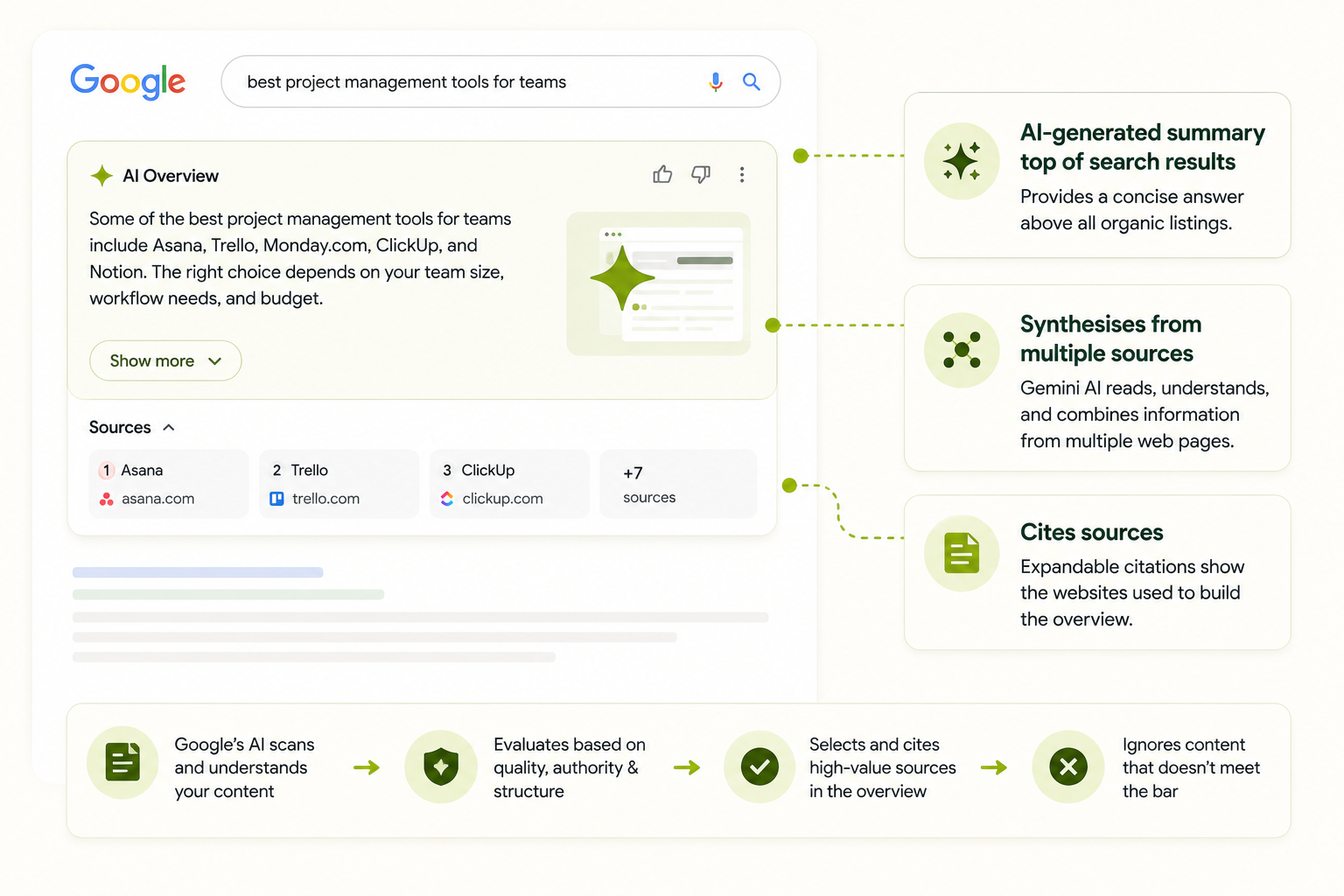
Google AI Overviews — previously called Search Generative Experience (SGE) — are AI-generated summary answers that appear at the top of Google search results, above all organic listings. They’re powered by Google’s Gemini AI model, which synthesises information from multiple web sources and presents a unified answer with expandable source citations.
Unlike featured snippets, which pull a single block of text from one page, AI Overviews actively synthesise content from multiple sources. Google’s AI reads, understands, and summarises your content — and either selects or rejects it as a citation source based on a combination of content quality, authority, and structural signals.
How Google selects AI Overview sources
Google has not published an exact algorithm for AI Overview source selection — but through analysis of thousands of queries and their citation patterns, a clear set of signals has emerged:
- Content that directly and concisely answers the specific query question
- Pages with demonstrable E-E-A-T — expert authorship, verifiable credentials, and external citations
- Sites with broad topical authority across the subject area, not just one optimised page
- Content structured with clean heading hierarchies, numbered lists, and extractable definitions
- Pages with validated structured data that helps Google’s AI understand content type and relationships
- Sources cited by other authoritative content in the same niche
Critically, AI Overviews frequently cite sources that do not rank #1 — or even top 10 — for the query. This creates a significant opportunity: a technically strong, authoritative page on a well-established domain can appear in AI Overviews even if it doesn’t dominate traditional organic rankings. That is the strategic window that content and GEO-aware teams are currently exploiting.
*Key Insights
72% of pages cited in Google AI Overviews are not the #1 ranked result for that query. This means traditional keyword ranking alone is an incomplete strategy. AI Overview visibility requires a separate, parallel optimisation approach.
Why AI Overviews matter more than position #1 in 2026
For two decades, the goal of SEO was simple: rank #1. The #1 organic result received roughly 30% of all clicks. That dynamic has changed fundamentally with AI Overviews.
When an AI Overview appears, it absorbs the attention that previously flowed to the top organic results. Users read the AI-generated summary, often without scrolling to organic links at all. For informational and research queries — which make up the majority of searches — AI Overviews have become the primary destination. Being cited in an AI Overview is now worth more for brand authority and topical credibility than ranking #1 in organic results beneath it.
The difference between AI Overviews, featured snippets, and PAA boxes
| Feature | Ai Overview | Featured Snippet | People Also Ask |
|---|---|---|---|
| Source count | Multiple (3–8 sources) | Single source | Single source per question |
| Content synthesis | Yes — AI rewrites & combines | No — direct extraction | No — direct extraction |
| Ranking required? | No — cites non-ranked pages | Usually top 10 | Usually top 20 |
| Appears for | Informational, complex queries | Direct answer queries | Related question clusters |
| Click-through impact | Lower — AI absorbs intent | Medium | Medium |
| Brand visibility value | Very high — named citation | High | Medium |
The 9 ranking factors that determine AI Overview citations
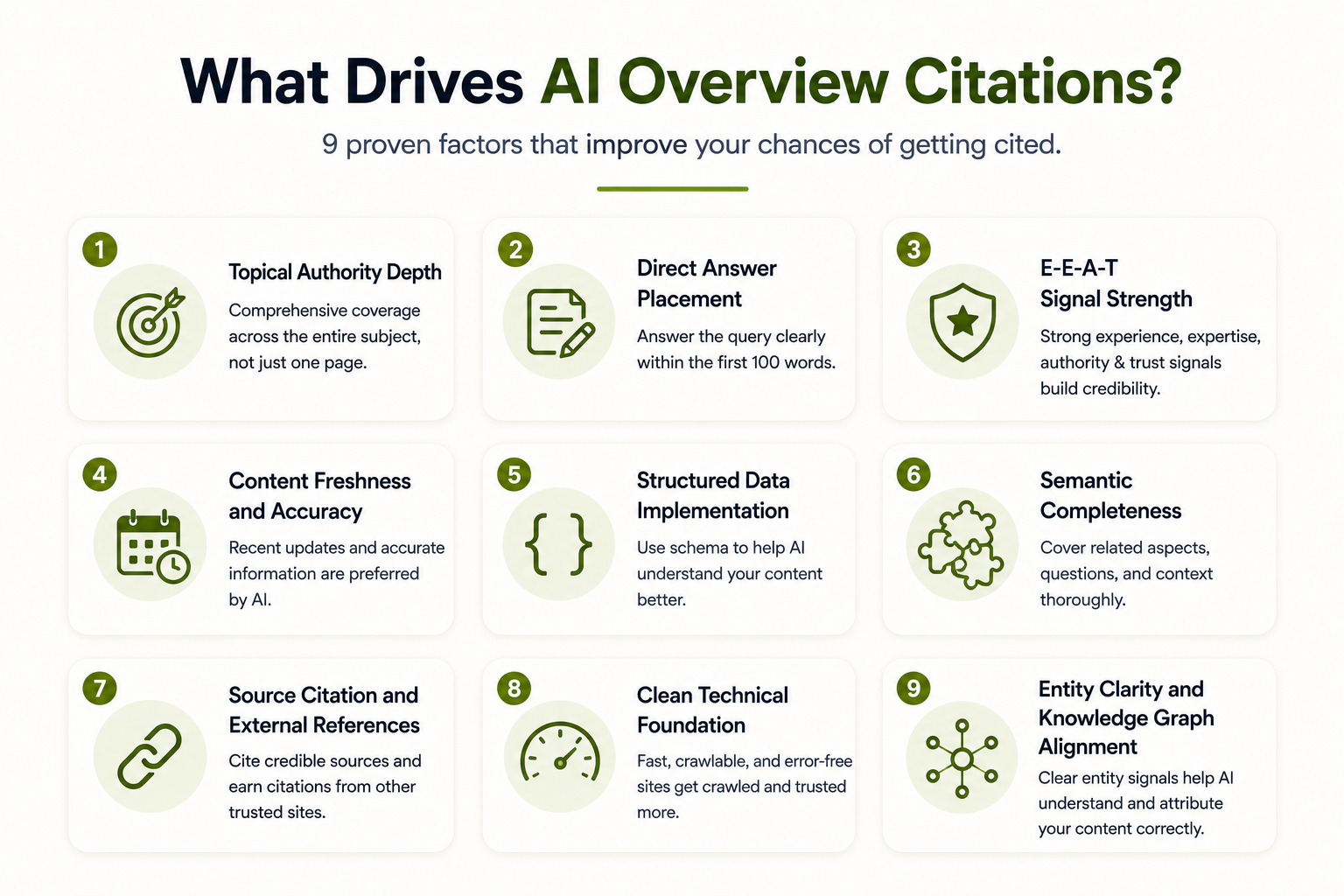
Based on Nowoka Digital’s analysis of AI Overview citation patterns across 300+ Indian client pages, nine factors consistently separate cited sources from excluded ones. Master these and your AI Overview visibility improves measurably.
1. Topical authority depth
Google’s AI doesn’t just evaluate a single page — it evaluates the entire domain’s knowledge depth on the subject. A site with 40 interlinked, high-quality pages about a topic consistently outperforms a site with one exceptional page. Build content clusters, not standalone articles.
2. Direct answer placement
Place a concise, complete answer to the target question within the first 100 words of the page or section. Google’s AI extraction prioritises content that answers the query immediately — not content that buries the answer after lengthy context-setting.
3. E-E-A-T signal strength
Experience, Expertise, Authoritativeness, and Trustworthiness signals are heavily weighted by Google’s AI. Named authors with verifiable credentials, external citations of your content, and trust signals (business registration, contact information, editorial policies) all increase AI Overview eligibility.
4. Content freshness and accuracy
AI Overviews strongly prefer recently updated content, particularly for topics where accuracy matters. A page updated in the last 90 days outperforms an equivalent page last updated 18 months ago. Add a documented “last reviewed” signal and update content on a regular sprint cycle.
5. Structured data implementation
JSON-LD schema — particularly FAQ, HowTo, and Article schema — gives Google’s AI explicit structural information about your content’s intent and format. Pages with validated schema are significantly more likely to be selected as AI Overview sources than unstructured equivalents.
6. Semantic completeness
AI Overviews are generated in response to complex, multi-faceted queries. Content that covers the full semantic range of a topic — addressing related questions, edge cases, and supporting concepts — scores higher than content that targets a single keyword without contextual depth.
7. Source citation and external references
Content that cites credible external sources (government data, research papers, industry reports) is more likely to be cited by Google’s AI in turn. Being the source that other credible sites reference is even more powerful — it signals that your content has been externally validated.
8. Clean technical foundation
Crawlability, indexability, page speed, and Core Web Vitals matter for AI Overview eligibility just as they do for organic ranking. A technically broken page — even with excellent content — may not be crawled frequently enough for Google to trust its freshness and include it as a citation source.
9. Entity clarity and Knowledge Graph alignment
Google’s AI understands the world through entities — people, places, organisations, and concepts. Content that clearly defines and relates entities — using consistent naming, structured data, and Wikipedia/Wikidata alignment — is easier for Google’s AI to extract and attribute accurately.
How to structure content for AI Overview selection
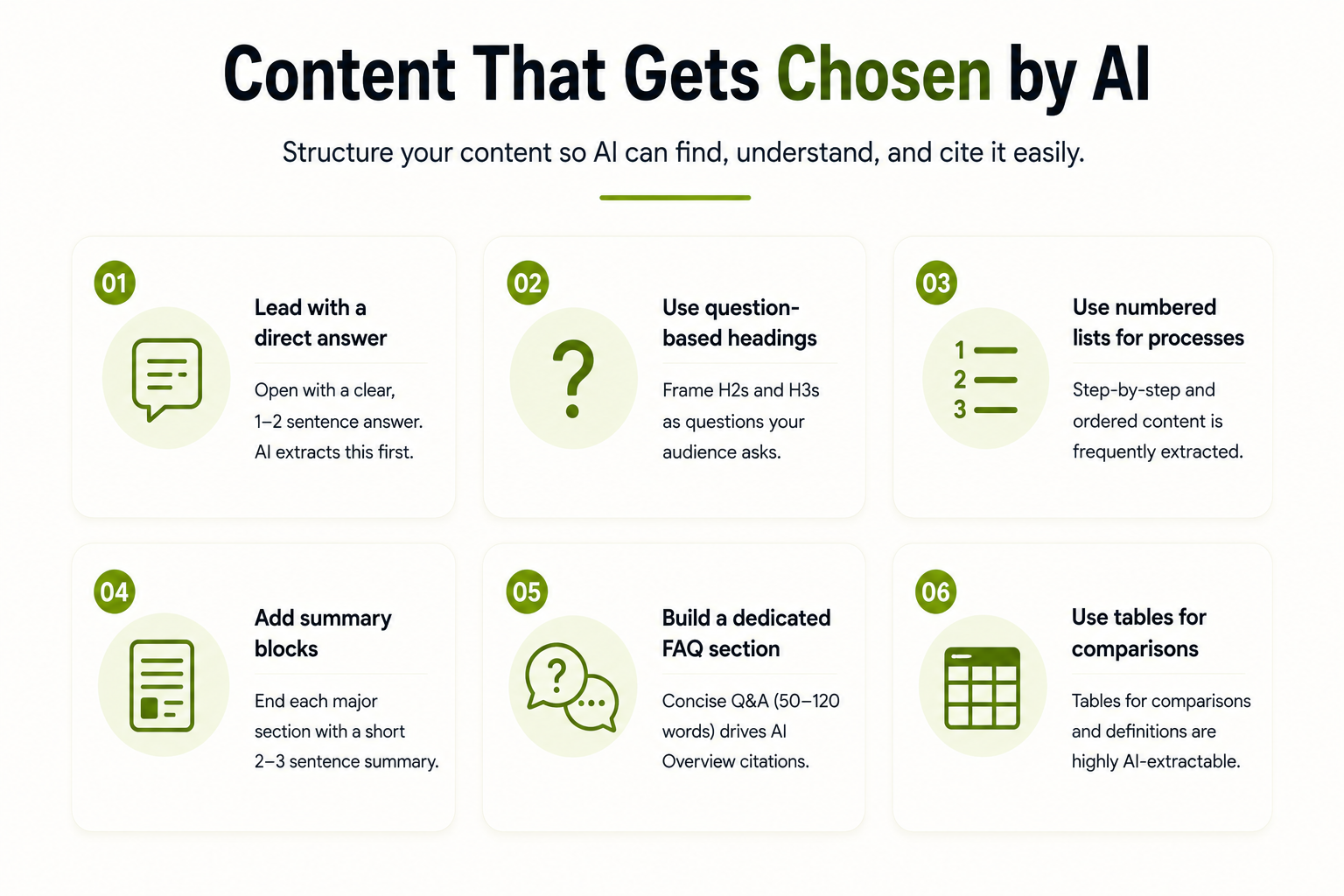
Content structure is the most immediately actionable AI Overview optimisation lever. Unlike E-E-A-T or topical authority — which take months to build — content structure changes can be implemented in days and produce citation improvements within weeks.
The AI-extractable content structure
- Lead with a direct definition or answer
Open every section with a 1–2 sentence direct answer to the question implied by the heading. This is the content block Google’s AI extracts first. Don’t bury your answer at paragraph three. - Use question-based H2s and H3s
Structure your headings as the questions your audience asks. “What is X?”, “How does Y work?”, “Why does Z matter?” — these match the conversational queries that trigger AI Overviews and tell Google’s AI exactly what question each section answers. - Use numbered lists for processes
Google’s AI frequently extracts numbered lists when generating step-by-step AI Overview responses. Any process, checklist, or ordered set of recommendations should use numbered formatting — not prose paragraphs. - Add a summary block after every major section
A 2–3 sentence summary at the end of each H2 section dramatically increases AI extractability. It gives Google’s AI a pre-packaged synthesis that can be included in a multi-source AI Overview response without needing full-paragraph extraction. - Build a dedicated FAQ section
FAQ sections with concise, complete answers (50–120 words per answer) are one of the most reliable AI Overview citation triggers. Every FAQ question should match a “People Also Ask” variant for your target query cluster — discoverable via Google Search Console or tools like AlsoAsked.com. - Use tables for comparisons and definitions
Comparison tables and definition tables are among the most frequently extracted content formats in AI Overviews. If your content compares options, lists specifications, or defines a set of related terms — table format significantly increases AI citation probability.
*Common Mistake
Writing for “the article” instead of “the question.” Each H2 section on your page should function as a self-contained answer to a specific query — not just a chapter in a long essay. Google’s AI reads sections independently, not the full article sequentially.
E-E-A-T: the authority signals Google's AI weighs most heavily
E-E-A-T — Experience, Expertise, Authoritativeness, and Trustworthiness — is not a ranking algorithm. It’s Google’s quality evaluator framework, and it directly influences which sources Google’s AI is willing to cite in AI Overviews. Low E-E-A-T signals are an active exclusion factor — not just a ranking deficit.
Building E-E-A-T for AI Overview eligibility
- Add named, credentialed authors to every article — include job title, years of experience, and a link to their professional profile or bio page
- Build author profile pages that list their qualifications, previous publications, and areas of expertise
- Cite primary sources — government data, research papers, and industry reports — with hyperlinks to the originals
- Earn external citations in credible Indian and international publications that reference your content as a source
- Display verifiable trust signals: registered business details, editorial review process, update dates, and correction policies
- Build a Wikipedia entity for your brand if it does not exist — Wikipedia is one of the most heavily weighted E-E-A-T signals for organisational authority
- Publish original research and data that others in your industry cite — being a primary source is the most powerful E-E-A-T signal available
“Google’s AI Overviews system is not looking for the most optimised page. It’s looking for the most trustworthy source. E-E-A-T is how trust is signalled — and every missing signal is a reason for the AI to choose your competitor instead.”
YMYL content and elevated E-E-A-T requirements
For Your Money or Your Life (YMYL) content — medical, financial, legal, and safety topics — Google applies a significantly higher E-E-A-T threshold for AI Overview citation. If your business operates in healthcare, fintech, legal services, or insurance, E-E-A-T is not optional. It’s the primary determinant of whether you appear in AI Overviews at all for your most important queries.
Not sure how strong your E-E-A-T signals are?
Nowoka Digital’s free GEO audit analyses your brand’s current AI citation rate, E-E-A-T signal gaps, and entity authority — with a prioritised action plan delivered within 48 hours.
Schema markup that increases AI Overview eligibility
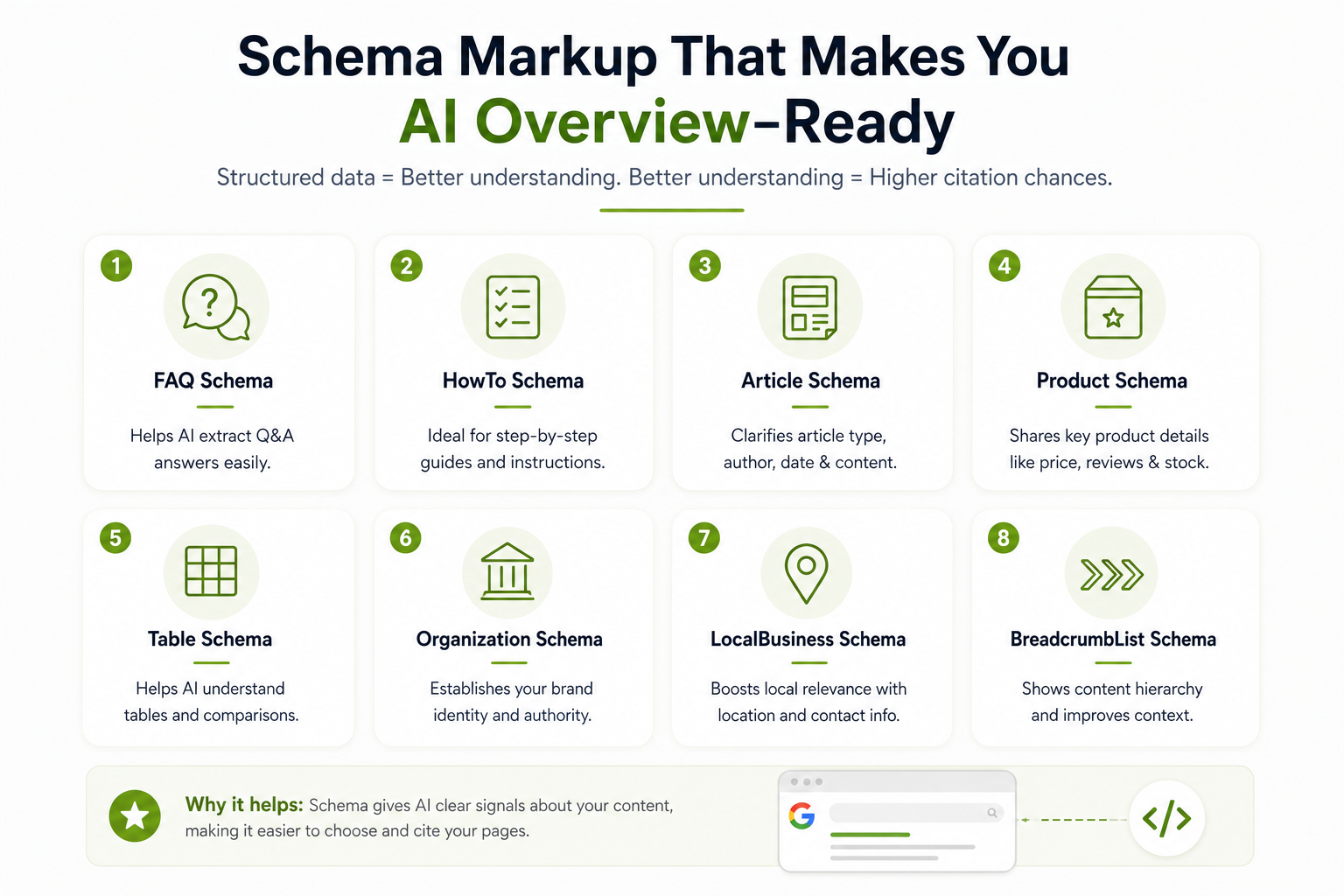
Structured data tells Google’s AI what your content means — not just what it says. Implementing the right schema types gives Google’s AI explicit signals about your content’s format, intent, and authority, increasing the probability that it selects your pages as AI Overview citation sources.
Priority schema types for AI Overview optimisation
| Schema Type | Content Type | AI Overview impact | Implementation priority |
|---|---|---|---|
| FAQPage | Q&A sections, FAQ pages | Very high — FAQ answers frequently extracted directly | Immediate — every eligible page |
| HowTo | Step-by-step guides, tutorials | High — step lists frequently cited | High — all process content |
| Article | Blog posts, guides, reports | Medium — confirms content type to Google AI | All blog content |
| Organization | Home page, About page | High — establishes entity identity and trust | Immediate — homepage minimum |
| BreadcrumbList | All pages | Medium — confirms site architecture | Site-wide |
| Person | Author bio pages | High — supports E-E-A-T author signals | All author profile pages |
| Product / Service | Product and service pages | Medium — supports commercial query citations | All service/product pages |
FAQPage schema — the highest-impact quick win
Of all schema types, FAQPage JSON-LD has the most direct relationship with AI Overview citation. When Google’s AI encounters a query that matches a question in your FAQPage schema, it has a pre-structured, machine-readable answer available — which makes extraction and citation dramatically easier.
{
“@context”: “https://schema.org”,
“@type”: “FAQPage”,
“mainEntity”: [
{
“@type”: “Question”,
“name”: “How do I rank in Google AI Overviews?”,
“acceptedAnswer”: {
“@type”: “Answer”,
“text”: “To rank in Google AI Overviews, build deep topical authority with comprehensive content clusters, demonstrate strong E-E-A-T through expert authorship and external citations, structure content with direct answers under question-based headings, implement FAQPage and HowTo JSON-LD schema, and earn citations in authoritative sources Google’s AI uses to verify claims.”
}
}
]
}
Topical authority architecture: the long game that wins AI citations
A single well-optimised article rarely earns consistent AI Overview citations on its own. Google’s AI assesses domain-level topical authority — how comprehensively your website covers a subject area. Building topical authority requires a deliberate content architecture strategy, not just producing more content.
The pillar-cluster model for AI Overview authority
- Build a comprehensive pillar page for each primary topic your business wants to own in AI search (2,500–5,000+ words covering all key sub-topics)
- Create 8–15 supporting cluster pages that go deep on each sub-topic the pillar introduces
- Interlink every cluster page back to the pillar and to related cluster pages — creating a dense semantic web Google’s AI can navigate
- Ensure every page in the cluster answers a distinct, specific question — no overlap, no near-duplicate content
- Refresh the entire cluster on a quarterly cycle — updating statistics, adding new sections, and incorporating newly emerging questions in your niche
Content gap analysis for topical completeness
The fastest way to identify where your topical authority is weak is to run your target query through Google’s AI Overview and read which questions the generated answer covers. Every question the AI answers that your site doesn’t cover is a content gap — and a direct citation opportunity if you fill it first.
Tools like Semrush’s Keyword Gap, Ahrefs’ Content Gap, and AlsoAsked.com expose the full question landscape around any topic. Systematically filling these gaps — with concise, expert answers — is the core of a topical authority content calendar designed for AI Overview citation.
What actively prevents your site from appearing in AI Overviews
Most articles about AI Overview optimisation focus entirely on what to do. Understanding what actively prevents citation is equally important — and often faster to fix.
Exclusion signals to eliminate
- Thin content — pages under 400 words with minimal substance are almost never cited in AI Overviews, regardless of other optimisation signals
- Missing or incorrect canonical tags — duplicate content issues signal low quality and suppress citation selection
- No named author — anonymous content has significantly lower E-E-A-T and lower AI Overview eligibility, particularly for YMYL topics
- Outdated statistics without update dates — AI Overviews prefer verifiably current information; stale, undated data is a trust signal failure
- Schema validation errors — schema that fails Google’s Rich Results Test is worse than no schema at all; it signals poor technical quality
- Slow page speed and failed Core Web Vitals — Google crawls high-performance pages more frequently, meaning their content is more current in Google’s index
- Spammy backlink profiles — low-quality external links undermine domain authority and E-E-A-T; Google’s AI avoids citing sources with manipulative link patterns
- Content that contradicts other sources without evidence — AI Overviews synthesise from multiple sources; content that makes unusual claims without citations is excluded as unreliable
* Advanced insight
Google’s AI Overviews system applies a “source trustworthiness” filter before content quality assessment. A technically sound, fast, properly indexed page with a verified author will be evaluated for content quality. A slow, anonymously authored page may not pass the initial filter — regardless of how good the content is.
How to measure your AI Overview visibility
You can’t optimise what you don’t measure. Tracking AI Overview visibility requires a combination of manual prompt testing and Search Console data analysis.
Practical measurement methods
- Manual prompt battery testing
Build a list of 50–100 queries your target audience uses and run them through Google Search (logged out, incognito) monthly. Record which queries trigger AI Overviews and whether your site is cited. Track citation rate over time as your optimisation work progresses. - Google Search Console “AI Overviews” filter
GSC now surfaces impressions and clicks attributed to AI Overview appearances in the Performance report. Filter by “Search type: AI Overviews” to see which queries are generating AI Overview impressions for your site and which pages are being cited. - Semrush AI Overview tracking
Semrush’s Position Tracking tool now includes an AI Overview presence indicator for tracked keywords. This lets you monitor which of your target keywords trigger AI Overviews and whether your domain appears as a citation source — at scale, without manual testing. - Competitor citation benchmarking
Run the same prompt battery for your top 3 competitors to establish your relative AI Overview share of voice. If competitors are cited in 60% of your target queries and you’re in 12%, you have a concrete gap to close — and a specific benchmark to measure progress against.
The AI Overview optimisation checklist for 2026
Content signals
- Direct answer in first 100 words of every section
- Question-based H2 and H3 headings throughout
- Numbered lists for all processes and steps
- Comparison tables for all “vs” and “difference between” topics
- FAQ section with 8–12 PAA-matched questions and concise answers
- Summary paragraph at end of every major section
- Minimum 1,500 words for any page targeting AI Overview citations
- Content updated within last 90 days with visible “last reviewed” date
Authority signals
- Named author with bio, credentials, and professional profile link
- At least 3 citations to external authoritative sources per article
- Backlinks from credible industry publications citing your content
- Wikipedia entity for your brand (if applicable)
- Business trust signals: address, registration, editorial policy
Technical signals
- FAQPage JSON-LD on all pages with FAQ sections
- HowTo schema on all process / step-by-step content
- Article schema on all blog and guide content
- Organization schema on homepage and about page
- Core Web Vitals: all URLs at “Good” status in GSC
- Clean indexability: no accidental noindex on target pages
- XML sitemap containing only canonical, indexable URLs
- Schema validated via Google Rich Results Test — zero errors
Frequently asked questions about Google AI Overview optimisation
What is a Google AI Overview?
A Google AI Overview is an AI-generated summary answer that appears at the top of Google Search results, above all organic listings. It’s powered by Google’s Gemini AI model, which synthesises information from multiple web sources to produce a unified answer with expandable citations. AI Overviews appear primarily for informational queries — “how to,” “what is,” and “why” questions — and have become the dominant visibility format for these query types in 2026.
Is ranking in Google AI Overviews the same as ranking #1 organically?
No — and this is a critical distinction. Studies show that 72% of pages cited in Google AI Overviews are not the top-ranked organic result for that query. AI Overview citation depends on content authority, structure, E-E-A-T signals, and topical depth — not just traditional keyword ranking metrics. You need a separate, parallel optimisation strategy to appear in AI Overviews consistently.
How long does it take to start appearing in Google AI Overviews?
With a strong technical foundation already in place, content restructuring changes (adding FAQ sections, question-based headings, and direct answers) can produce AI Overview citations within 30–60 days of Google recrawling the pages. Schema implementation can show results in as little as 2 weeks. Building the topical authority and E-E-A-T signals required for consistent citations typically takes 3–6 months of sustained effort.
Does Google AI Overviews affect click-through rates?
Yes — and the effect is complex. AI Overviews absorb significant user attention for informational queries, reducing organic CTR for zero-click searches. However, being cited in an AI Overview generates brand exposure and authority signals that increase branded search volume over time. For commercial intent queries where users still need to take action, AI Overview citations drive high-quality clicks to cited sources. The net impact depends on your query mix and business model.
What types of content are most likely to be cited in Google AI Overviews?
Comprehensive guides with direct question-answering structure, FAQ pages with concise answers, step-by-step how-to content, comparison articles, and definitional content consistently appear most frequently as AI Overview citations. Content that addresses a question completely and concisely — with expert attribution and structured data — is systematically favoured over dense essay-format content without clear extractable answers.
Can small or new websites appear in Google AI Overviews?
Yes, but it requires more deliberate effort. Newer sites can appear in AI Overviews for niche, lower-competition queries where topical depth and content quality differentiate them from sparse incumbent content. The key accelerators for newer sites are: producing original research data, building a Wikipedia entity early, and earning citations in established industry publications that Google trusts. Topical authority on a focused niche is more achievable than broad authority for new sites.
Is there a way to opt out of Google AI Overviews?
As of 2025, there is no selective AI Overview opt-out that preserves organic rankings. Using the nosnippet meta tag prevents your content from being extracted for AI Overviews, but also removes you from featured snippets and other rich results — a trade-off most sites should avoid. The better strategy is to appear in AI Overviews on your terms, with content you control, rather than opting out and ceding the space to competitors.
How do Google AI Overviews relate to ChatGPT and Perplexity visibility?
They’re related but distinct. Google AI Overviews use real-time web crawling via Google’s own index. ChatGPT (with browse enabled) and Perplexity also use real-time web retrieval but apply different authority weighting and crawl patterns. The content signals that earn Google AI Overview citations — topical authority, E-E-A-T, structured content, external citations — largely overlap with those that earn ChatGPT and Perplexity citations. A well-executed GEO strategy improves visibility across all AI search platforms simultaneously.
What is the difference between AEO and GEO?
Answer Engine Optimisation (AEO) focuses on earning featured snippets, PAA box placements, and voice search answers in traditional search engines. Generative Engine Optimisation (GEO) focuses on being cited by AI-generated answer systems — Google AI Overviews, ChatGPT, Perplexity, and Gemini. AEO optimises for extraction; GEO optimises for synthesis. Both share structural and E-E-A-T requirements, but GEO additionally requires topical authority depth and source citation building that AEO alone does not.
Should I optimise for Google AI Overviews or traditional SEO first?
Both — in parallel. Traditional technical SEO (crawlability, indexability, Core Web Vitals, page speed) is the foundation that enables AI Overview citation. Without it, AI Overview optimisation efforts produce inconsistent results. Build a technically sound site first, then layer AI Overview content and authority optimisation on top. The two strategies reinforce each other: a technically optimised site with strong E-E-A-T and topical authority performs better in both traditional organic rankings and AI Overview citations simultaneously.
Key takeaways
- Google AI Overviews are the dominant visibility format for informational queries in 2026 — being cited is worth more than ranking #1 below them
- 72% of AI Overview citations come from pages that don’t rank #1 — traditional ranking and AI citation require separate strategies
- Topical authority, E-E-A-T signals, and content structure are the three highest-leverage optimisation levers
- FAQPage and HowTo JSON-LD schema are the fastest technical wins for AI Overview eligibility
- Exclusion signals matter as much as optimisation signals — thin content, missing authors, and slow pages actively prevent citation
- Measure AI Overview visibility monthly with a structured prompt battery and GSC AI Overviews filter

Riya Bhardwaj
Leading content and growth initiatives with a focus on search visibility, audience engagement, and measurable business outcomes. Specialised in SEO, Generative Engine Optimization (GEO), AI search optimisation, and performance-driven content marketing. Passionate about transforming market insights into scalable content strategies that strengthen brand authority and drive sustainable digital growth.
Ready to start appearing in Google AI Overviews?
Nowoka Digital’s GEO and Technical SEO teams will audit your current AI citation rate, identify every exclusion signal on your site, and build a prioritised action plan — delivered within 48 hours. No commitment required.