
Short answer: yes — and it’s often the faster, cheaper way to grow. Rankings and conversion are two separate levers, and the one you fully control is the one most businesses ignore.
Quick answer
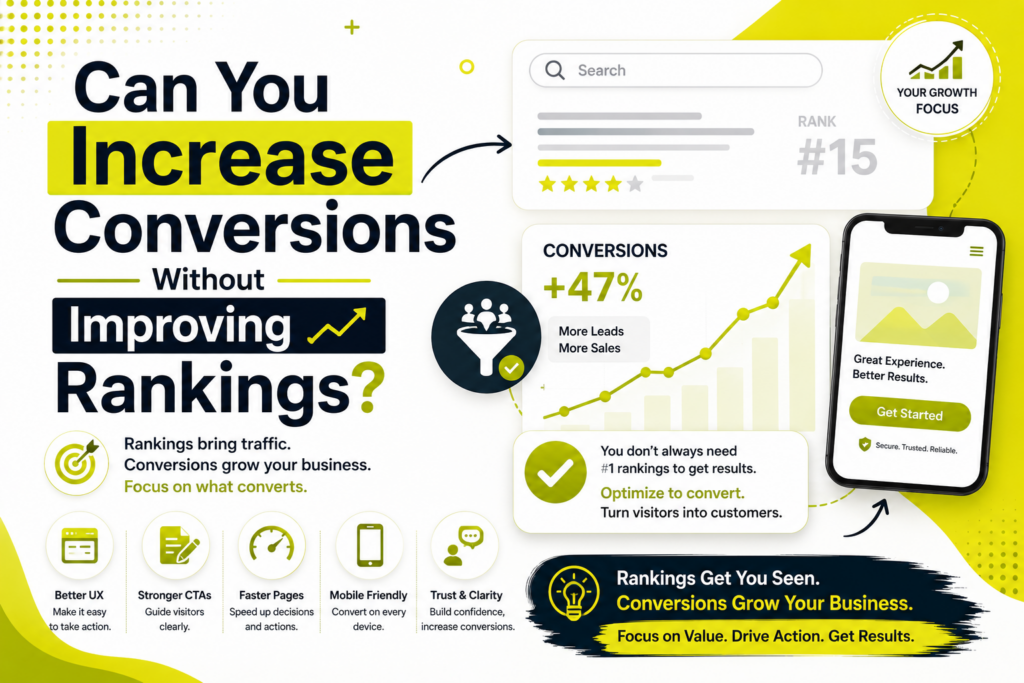
Yes, you can increase conversions without improving rankings. Rankings decide how much traffic reaches your site; conversion decides how many of those visitors become customers — two different jobs. Because revenue is roughly traffic × conversion rate × average order value, lifting your conversion rate grows revenue from the exact same traffic. Going from a 1% to a 2% conversion rate doubles your sales without a single new visitor, and it’s usually faster than SEO because it acts on traffic you already have. The levers: clearer messaging, one obvious call to action, faster pages, trust signals, less friction, and pages that match visitor intent.
There’s a common assumption that the only way to grow is to get more traffic — rank higher, run more ads, reach more people. It’s half the picture. Every visitor you already have is a chance you’ve already paid for, in SEO effort or ad spend, and most sites quietly waste the majority of them. Fixing that doesn’t require Google’s permission.
Rankings and conversion are two different jobs
It helps to see the whole equation. Revenue comes down to three things:
Revenue ≈ Traffic × Conversion rate × Average order value
SEO works on the first variable — getting more of the right people to your site. Conversion optimization works on the second and third — turning those people into leads and sales, and increasing what each one is worth. They’re independent inputs. You can leave your rankings exactly where they are and still grow revenue substantially by improving the other two. So when someone asks whether conversion can rise without better rankings, the answer isn’t just “yes” — it’s “that’s often where the biggest, fastest gains are hiding.”
Why conversion is often the faster win
Three reasons it usually beats chasing rankings first:
- The math is dramatic. Doubling conversion doubles revenue from the same traffic. Getting double the traffic through SEO can take many months; doubling conversion can come from a clearer headline and a simpler form.
- No waiting on search engines. SEO improvements typically take three to six months to show up. Conversion changes act on visitors who are already arriving, so results can appear in days or weeks.
- It makes everything else more profitable. A higher conversion rate improves the return on every channel at once — SEO, ads, social, email. You’re not just adding a lever; you’re multiplying all the others.
The levers that lift conversion without touching rankings
- Clarify your message
A visitor should grasp what you offer, who it’s for, and why it’s better within about five seconds. Vague, clever, or jargon-filled positioning is the single most common conversion killer — and it has nothing to do with rankings. Say plainly what you do and what the visitor gets. - Give one obvious call to action
Every key page needs a single, clear next step — and it should ask for the smallest reasonable commitment. Burying the CTA, or offering ten competing options, splits attention and kills action. One page, one primary ask. - Speed up your pages
Faster pages convert better, full stop — every second of delay costs conversions, especially on mobile. This one happens to help rankings too, but the conversion benefit is direct and immediate. (More in why website speed impacts sales and why your website is slow.) - Add trust and social proof
People don’t buy from sites they don’t trust. Reviews, testimonials, recognizable client logos, security badges, guarantees, and a real team page all reduce the hesitation that stops a purchase. New or unknown brands especially need to manufacture credibility on the page. - Remove friction
Every extra form field, checkout step, forced account creation, or moment of confusion loses people. Shorten forms, simplify checkout, show pricing clearly, and make everything effortless on mobile. Friction is where intent goes to die. - Match the page to intent
Land visitors on a page that answers exactly what they came for. Sending someone from a specific search or ad to a generic homepage forces them to hunt — and many won’t. Align the message on the page with the promise that brought them there. - Sell outcomes, with strong copy and visuals
Lead with the result the customer gets, not a list of features. Clear benefit-led headlines, readable layout, and quality images or demos do more for conversion than any ranking position.* - Test and measure
You can’t improve what you don’t watch. Use analytics to find where visitors drop off, session recordings and heatmaps to see why, and simple A/B tests to confirm what works. Small, measured changes compound.
First, know which problem you actually have
Be honest about your numbers before you invest, because the right fix depends entirely on where the leak is:
| What you're seeing | The real problem | Where to start |
|---|---|---|
| Decent traffic, few leads/sales | Conversion | The levers above — start here |
| Almost no traffic at all | Visibility | SEO, ads, or other traffic sources first |
| Traffic and leads, but low revenue | Average order value / lead quality | Pricing, upsells, better-fit targeting |
| Good rankings, high bounce | Intent mismatch or slow pages | Message-match and speed |
The honest caveat: conversion optimization multiplies traffic you already have, so if virtually no one is reaching your site, you do need visibility first — there’s nothing to convert. But most established sites with flat results don’t have a traffic problem. They have a conversion problem they’ve mistaken for one. If that sounds like you, the full diagnosis lives in why your website isn’t generating leads.
The catch: independent, but connected
Two truths hold at once. You can raise conversion without improving rankings — that’s the point of this article. But the two also feed each other. Many conversion improvements (faster pages, clearer content, better mobile experience, lower bounce, longer engaged sessions) are exactly the signals that can support rankings over time. And better rankings simply send more traffic into whatever conversion rate you’ve built. So it’s never truly either/or — but you can, and usually should, start with conversion, because it pays off first and makes every future ranking gain worth more.
Where to start this week
- Check your analytics: is this a traffic problem or a conversion problem? Fix the right one.
- Read your homepage and top landing page as a stranger — is the offer clear in five seconds?
- Make sure each key page has one obvious call to action.
- Test your mobile load speed and fix the worst offenders.
- Add or strengthen trust signals near your calls to action.
- Cut one step or field out of your form or checkout.
None of that requires a ranking change — and for most businesses, it’s the fastest revenue you’ll find. When you’d rather have it diagnosed and done for you, that’s exactly what our free website audit and growth services are built for.
Frequently asked questions
Can you increase conversions without improving rankings?
Yes. Rankings and conversion are separate levers — rankings bring traffic, conversion turns existing visitors into customers. You can raise conversion through clearer messaging, a stronger CTA, faster pages, trust signals, and less friction without changing rankings, and it’s often faster and cheaper than earning more traffic.
What's the difference between SEO and conversion rate optimization?
SEO increases traffic — getting more of the right people to your site. CRO increases the share of those visitors who take action. SEO grows the top of the funnel; CRO grows the bottom. They’re complementary but can be improved independently.
Is it faster to improve conversion or rankings?
Usually conversion. SEO gains typically take three to six months; conversion changes act on traffic you already have, so a clearer headline, simpler form, or faster page can lift results in days or weeks. Doubling conversion doubles revenue from the same visitors.
How do I know if my problem is traffic or conversion?
Check your numbers. Reasonable traffic but few leads means a conversion problem — fix it first. Almost no traffic means a visibility problem needing rankings or ads before conversion work pays off. Most established sites with flat results have a conversion problem.
Does improving conversion also help SEO?
Indirectly, yes. Faster pages, clearer content, better mobile experience, lower bounce, and longer sessions are positive signals that can support rankings over time. Conversion work rarely hurts SEO and often quietly helps it.
What hurts conversion the most?
Unclear messaging, no obvious call to action (or too many), slow load times, missing trust signals, and unnecessary friction like long forms or confusing checkouts. Fixing these usually beats any ranking change for speed of impact.
You’ve paid for your traffic once — in SEO or ad spend. Get a free audit and we’ll show you exactly where visitors are dropping off and how to convert more of them, without waiting on rankings.

Riya Bhardwaj
Leading content and growth initiatives with a focus on search visibility, audience engagement, and measurable business outcomes. Specialised in SEO, Generative Engine Optimization (GEO), AI search optimisation, and performance-driven content marketing. Passionate about transforming market insights into scalable content strategies that strengthen brand authority and drive sustainable digital growth.