
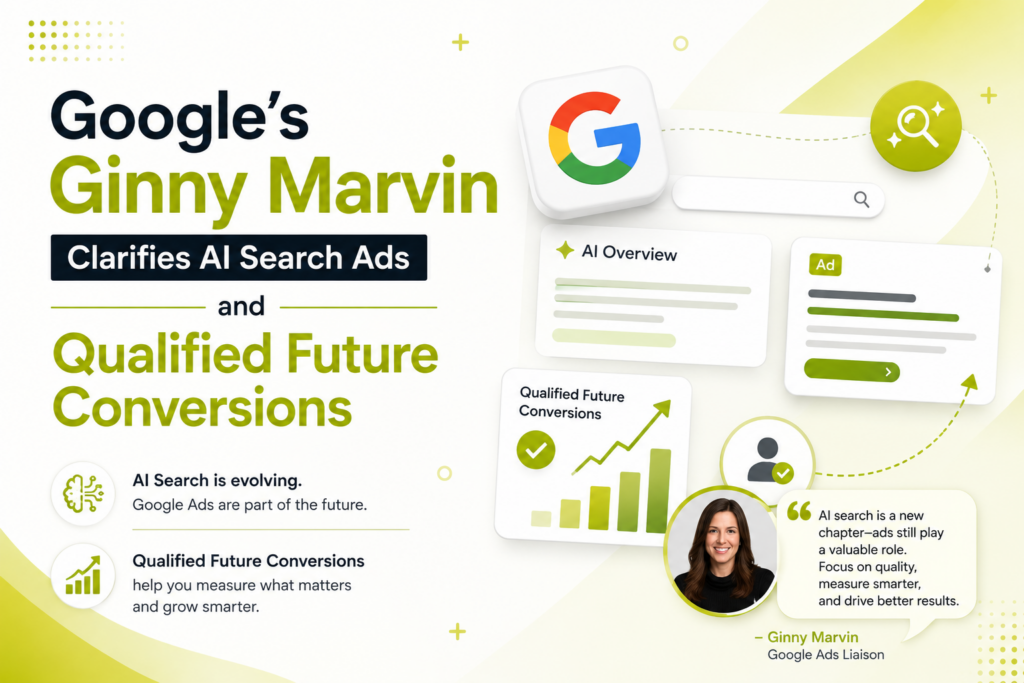
In a post–Google Marketing Live Q&A, Google’s Ads Liaison added much-needed context to two of the year’s most-asked-about topics: how ads appear in AI Search, and the new predictive metric that credits sales before they happen.
Quick answer
Google Ads Liaison Ginny Marvin used a recent Ads Decoded Q&A to clarify (not newly announce) topics from Google Marketing Live 2026. Two headlines for businesses: first, you don’t need AI Max to appear in AI Overviews and AI Mode — campaigns using broad match keywords are already eligible, and Google evaluates both the user’s query and the AI-generated response for ad relevance. Second, Qualified Future Conversions (QFC) is a new Gemini-powered predictive metric that estimates conversions up to 180 days (about six months) after an ad interaction, using early signals like branded searches. It’s supplemental — not a replacement for existing conversion tracking — and is in limited testing, with wider rollout expected later in 2026.
Google Marketing Live 2026 delivered a wave of AI-heavy announcements, but left advertisers with plenty of questions. Google’s Ads Liaison, Ginny Marvin, addressed several of them in a community Q&A and the accompanying Ads Decoded newsletter. Importantly, none of it was a new product launch — it was context, clarifying how Google expects businesses to actually use what was announced. Here’s what matters, and what it means for you.
Who is Ginny Marvin, and what did she clarify?
Ginny Marvin is Google’s Ads Liaison — the person who translates Google Ads changes for advertisers and carries advertiser feedback back to Google’s product teams. In this Q&A she focused on three recurring questions from the post-GML community: how ads become eligible for AI Search, what Qualified Future Conversions actually measures, and how advertisers should think about YouTube Creator Partnerships. The first two are the ones with the broadest implications.
How do ads appear in AI Search (AI Overviews and AI Mode)?
This was the most common question, and the answer is reassuringly simple: you don’t need AI Max enabled to show up. According to Marvin, campaigns using broad match keywords are already eligible to appear in AI Overviews and AI Mode. AI Max expands that eligibility — applying broad match behavior to phrase and exact match keywords, and enabling keywordless matching — but it’s an accelerant, not a prerequisite.
She also clarified a subtle but important point: Google’s systems evaluate both the user’s query and the AI-generated response when deciding which ads are relevant. That’s why Google keeps investing in contextual matching as AI Search grows more sophisticated — relevance is being judged against the whole conversational answer, not just the keyword.
What are Qualified Future Conversions (QFC)?
QFC generated the most confusion, so the clarification is welcome. Marvin described it as a predictive metric that estimates conversions occurring up to 180 days after an ad interaction. Powered by Gemini, it combines early user signals — like branded searches and engaged visits — with historical data to forecast future sales.
The problem it’s built to solve is what Google calls the “growth gap.” By Google’s own figures, roughly 70% of conversions from standard Google Ads campaigns land within a 30-day click and three-day engaged-view window — which means the long tail of awareness and demand-generation impact simply never gets counted. QFC tries to close that gap by crediting conversions that haven’t happened yet, but only when a user was exposed to an ad and then took a defined “leading user action.”
A few practical details Marvin and Google have emphasized:
| Question | Answer |
|---|---|
| What it is | A Gemini-powered forecast of conversions up to ~180 days out |
| What triggers it | Ad exposure + a leading action (e.g. branded search, engaged visit) |
| Setup required | None — out-of-the-box, no custom tagging |
| Replaces existing metrics? | No — supplemental, like Attributed Branded Searches |
| Best suited to | Awareness / demand-gen, and B2B or lead-gen with long sales cycles |
| Availability | Limited testing now; broader rollout expected later in 2026 |
Google has pointed to real results — UK retailer Crew Clothing reportedly saw a large uplift in long-term conversions after keeping a YouTube campaign that looked ineffective under standard attribution. The lesson: campaigns judged “failures” on a 30-day window may be doing real work that only a longer lens reveals.
How QFC fits Google's bigger measurement shift
QFC doesn’t stand alone. It joins Attributed Branded Searches, an emphasis on “Data Strength” (the quality and completeness of your first-party data), and Meridian — Google’s open-source marketing-mix model now integrating with Analytics 360. The common thread is a move from measuring what already happened to forecasting future value. For businesses running awareness or long-cycle campaigns, that’s a genuinely useful lens.
The trade-off businesses should watch
There’s a flip side worth naming. As Google takes over more of the qualification, forecasting, and attribution, advertisers gain convenience but lose visibility — QFC is a Gemini forecast you can’t fully audit, and it’s slated to flow into the very models meant to serve as an independent check. That doesn’t make it useless; predictive signals can reveal value humans miss. But treat QFC as a directional, supplemental signal to validate against your own business data, not as ground truth. Keep your own record of what converts, and don’t let a forecast quietly become the scoreboard.
What this actually means for your business
Even if you’re not a heavy Google Ads spender, these shifts matter — because both hinge on things the organic side of your marketing controls:
- AI Search visibility is now a paid and organic game. Ads can appear in AI Overviews and AI Mode, but so can citations of your content — and being referenced by AI increasingly shapes decisions. Getting cited is its own discipline: see ranking in AI Overviews and optimizing for ChatGPT, or our GEO and LLM SEO services.
- SEO feeds the signals QFC measures. Branded searches and engaged visits — the “leading actions” QFC counts — are exactly what strong content, brand awareness, and SEO generate. Organic isn’t separate from the conversion story; it creates the demand that later gets credited.
- Measurement is getting more predictive — so track it properly. As attribution stretches to 180 days and AI-referred visits grow, clean analytics matter more than ever. Start with tracking AI referral traffic in GA4.
- Lead quality beats lead volume. Google’s push toward “qualified” future conversions mirrors what every business actually wants — better leads, not just cheaper ones. That starts with a site that converts the right visitors, which we cover in why your website isn’t generating leads.
The bigger picture across GML 2026 is consistent: Google is weaving AI through discovery, measurement, and buying at once. Businesses that treat SEO, content, and ads as connected — rather than separate departments — will adapt fastest.
Frequently asked questions
Who is Ginny Marvin?
Google’s Ads Liaison — the official who communicates Google Ads updates to advertisers and relays their feedback to Google’s product teams, often through the Ads Decoded newsletter and community Q&As.
Do I need AI Max to show ads in AI Overviews and AI Mode?
No. Marvin confirmed that campaigns using broad match keywords are already eligible for AI Overviews and AI Mode. AI Max expands eligibility (broad match behavior on phrase/exact match, plus keywordless matching) but isn’t required.
What are Qualified Future Conversions (QFC)?
A Gemini-powered predictive metric estimating conversions likely within about 180 days of an ad interaction, linking early intent signals like branded searches with historical data to forecast future sales — capturing long-term impact that standard attribution windows miss.
Does QFC replace my existing conversion tracking?
No. Google positions it as a supplemental signal, like Attributed Branded Searches — a forward-looking view alongside your standard conversion reporting, not a replacement.
When will Qualified Future Conversions be available?
As of mid-2026 it’s in limited testing, with broader availability expected later in the year. It’s designed to work out of the box with no custom tagging.
How does SEO relate to Qualified Future Conversions?
QFC relies on early intent signals like branded searches and engaged visits — the exact behaviors strong SEO, content, and brand awareness create. Organic search builds the demand and trust that later surface as the leading actions QFC measures.
Whether the click comes from an ad, an AI Overview, or an organic result, it still lands on your site — and your site has to earn the conversion. We help businesses win visibility across search and AI, and turn it into qualified leads.

Riya Bhardwaj
Leading content and growth initiatives with a focus on search visibility, audience engagement, and measurable business outcomes. Specialised in SEO, Generative Engine Optimization (GEO), AI search optimisation, and performance-driven content marketing. Passionate about transforming market insights into scalable content strategies that strengthen brand authority and drive sustainable digital growth.