

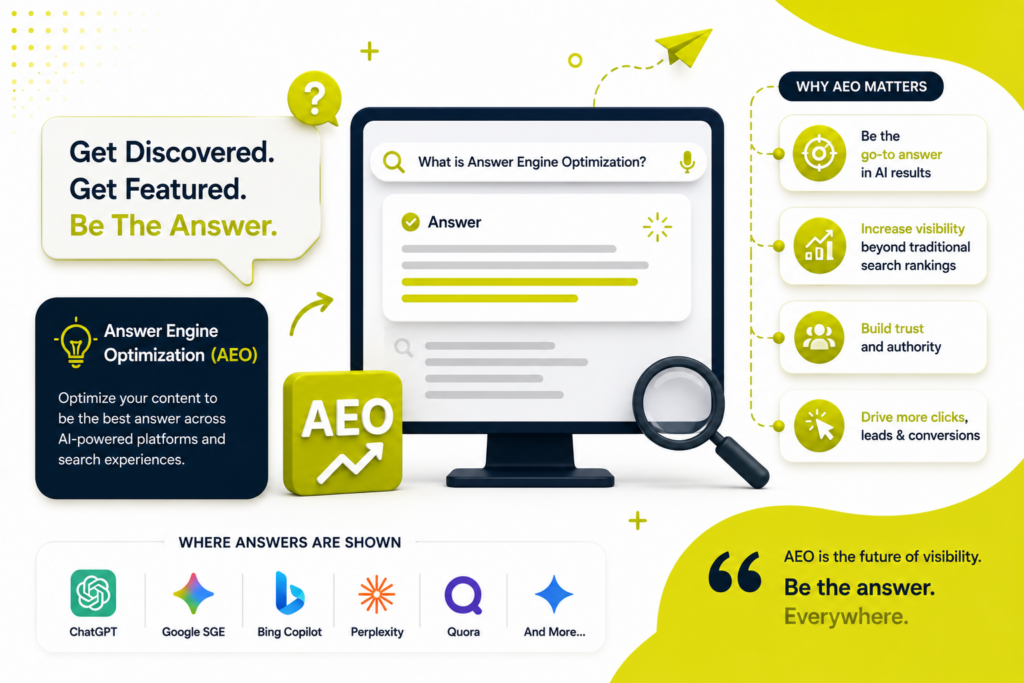
Search stopped being a list of links and became an answer. Answer Engine Optimization is how you make sure that answer is yours — or at least cites you. Here’s what AEO really means, minus the hype.
Quick answer
Answer Engine Optimization (AEO) is the practice of structuring and writing content so answer engines — Google AI Overviews, ChatGPT Search, Bing Copilot, Perplexity, Gemini, plus classic features like featured snippets and People Also Ask — can easily understand, trust, extract, and cite it. The goal shifts from ranking as a link below the answer to becoming the answer, or the source it cites. AEO isn’t a replacement for SEO; it’s an upgrade built on the same fundamentals — crawlability, useful content, structured data — plus answer-first structure, clear entities, and verifiable sources. It’s closely related to GEO (Generative Engine Optimization), which focuses on citations inside generative AI; the terms overlap and aren’t fully standardized. It matters because a large and growing share of searches — estimates range from around 40% to 60%+ — now end without a click.
For twenty years, the job was simple to describe: rank higher. Get your blue link nearer the top and win the click. But when a searcher now types a question and gets a complete, synthesized answer at the top of the page — or asks ChatGPT and never opens Google at all — ranking tenth, or even first, beneath that answer can mean being invisible. AEO is the discipline built for that world. This guide explains what it is, how it relates to SEO and GEO, and how to actually do it — without the snake oil that’s flooded the topic.
What is answer engine optimization?
An “answer engine” is any system that gives users a direct answer instead of just a list of sources: Google’s AI Overviews and AI Mode, ChatGPT Search, Microsoft Copilot, Perplexity, Gemini — and older features like featured snippets, People Also Ask, and voice assistants. AEO is optimizing so those systems can understand, trust, extract, and cite your content. Where SEO earns visibility in the results, AEO earns visibility inside the answer — becoming the source that gets quoted, summarized, or recommended.
AEO vs SEO vs GEO — what’s the difference?
These three acronyms get muddled constantly. Here’s the cleanest way to hold them:
| Discipline | Goal | Where it plays |
|---|---|---|
| SEO — Search Engine Optimization | Rank on the results page | Google & Bing organic results |
| AEO — Answer Engine Optimization | Be the direct answer | AI Overviews, featured snippets, PAA, voice |
| GEO — Generative Engine Optimization | Get cited inside AI answers | ChatGPT, Perplexity, Gemini, Copilot |
One way to phrase it: SEO gets you onto the results page, AEO makes your content the answer on it, and GEO gets AI models to recommend you beyond the Google ecosystem. But be honest about the messiness — the industry hasn’t standardized these terms. Many practitioners treat GEO as the generative-AI subset of AEO (with AEO as the umbrella), some use “AEO” and “GEO” interchangeably, and you’ll also see “LLMO” for the technical, LLM-citation slice. Don’t get lost in vocabulary; the underlying work overlaps enormously, and it all rests on strong SEO.
Why AEO matters now
The shift is measurable. A large and rising share of searches end without a click — estimates vary by study and methodology but commonly land between roughly 40% and 60%+. Ahrefs reported that AI Overviews cut click-through rates for top-ranking content by around 58% (up sharply from the prior year). And on the upside: a 2024 study from Princeton, Georgia Tech, and IIT Delhi found that content optimized for generative engines saw citation rates rise by roughly 30% to 115%. Translation — the traffic you used to win by ranking is increasingly captured by the answer, and being in that answer is now the game.
If you’re not the answer, you’re the footnote nobody scrolls to.
The honest truth: AEO is an upgrade to SEO, not magic
This is the part the hype merchants skip. In 2026, Google stated plainly that there are no special optimizations or extra requirements for AI Overviews and AI Mode beyond Search fundamentals — it still just wants crawlable, indexable, genuinely useful content with structured data that matches what’s visible on the page. AI Overviews largely pull from the top organic results, so weak SEO can’t be leapfrogged by an “AEO trick.”
Red flag: anyone guaranteeing you a spot in AI Overviews or ChatGPT answers is selling snake oil — no one can guarantee AI placement. AEO improves your odds of being understood and cited; it doesn’t buy a seat. Treat “guaranteed AI visibility” the way you’d treat “guaranteed #1 on Google.”
So AEO is best understood as organizing your existing SEO strength into an answer-first shape. If your foundations are shaky, start there — see why SEO isn’t working and whether SEO is dead in 2026 — because AEO builds on top of them, it doesn’t bypass them.
How to do AEO — the core practices
- Lead with the answerPut a direct, concise answer at the top of each page or section, before the context and nuance. Answer engines extract the clearest, most self-contained response — so make yours the easiest to lift. (The “Quick answer” box on this page is exactly this pattern.)
- Use question-based headings and FAQsPhrase headings the way people actually ask, and include a genuine FAQ section. This maps your content directly onto the questions answer engines are trying to resolve.
- Add structured data that matches your contentMark up articles, FAQs, products, and your organization with schema — and make sure it reflects what’s visibly on the page. Structured data helps machines parse and trust your content; it’s a core part of the technical SEO checklist.
- Establish clear entities and topical authorityBe unambiguous about who you are and what you’re expert in, and cover topics comprehensively so engines associate your brand with them. Depth and consistency build the trust that earns citations.
- Cite verifiable sources and keep it freshReal data, clear sourcing, visible dates, and genuine expertise (E-E-A-T) make your content quotable and current — answer engines favor material they can trust, and fresh content over stale.
- Format for extractionShort paragraphs, bullet lists, comparison tables, and clear definitions give engines clean, liftable chunks. A wall of text is hard to quote; a crisp table or a two-sentence definition is easy.
- Make sure AI crawlers can reach youConfirm you’re not accidentally blocking GPTBot, ClaudeBot, PerplexityBot, or Google-Extended, and that key content is server-rendered rather than JavaScript-only — many AI crawlers don’t execute JS.
- Build brand presence and off-site citationsAnswer engines synthesize from across the web, so mentions, reviews, and credible third-party references (even well-formatted, genuinely helpful contributions on communities like Reddit) increase the odds you’re recommended.
- Measure your AI visibilityTrack citations and share-of-voice inside AI answers, monitor branded search, and separate AI-referred traffic — start with tracking AI referral traffic in GA4.
For platform-specific execution, see ranking in Google AI Overviews and optimizing for ChatGPT. Different engines have quirks — Perplexity rewards freshness and authority, Gemini reads multimodal content, and comprehensive long-form tends to travel well — but the fundamentals above apply everywhere.
This page is an example of AEO
Look at how this article is built: a self-contained answer box up top, question-based headings, a comparison table, a numbered how-to, an FAQ, and structured data behind the scenes. That’s not decoration — it’s AEO in practice, the same pattern every post in our library uses. The best way to understand answer engine optimization is to notice you’re reading it.
How to measure AEO success
Because so many answer-engine interactions end without a click, old metrics understate your impact. Rankings and impressions still matter, but add: AI citations (how often engines quote or reference you), share of voice in answers for your key topics, branded search growth (a proxy for being seen in answers), and AI-referred traffic and conversions. If more people arrive already knowing your name, your AEO is working — even when the click count looks flat. This ties to the bigger measurement shift in the AI-search trust gap and why being the source now wins.
Frequently asked questions
What is answer engine optimization (AEO)?
The practice of structuring and writing content so answer engines — Google AI Overviews, ChatGPT, Copilot, Perplexity, Gemini, plus featured snippets and PAA — can easily understand, trust, extract, and cite it. The goal shifts from ranking as a link below the answer to becoming the answer, or the source it cites.
What's the difference between AEO, SEO, and GEO?
SEO earns rankings on the results page; AEO makes your content the direct answer within results; GEO earns citations inside generative AI responses like ChatGPT and Perplexity, often outside Google. The terms overlap and aren’t standardized — many treat GEO as the generative subset of AEO, and all three share the same foundations.
Is AEO replacing SEO?
No — it’s an upgrade, not a replacement. Traditional search still drives most web traffic, and AI Overviews largely draw from top-ranking results. Google said in 2026 there are no special optimizations beyond Search fundamentals. Keep SEO strong and add answer-first structure, clear entities, sources, and schema.
How do I optimize for answer engines?
Lead with a direct answer; use question-based headings and FAQs; add schema matching visible content; establish clear entities and topical authority; cite verifiable sources and stay fresh; format for extraction with lists and tables; ensure AI crawlers can access you; build brand presence and citations; and track AI visibility.
Does AEO require special tricks beyond good SEO?
No. Google has said there are no special optimizations for AI Overviews beyond Search fundamentals — crawlability, indexability, useful content, and matching structured data. AEO organizes those into an answer-first format. Be skeptical of “magic” AEO, and treat guarantees of AI placement as a red flag.
How do I measure AEO success?
Track AI citations and share of voice in answers, branded search growth, and AI-referred traffic and conversions. Because many answer-engine interactions are click-free, citations and brand lift are truer measures than impressions or rankings alone.
AEO is where search is heading — and it rewards businesses that are structured, credible, and citable. We help you build the SEO foundation and the answer-first layer on top, so AI engines understand and recommend you. No guarantees of magic — just the work that moves the needle.

Riya Bhardwaj
Leading content and growth initiatives with a focus on search visibility, audience engagement, and measurable business outcomes. Specialised in SEO, Generative Engine Optimization (GEO), AI search optimisation, and performance-driven content marketing. Passionate about transforming market insights into scalable content strategies that strengthen brand authority and drive sustainable digital growth.