

AI has gone from experiment to infrastructure — most marketers now use it daily. But the businesses winning with it aren’t the ones automating the most. They’re the ones pairing AI’s scale with the human strategy and trust it can’t replace.
Quick answer
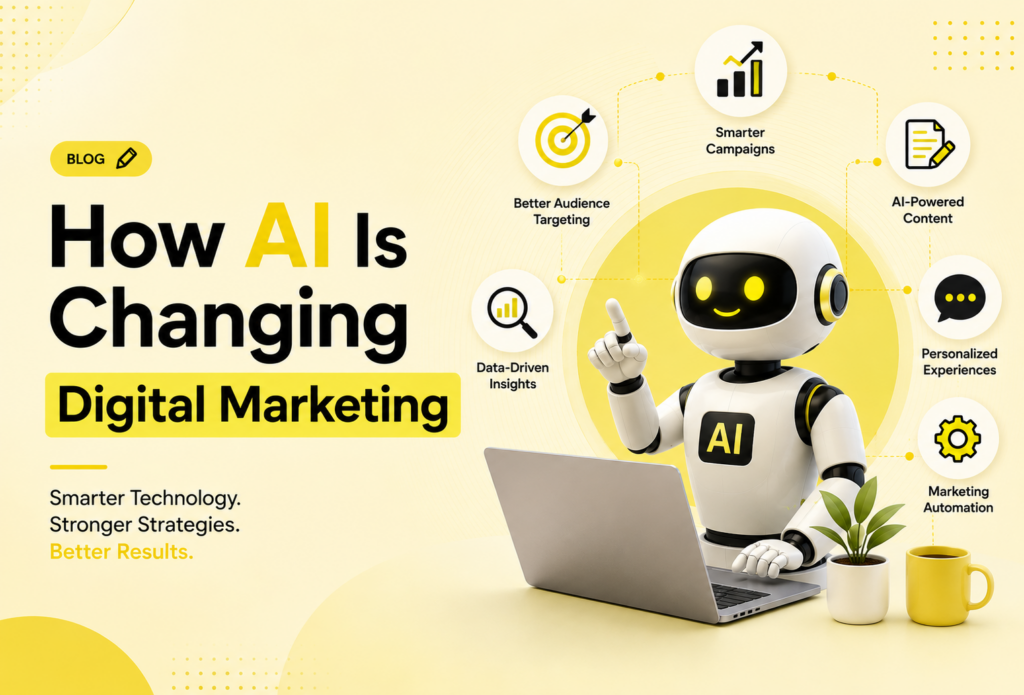
AI is reshaping digital marketing across six areas: search (AI Overviews and answer engines changing how people find you), content (generative copy, images, and video at scale), personalization (real-time, individual experiences), advertising (automated targeting, bidding, and creative), analytics (predictive forecasting), and customer service (conversational AI and agents). Adoption is near-universal in 2026 — most surveys put marketer use of generative AI at 85–90% — and it’s saving time (around six hours a week) and improving ROI (payback now roughly four months). But there’s a catch: AI also commoditizes content and raises the stakes on privacy and authenticity, so the winners combine AI’s speed with human strategy, creativity, and trust. In India, adoption is especially high, at around 81% of marketers.
Every few years a technology gets called a “revolution” in marketing. Most aren’t. AI is — not because of the hype, but because of the adoption: it has quietly become part of how marketing gets done, from the search results your customers see to the ads that reach them to the reports on your desk. The useful question in 2026 isn’t whether AI is changing marketing. It’s where it’s changing, how much of the change is real, and what still depends on humans. Let’s be specific about all three.
How big is the shift, really?
Big — and measurable, though you should read vendor statistics with a healthy skepticism. The credible picture: by 2026, roughly 85–90% of marketers use generative AI in at least one workflow (Salesforce’s State of Marketing puts it around 87%, up from about half in 2024). Marketers report saving on the order of six hours a week on average (HubSpot), and McKinsey’s blended figures show AI paying back fastest in content drafting and personalization, with median payback now around four months, down from nearly eight two years ago. Gartner reports a clear majority of recent adopters seeing positive ROI within six months. For India specifically — Nowoka’s home market — adoption runs high, with Salesforce finding around 81% of Indian marketers already using AI.
The debate has moved from “should we use AI?” to “how do we use it better than everyone else who already does?”
The honest caveat behind those numbers: returns vary enormously by use case and execution. AI amplifies a good strategy and accelerates a bad one. So treat the averages as a signal that the tools work, not a promise that they’ll work for you regardless of how you apply them.
The six areas AI is changing digital marketing
- Search & discovery — the biggest shift
This is the change that touches everyone. AI Overviews, ChatGPT Search, and Perplexity increasingly answer queries without a click, and estimates of the resulting organic-traffic impact commonly land anywhere from roughly 18% to nearly 50% on affected queries. The response is a new discipline: optimizing to be the answer, not just to rank below it — answer engine optimization (AEO) and its generative cousin, covered in our GEO and LLM SEO work. If your traffic is dipping while rankings hold, this is usually why — and why SEO isn’t working the way it used to. - Content creation — faster, and more commoditized
Generative AI now drafts copy, images, and video, cutting long-form production from hours to under two in many teams. But there’s a trap: when everyone can generate competent content instantly, competent content stops being a differentiator. Google’s helpful-content systems and AI answer engines both reward genuine expertise over generic output — which is exactly why commodity content is losing its value. Use AI to draft and scale; use humans for the insight, experience, and point of view that make content worth citing. - Personalization & customer experience
AI turns personalization from “Hi [First Name]” into real-time, individual experiences — content and recommendations that adapt to dozens of behavioral signals at once. Consumers reward it: surveys consistently find the large majority (around 90%) are more likely to buy from brands that personalize well. The shift is from segments to individuals, at a scale no manual team could manage. - Advertising — automation takes the wheel
Ad platforms increasingly run themselves: automated targeting, bidding, and even creative generation, plus predictive metrics that credit conversions before they happen — like Google’s Qualified Future Conversions. This buys efficiency but costs transparency, so the marketer’s job shifts from pulling levers to setting strategy, feeding clean first-party data, and validating what the machine reports. Our PPC work lives in exactly this tension. - Analytics & prediction
AI is reshaping measurement itself — predictive analytics forecast customer behavior and campaign outcomes, and attribution is moving from what already happened to what’s likely to. Most top-performing teams now lean on predictive analytics for planning. The practical starting point is clean measurement, including the growing slice of AI-referred visitors — see tracking AI referral traffic in GA4. - Conversational marketing, service & agents
AI chatbots and assistants now handle a large share of first-line customer interaction, and the frontier is agentic: AI that completes multi-step tasks and, increasingly, researches and transacts on a customer’s behalf. That’s the agentic web — a new kind of visitor your marketing has to be readable to, and it pairs with the automation you can already build today, like API-automated email and automated reporting.
What AI can’t (and shouldn’t) replace
Here’s the part the hype skips — and it matters more as automation spreads. AI is extraordinary at production and pattern-finding. It’s weak at exactly the things marketing ultimately runs on:
- Strategy and judgment. AI can execute a plan; it can’t decide which plan is right for your business, market, and moment. Cost reduction comes from automation; strategy still needs human judgment.
- Brand and creativity. A distinctive brand voice and a genuinely original idea are, by definition, not what a model trained on everyone else’s output produces best.
- Trust and authenticity. As audiences get better at spotting generated content, human credibility — real experience, real opinions, real accountability — becomes the scarce, valuable thing.
- Relationships. The judgment in a sales conversation, the empathy in handling a complaint, the taste in a campaign — these stay human.
AI replaces tasks, not marketers. The people at risk are the ones who only do the tasks.
The risks marketers have to manage
Adopting AI well means managing its downsides deliberately:
| Risk | How to manage it |
|---|---|
| Commoditized, generic content | Use AI to draft, humans to add expertise and originality |
| Privacy & compliance failures | Prioritize first-party data, consent, and transparent use |
| Hallucinations & brand-safety errors | Keep a human reviewing anything customer-facing |
| Loss of authenticity | Disclose where appropriate; keep a real brand voice |
| Tool sprawl | Consolidate; adopt tools against goals, not hype |
| Over-automation | Automate the repetitive; protect the human judgment |
Notice the pattern: in 2026, responsible and transparent AI use isn’t just risk management — it’s a differentiator. Consumers increasingly favor brands that respect their data and feel genuine, which turns “using AI well” into a trust advantage, not just a compliance box. It’s the same lesson as the AI-search trust gap: people adopt AI faster than they trust it, and the credible brand wins.
How to adopt AI the right way
- Start with goals, not tools. Decide what you’re improving — leads, retention, personalization, efficiency — then bring AI where it clearly helps.
- Augment, don’t replace. Use AI to amplify your team’s output, keeping human strategy and judgment in the loop.
- Keep a human on customer-facing output. Review generated content, ads, and replies before they ship.
- Measure against real outcomes. Track ROI, conversions, and pipeline — not vanity metrics or activity.
- Use data responsibly. Lead with first-party data, consent, and transparency.
- Start small, then scale. Prove value on one or two high-return use cases (content drafting, reporting automation) before expanding.
What this means for your business
Strip away the noise and the strategy is clear. AI raises the floor — everyone can now produce competent marketing fast — which means the ceiling is set by the things AI can’t do: sharp strategy, a distinctive brand, genuine expertise, and earned trust. For businesses in high-adoption markets like India especially, the opportunity isn’t to use AI (everyone will); it’s to use it and stay unmistakably human where it counts. Get visible in AI-era search, personalize with care, automate the busywork, and pour the time you save back into the strategy and creativity that make you worth choosing. That’s the balance we help clients strike across SEO, GEO, social, and paid.
Frequently asked questions
How is AI changing digital marketing?
Across six areas: search and discovery (AI Overviews and answer engines), content creation (generative copy, images, video at scale), personalization (real-time and individual), advertising (automated targeting, bidding, creative), analytics (predictive forecasting), and customer service (conversational AI and agents). Adoption is near-universal in 2026, around 85–90% of marketers.
Will AI replace digital marketers?
No — it replaces tasks, not marketers. AI automates repetitive production and analysis, freeing people for strategy, brand, creativity, and judgment, which it can’t do well. Marketers who only do automatable work are at risk; those who use AI to amplify human strategy become more valuable.
What are the biggest AI marketing trends in 2026?
The shift from SEO to answer/generative engine optimization, hyper-personalization at scale, generative AI for content and creative, agentic AI running campaigns and workflows, predictive analytics reshaping measurement, and a rising premium on trust, authenticity, and first-party data.
Does AI marketing actually improve ROI?
For most teams, yes, though it varies widely by use case. Research reports strong blended returns (content and personalization lead), median payback around four months (down from nearly eight in 2024), and most adopters seeing positive ROI within six months. Results follow execution — AI amplifies good strategy and accelerates bad.
What are the risks of using AI in marketing?
Commoditized generic content, privacy and compliance failures, hallucinations and brand-safety errors, loss of authenticity, tool sprawl, and over-automation removing valued human judgment. Responsible, transparent use with human oversight is now a competitive differentiator.
How should a business start using AI in marketing?
Start with goals, not tools; use AI to augment rather than replace judgment; keep a human on customer-facing output; measure ROI against real outcomes; use data responsibly and transparently; and consolidate tools. Begin with one or two high-return use cases, prove value, then expand.
The winners in 2026 pair AI’s speed with human strategy and trust. We help businesses get visible in AI-era search, personalize with care, and automate the busywork — so your team spends its time where AI can’t compete. Let’s build your plan.

Riya Bhardwaj
Leading content and growth initiatives with a focus on search visibility, audience engagement, and measurable business outcomes. Specialised in SEO, Generative Engine Optimization (GEO), AI search optimisation, and performance-driven content marketing. Passionate about transforming market insights into scalable content strategies that strengthen brand authority and drive sustainable digital growth.