

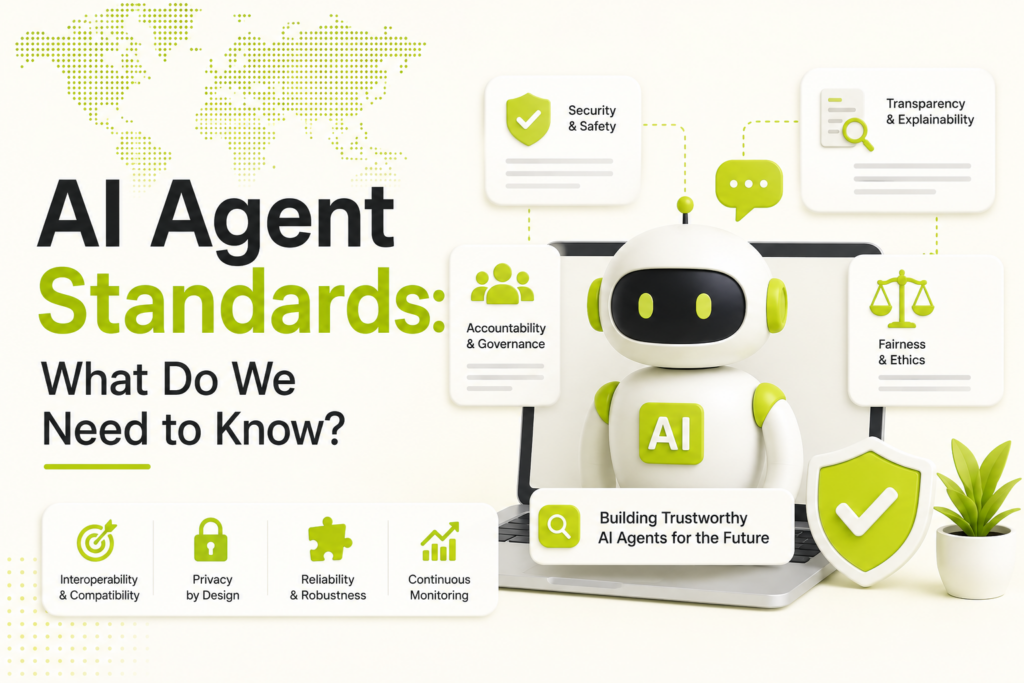
In about 18 months, AI agents went from demos to production — and the bottleneck became interoperability. A standards stack has emerged faster than the web itself did. Here’s the plain-English version, and why it matters for your business.
Quick answer
AI agents need shared standards to connect to tools, coordinate with other agents, transact, and prove their identity — otherwise every integration is a custom build. The stack that’s emerged in 2026 isn’t a set of rivals but a set of layers: MCP connects agents to tools and data (the settled default, from Anthropic, now industry-wide); A2A connects agents to each other (from Google, now at version 1.0 under the Linux Foundation); commerce protocols like AP2 handle payments; and web conventions like WebMCP and llms.txt prepare the “agentic web.” The unsolved parts are identity/trust and security. For most businesses, the takeaway isn’t to build agents — it’s to make your site readable and trustworthy to the agents that will increasingly act on customers’ behalf.
Two years ago, building an AI agent meant picking a model and writing prompts. Today it means navigating a growing set of standards that decide how an agent connects to tools, talks to other agents, pays for things, and proves who it is. Multi-agent systems matured fast, and the moment agents built by different teams needed to work together, the industry hit a wall: no shared language. Protocols are the answer — and the pace of standardization here is remarkable. What took the web most of a decade, the agent ecosystem has done in roughly eighteen months.
What are "AI agent standards," and why do they matter?
An AI agent is software that can take actions toward a goal — not just answer, but do. To do anything useful it needs to reach your tools and data, often coordinate with other agents, sometimes transact, and (increasingly) prove it’s a legitimate actor. Without shared standards, each of those connections is a bespoke one-off: connect this model to that database, write custom code; connect a different model to a different app, write different custom code. Standards replace that N-by-N mess with common protocols — the same reason the web needed HTTP.
The core protocol stack (layers, not rivals)
The most common mistake is treating these as competitors fighting for one slot. They’re not — they solve different problems at different layers, and the ecosystem has converged on a stack:
| Layer | Standard(s) | What it does | Status |
|---|---|---|---|
| Tools & data | MCP (Model Context Protocol) | Connects an agent to tools, data, and services — gives it the ability to act | Settled default; from Anthropic, backed across OpenAI, Google, Microsoft, AWS |
| Agent ↔ agent | A2A (Agent2Agent) | Lets agents discover each other and delegate tasks across frameworks | v1.0 in 2026, signed Agent Cards, Linux Foundation, 150+ orgs |
| Commerce | AP2 and peers | Machine-native payments, mandates, and checkout | Emerging; keep payments in the commerce layer, not in MCP/A2A |
| User interface | AG-UI / A2UI | Surfaces agent work to human users | Newer, still maturing |
| The agentic web | WebMCP, llms.txt | Lets websites expose agent-facing capabilities and guidance | WebMCP in preview (W3C track); llms.txt low-cost, debated |
| Semantics | OSI (Open Semantic Interchange) | Shared meaning for data, so agents trust what they read | Live under Apache 2.0 (2026) |
A simple way to hold it: MCP gives an agent hands to use tools, A2A gives it colleagues to work with, the commerce layer gives it a wallet, and the web conventions give the rest of us a storefront agents can actually read. MCP is the settled layer — adopting it and wrapping your internal capabilities as well-described MCP tools is the highest-return integration work available right now. A2A matters once you genuinely have multiple agents that must interoperate across teams or organizations — a later stage than most projects admit.
The parts that aren't solved yet: identity, trust, and security
This is the “what to watch” section, and it’s where honesty matters. The plumbing is maturing, but two cross-cutting problems remain open:
- Identity and trustProgress is real but partial. Signed Agent Cards give A2A verifiable identities, web-bot authentication points the same way, and payment mandates carry cryptographic accountability. What doesn’t yet exist is a unified answer — one way for an agent to carry who it is, who it acts for, and what it’s allowed to do across every layer at once. Expect that to be the defining standards fight of 2027.
- Security and authorizationEvery protocol that standardizes a capability also widens an attack surface. Tool descriptions and web content become prompt-injection vectors; agent-to-agent delegation creates “confused deputy” risks at machine speed; payment autonomy raises the stakes of any upstream compromise. OWASP now publishes a top-ten for agentic applications, and fine-grained authorization — exactly what an agent may and may not do on your behalf — is still being worked out.
The pipes are nearly built. Deciding which agents to trust, and with what, is the hard part still ahead.
What this actually means for your business
Here’s the bridge most technical coverage skips. You don’t need to build agents to be affected by them. The direction of travel is an agentic web, where AI agents research, compare, and increasingly transact on behalf of your customers. When that happens, your website has a new kind of visitor — one that reads structure, not style, and that trusts sources it can parse and verify.
Which means the work that makes you visible to AI is largely the same work that makes you usable by agents:
- Be machine-readable. Server-rendered, crawlable content and accurate structured data — because many agents and AI crawlers don’t execute JavaScript, so JS-only content is invisible to them. This is core technical SEO, extended to a new audience.
- Be consistent and authoritative. Clean, consistent business and product data so an agent gets your details right — the same “be the source” logic behind the AI-search trust gap and why the individual is becoming the strategy.
- Be citable. The content agents pull from is the content that earns you presence in answers — the discipline behind AI Overviews, ChatGPT, and our GEO and LLM SEO work.
- Decide crawler access deliberately. Choose how AI and agent crawlers may use your site, and consider publishing an
llms.txt— low-cost positioning for the consensual-agent-traffic world that’s coming.
What to do now
Two tracks, depending on who you are:
- If you run a website or brand (most businesses): get agent-ready. Solidify technical SEO and structured data, keep your data consistent, decide crawler access, and measure the new traffic — start by tracking AI referral traffic in GA4 and building on a strong technical foundation.
- If you’re building products: adopt MCP now and treat every tool as a security boundary; add A2A only when you truly have multiple interoperating agents; keep payments in a dedicated commerce protocol; and don’t build yet another custom integration layer — the standards and SDKs are production-ready.
The safe bet in a fast-moving space: you can’t predict which protocol wins every slot, but you can make your business legible and trustworthy to agents — and that pays off no matter how the standards settle.
Frequently asked questions
What are AI agent standards?
Shared protocols that let AI agents connect to tools and data, coordinate with other agents, transact, and identify themselves — without every integration being custom-built. The main layers are MCP (agent-to-tools), A2A (agent-to-agent), commerce protocols like AP2, and web conventions like WebMCP and llms.txt.
What is MCP (Model Context Protocol)?
The standard that connects an AI agent to tools, data, and services — giving it the ability to act. Introduced by Anthropic, it started the current wave of agent standardization and is now backed across the industry, making it the settled default for tool access.
What is A2A (Agent2Agent)?
The standard for agents to discover, communicate, and collaborate regardless of framework — the multi-agent layer. Created by Google in 2025 and donated to the Linux Foundation, it reached version 1.0 in 2026 with signed Agent Cards and adoption across 150+ organizations.
Do businesses need to build AI agents to prepare?
No. For most businesses the priority is making your website and data readable and trustworthy to the agents that will research, compare, and act on customers’ behalf — clean crawlable content, accurate structured data, consistent information, and being a credible source.
What's the biggest unsolved problem in AI agent standards?
Identity and trust — there’s still no unified way for an agent to prove who it is, who it acts for, and what it may do across all layers at once. Signed Agent Cards and web-bot auth are partial steps; a full answer is expected to be 2027’s defining fight. Security (see OWASP’s agentic top-ten) is the other cross-cutting concern.
How do I make my website ready for AI agents?
Treat it as technical SEO plus AI visibility: server-rendered, crawlable content, accurate structured data, consistent business info, a deliberate AI-crawler policy, and possibly an llms.txt file. The goal is to be legible to agents and credible enough to be the source they rely on.
You don’t need to build agents — you need to be readable and trustworthy to them. We make sites technically clean, well-structured, and citable, so you’re visible across search, AI answers, and the agents coming next.

Riya Bhardwaj
Leading content and growth initiatives with a focus on search visibility, audience engagement, and measurable business outcomes. Specialised in SEO, Generative Engine Optimization (GEO), AI search optimisation, and performance-driven content marketing. Passionate about transforming market insights into scalable content strategies that strengthen brand authority and drive sustainable digital growth.