
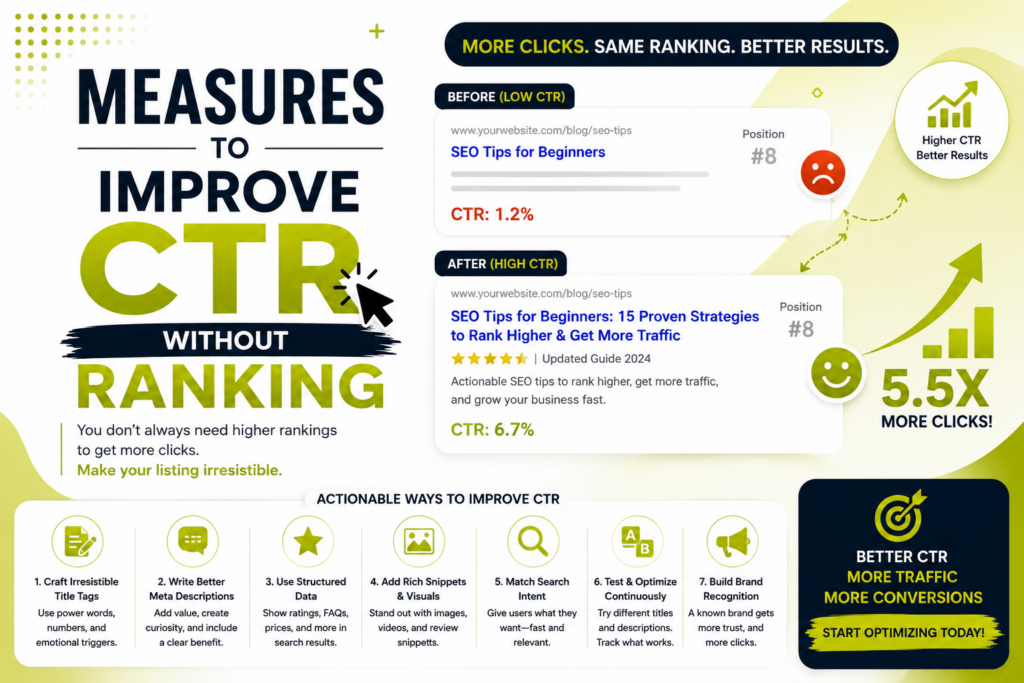
You don’t need to climb the rankings to win more clicks. A better title, a sharper snippet, and the right SERP features can pull more traffic from the position you already hold. Here are the measures that work.
Quick answer
To improve click-through rate without ranking higher, take these measures: audit Google Search Console for high-impression, low-CTR pages; rewrite title tags to lead with the keyword and a clear promise; sharpen meta descriptions with a benefit and call to action; add structured data to earn rich results; target featured snippets and “People Also Ask”; match search intent precisely; clean up URLs; strengthen brand signals; add genuine freshness cues; and A/B test, then keep what wins. Measure your CTR against positional benchmarks to spot the gaps. The 2026 caveat: AI Overviews compress clicks, so make your snippet offer something the AI answer can’t.
Rankings decide whether you’re seen. Your snippet decides whether you’re chosen. Searchers spend under a second scanning each result before clicking or moving on, and in that instant a compelling listing at position four can out-earn a dull one at position two. That’s the whole opportunity here: more clicks from the same spot, no ranking change required. Below are the specific measures to make it happen, in the order you should take them.
First: what “CTR without ranking” really means
Every position has an expected click-through rate — the clicks a result in that spot typically earns. The gap between that expected rate and your actual rate is your opportunity. A page ranking comfortably at position five but pulling far below the positional average doesn’t have a ranking problem; it has a click problem — and click problems are fixable this week, without Google’s help.
You’re not trying to move up the page. You’re trying to win the click you already earned the right to compete for.
The measures, in priority order
- Audit CTR in Google Search Console
Start with data, not guesswork. Pull the Performance report and find pages and queries with high impressions but low CTR — results people see constantly and skip. Those are your fastest wins. For each, open the live SERP and note what’s taking the click. - Rewrite your title tags
The single biggest measure. Lead with the primary keyword in the first ~30 characters, make it a concrete promise (a number, a year like “(2026)”, or a clear benefit), use restrained power words (Complete, Proven, Essential, Updated), and mirror how people actually phrase the search. Keep it under ~60 characters so it doesn’t truncate. - Optimize your meta descriptions
In roughly 155 characters, promise a clear benefit and add a real call to action (“Get the checklist”, “See the comparison”). Include the query term so Google bolds it. Remember Google often rewrites descriptions — so prioritize the title and treat the meta as reinforcement. - Add structured data for rich results
Schema can make your listing physically larger and more clickable — review stars, product price and availability, breadcrumbs, and sitelinks all claim more SERP space. Validate the markup as part of your technical SEO checklist. Be realistic: Google narrowed FAQ and HowTo rich results, so focus on review, product, and breadcrumb markup rather than counting on FAQ stars. - Target featured snippets and People Also Ask
If a featured snippet or PAA box sits above you, that’s where the clicks are going. Add a concise, direct answer to the exact question near the top of your page to compete for the feature — winning it can matter more than the organic rank beneath it. - Match search intent exactly
A snippet that promises precisely what the searcher wants gets chosen. Align your title and description with the query’s intent — informational, comparison, or transactional — so there’s zero doubt your page has the answer. Intent mismatch is a quiet CTR killer and a classic SEO mistake.
| - Clean up your URLs
Short, readable, keyword-containing URLs show in the result and in breadcrumbs, and quietly signal relevance and trust. A tidy path beats a string of parameters. - Strengthen brand signals
People click names they recognize. Every bit of brand awareness — content, social, PR, reviews — lifts CTR across all your listings at once, because a familiar brand reads as the safe choice in a list of strangers. - Add genuine freshness cues
For topics where recency matters, a visible, honest “Updated 2026” signals relevance. Only use it when the content is truly current — misleading dates destroy trust fast. - Test, measure, and prune
Change one title, wait a few weeks, and compare CTR in GSC against the baseline — protecting pages that already perform. Keep the winners, revert the rest, and be willing to conclude a keyword isn’t worth chasing if the clicks never arrive.
Measure against benchmarks
To know whether a page has a gap worth closing, compare its CTR to typical ranges for its position. Treat these as directional — studies differ by dataset, industry, and SERP layout:
| Position (non-branded) | Without AI Overview | With AI Overview |
|---|---|---|
| Position 1 | ~20–28% | ~10–12% |
| Positions 2–3 | ~10–18% | Lower / compressed |
| Positions 4–10 * | ~2–8% | Lower / compressed |
If a page sits well below its range, the title and meta are underperforming — that’s your fix. If it’s above the range, your snippet already works, so focus your energy on moving the ranking up instead.
Account for AI Overviews (the 2026 measure)
Any CTR plan today has to reckon with AI Overviews. When Google places an AI summary above the links, fewer people click through. Studies vary a lot in magnitude — some report modest dips, others declines beyond 60% for certain segments — but they agree on direction: AI-Overview SERPs are more click-compressed. Two things to know: appearing in both the Overview and the organic results can double-count your impressions, making CTR look worse than it is; and being cited inside the Overview measurably helps versus being left out.
This is where CTR work meets AI visibility: the goal is to earn the click and be the source the AI cites — the focus of our AI Overviews and GEO work, and part of the wider shift in the AI-search trust gap.
Your action plan
- List your top 10–20 high-impression, low-CTR pages in GSC.
- Read each live SERP to see what’s winning the click.
- Rewrite the weakest titles first, then the meta descriptions.
- Add or fix structured data on eligible pages.
- Compete for any snippet or PAA box stealing your clicks.
- Wait a few weeks, compare CTR, keep what wins.
And remember the click is only half the job — once the visitor lands, turning them into a customer is a separate discipline, covered in how to increase conversions without improving rankings. Both grow revenue from rankings you already hold, which is the smartest work in any SEO program. When you’d like it done for you, that’s our SEO team’s core focus.
Frequently asked questions
Can CTR improve without ranking higher?
Yes. CTR depends on what searchers see before clicking — title, meta, URL, rich results, brand — not position alone. Two results in the same spot can earn very different click rates, so a better snippet wins more clicks from the same ranking, often within days.
What is the single most effective measure to improve CTR?
Rewriting the title tag — it’s the first and largest thing a searcher reads. Lead with the primary keyword, match intent precisely, and make it a concrete promise (a number, a year, or a clear benefit) while keeping it short enough to avoid truncation.
What is a good organic CTR by position in 2026?
Use ranges, since studies differ and AI Overviews change things. Non-branded position one without an AI Overview often sits around 20–28%; with one present it can fall to ~10–12%. Compare your own CTR — well below means your title and meta need work.
How do I find which pages to improve?
Use Google Search Console: find pages and queries with high impressions but low CTR — results seen often and skipped, your fastest wins. Compare each page’s CTR to its positional average; the gap is the opportunity to close without ranking higher.
Do meta descriptions still matter for CTR?
Yes, as a supporting measure — a clear benefit and CTA give searchers a reason to choose you, and Google bolds matching query terms. But Google often rewrites them, so prioritize the title and treat the meta as reinforcement.
How should I handle AI Overviews when improving CTR?
They compress CTR because users get answers without clicking. Aim to be cited inside the Overview, and make your snippet promise what the AI can’t — a tool, template, comparison, dataset, or expert take. Competing on the same plain answer rarely wins.
Most sites sit on pages that rank but don’t get clicked. Get a free audit and we’ll pinpoint your biggest CTR gaps — the high-impression, low-click pages — and show you the exact measures to win more traffic without moving a single ranking.

Riya Bhardwaj
Leading content and growth initiatives with a focus on search visibility, audience engagement, and measurable business outcomes. Specialised in SEO, Generative Engine Optimization (GEO), AI search optimisation, and performance-driven content marketing. Passionate about transforming market insights into scalable content strategies that strengthen brand authority and drive sustainable digital growth.