

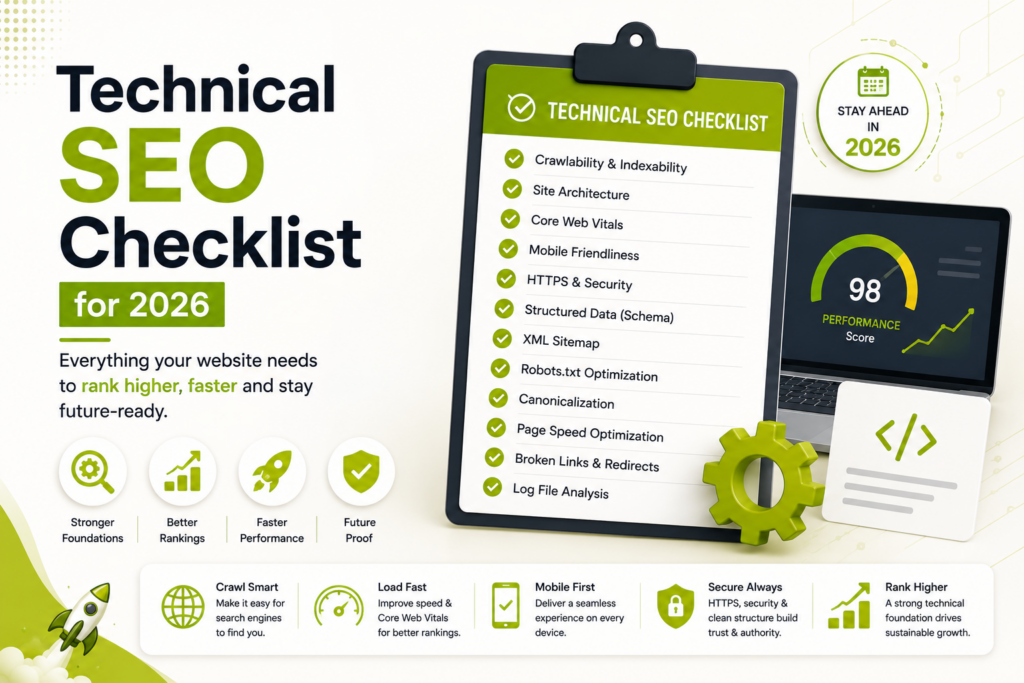
A page has to be discoverable before it’s crawlable, crawlable before it’s renderable, indexable before it can rank, and machine-readable before AI will cite it. This checklist follows that logic — in the exact order you should work it.
Quick answer
A complete 2026 technical SEO checklist covers nine areas, worked in dependency order: (1) crawlability & indexing, (2) rendering & JavaScript, (3) Core Web Vitals & speed, (4) mobile-first readiness, (5) site architecture & internal linking, (6) structured data, (7) HTTPS & hygiene, (8) AI-crawler readiness, and (9) analytics & monitoring. Fix indexability first — a page that’s blocked or noindexed can never rank — then crawl efficiency, then speed, then everything else. The two biggest 2026 shifts: INP is the interactivity metric (under 200ms), and structured data plus AI-crawler access now decide whether AI answer engines can cite you at all.
Technical SEO isn’t the exciting part of search marketing — nobody brags about their XML sitemap. But it’s the multiplier that makes everything else work: great content on a broken technical foundation is a Formula 1 engine on flat tires. Around a quarter of pages submitted in sitemaps are commonly excluded from Google’s index for technical reasons alone, and in 2026 there’s a second audience to satisfy — AI crawlers like GPTBot, ClaudeBot, and PerplexityBot now read your site alongside Googlebot, and most of them don’t run JavaScript. This checklist gets you clean for both. (For the business case behind all of this, see why businesses need technical SEO.)
How to use this checklist
Work top to bottom — the order reflects dependency, not convenience. Fixing schema before you fix indexing is polishing a page nobody can reach. Start with your highest-value URLs (service pages, product categories, key blog posts), re-crawl after each fix so you’re not chasing symptoms of a single root cause, and treat this as a quarterly cadence rather than a one-time project.
Step 1
Crawlability & indexing
Why it matters: if search engines and AI crawlers can’t discover, reach, and index a page, nothing else on this list can help it.
robots.txtexists at the root, returns a 200, and has no rules that unintentionally block entire sections or user-agents.- You are not blocking CSS or JS in robots.txt — that prevents Google from rendering pages correctly.
- XML sitemap is reachable, referenced in robots.txt, returns 200, and lists only canonical URLs you actually want indexed.
- No conflict between
noindexand canonical tags — contradicting signals are one of the most common silent indexation killers. - Duplicate entry points resolved: www vs non-www, HTTP vs HTTPS, trailing slashes, and URL parameters aren’t creating near-identical pages.
- Submitted sitemap URLs match what’s actually indexed in Search Console’s Page Indexing report (investigate “crawled – currently not indexed”).
- Key pages sit within about three clicks of the homepage; deeper pages get crawled and linked less.
- Log-file review (for larger sites) confirms which URLs Googlebot actually crawls versus what your sitemap claims exists.
Step 2
Rendering & JavaScript
Why it matters: Google renders JavaScript (with a delay), but most AI crawlers don’t execute it at all — so JS-dependent content is invisible to ChatGPT, Perplexity, and Claude.
- Primary content, headings, and links appear in the initial HTML (check “view source”, not just the rendered page).
- Server-side rendering or static generation is used for indexable routes (Next.js, Nuxt, Astro, etc. configured for SSR/SSG).
- Main navigation and footer links are crawlable without JavaScript execution.
- No critical content hidden behind
onClick— tabs, accordions, and “read more” render into the DOM, not on click. - Fetching key URLs as GPTBot / PerplexityBot user-agents returns the same core content Googlebot sees.
- Content-Security-Policy and other headers don’t block rendering resources (fonts, CSS, JS).
Step 3
Core Web Vitals & speed
Why it matters: Core Web Vitals are a confirmed ranking signal and a direct conversion lever — and after INP replaced FID, a large share of previously-passing sites now fail.
| Metric | Measures | 2026 target (75th pct, mobile) |
|---|---|---|
| LCP | Loading | ≤ 2.5s |
| INP | Interactivity | ≤ 200ms |
| CLS | Visual stability | ≤ 0.1 |
| TTFB | Server response | ≤ 800ms |
- Measured on real-user field data (CrUX / Search Console), not just lab tools like Lighthouse.
- Largest image above the fold is compressed, served as WebP/AVIF, and preloaded with
fetchpriority="high". - Long JavaScript tasks are broken up and non-critical scripts deferred to keep INP under 200ms.
- Explicit width/height (or reserved space) on all images, embeds, and ads to prevent layout shift.
For the full breakdown of causes and the commercial case, see why your website is slow and why website speed impacts sales.
Step 4
Mobile-first readiness
Why it matters: Google evaluates the mobile version of your site as the primary version, so mobile issues affect rankings everywhere.
- Content parity: the mobile version contains the same content, structured data, and links as desktop.
- Tap targets, font sizes, and spacing are comfortable on a phone; no horizontal scroll.
- Mobile passes the URL Inspection live test in Search Console with the DOM Google actually renders.
Step 5
Site architecture & internal linking
Why it matters: structure and internal links decide how crawl priority and authority flow to your most important pages.
- Shallow, logical hierarchy; revenue pages reachable from the main navigation.
- No orphan pages (every important URL has internal links pointing to it).
- Descriptive anchor text — not “click here” — so users and crawlers understand the destination.
- One primary keyword per URL; consolidate cannibalizing pages that compete for the same term.
- Clean URLs: short, lowercase, hyphen-separated, keyword-first (e.g.
/blog/technical-seo-checklist/).
Step 6
Structured data (schema)
Why it matters: schema has moved from “rich-result candy” to core infrastructure — it’s increasingly how AI engines decide what to cite.
- JSON-LD (not Microdata), validated in both the Schema.org validator and Google’s Rich Results Test with zero errors.
- Article/BlogPosting on content, with author as a structured entity plus
datePublishedanddateModified. - Product/Offer schema on commerce pages (price, availability, and review aggregates only where genuinely present).
- Organization/LocalBusiness and BreadcrumbList sitewide; FAQPage and HowTo where relevant (note: Google narrowed FAQ rich results in the SERP in late 2025, but the markup still helps AI citation).
- You never mark up ratings, reviews, or data you don’t actually have — that’s a risk, not a shortcut.
For store-specific schema and the faceted-navigation traps, see common eCommerce SEO mistakes.
Step 7
Security & hygiene
Why it matters: baseline trust and clean crawl paths — cheap to fix, costly to ignore.
- HTTPS enforced sitewide with a valid certificate and no mixed-content warnings (certificates are free via Let’s Encrypt).
- No broken links (404s) on important pages; internal links point to live, canonical URLs.
- Redirects are single-hop 301s — no multi-hop chains or redirect loops slowing users and crawlers.
- Custom 404 handling and deliberate 410s for genuinely removed content.
Step 8 · New for 2026
AI-crawler readiness (GEO)
Why it matters: answer engines now read your site to decide who to cite and recommend — a visibility channel that only grows.
- AI-crawler access is a deliberate choice: GPTBot, ClaudeBot, PerplexityBot, OAI-SearchBot, and Google-Extended are explicitly allowed (to be cited) or blocked — not left to default.
- Your CDN, WAF, or bot-protection isn’t blocking those crawlers by accident (a common silent GEO killer).
- Answer-first formatting: the core answer sits in the first sentence of each section so machines can extract it cleanly.
- Clean, semantic HTML with clear H1–H3 hierarchy and consistent entity/brand signals across pages.
- (Optional) An
llms.txtfile describing your business and key pages — low-cost, but still an unofficial, debated standard; don’t prioritize it over schema and clean HTML.
To go deeper on being cited, see ranking in AI Overviews and optimizing for ChatGPT, or hand it to our GEO and LLM SEO teams.
Step 9
Analytics & monitoring
Why it matters: you can’t protect what you don’t watch — technical SEO is a system you maintain, not a task you finish.
- Google Search Console and analytics are set up, with conversion tracking that ties SEO to revenue.
- AI-referred traffic is separated out so you can see the channel growing (how to track AI referral traffic in GA4).
- Automated alerts fire when Core Web Vitals slip, crawl errors spike, or index coverage drops.
- A full audit runs quarterly, plus immediately after any redesign, migration, or platform change.
If flat rankings are the reason you’re here, this checklist is the foundation — but strategy matters too; see why SEO isn’t working and build on a solid SEO program.
Frequently asked questions
What are the most important technical SEO factors in 2026?
In priority order: crawlability and indexing, rendering and JavaScript reliability, Core Web Vitals and speed, mobile-first readiness, architecture and internal linking, structured data, HTTPS and hygiene, AI-crawler readiness, and analytics. Fix them in that dependency order, not by whichever is easiest.
What are the Core Web Vitals thresholds for 2026?
LCP under 2.5s, INP under 200ms, and CLS under 0.1 on real users at the 75th percentile on mobile, with TTFB under about 800ms. INP replaced First Input Delay in March 2024 and is the metric most sites now fail.
Should I allow or block AI crawlers like GPTBot?
It’s a deliberate decision, not a default. Allowing GPTBot, ClaudeBot, PerplexityBot, and Google-Extended is the first step to being cited in AI answers; blocking them protects content but forfeits that visibility. The real mistake is leaving it to accident — confirm your CDN or WAF isn’t blocking them unknowingly.
Do I need an llms.txt file?
It’s optional and debated. llms.txt is an emerging, unofficial standard for describing your business to AI crawlers, but there’s no confirmation major systems rely on it and it doesn’t control crawlers like robots.txt does. Low-cost to add, but valid schema, clean HTML, and answer-first content matter far more.
How often should I run a technical SEO audit?
Quarterly at minimum, with monthly monitoring of Core Web Vitals, crawl stats, and index coverage during heavy growth — and always a fresh audit right after a redesign, migration, or platform change, when regressions are most likely.
Working through this manually means cross-referencing Search Console, a crawler, PageSpeed data, and a schema validator — before you’ve even prioritized anything. Get a free audit and we’ll flag your crawlability, Core Web Vitals, schema, and AI-readiness issues, ranked by impact.

Riya Bhardwaj
Leading content and growth initiatives with a focus on search visibility, audience engagement, and measurable business outcomes. Specialised in SEO, Generative Engine Optimization (GEO), AI search optimisation, and performance-driven content marketing. Passionate about transforming market insights into scalable content strategies that strengthen brand authority and drive sustainable digital growth.