
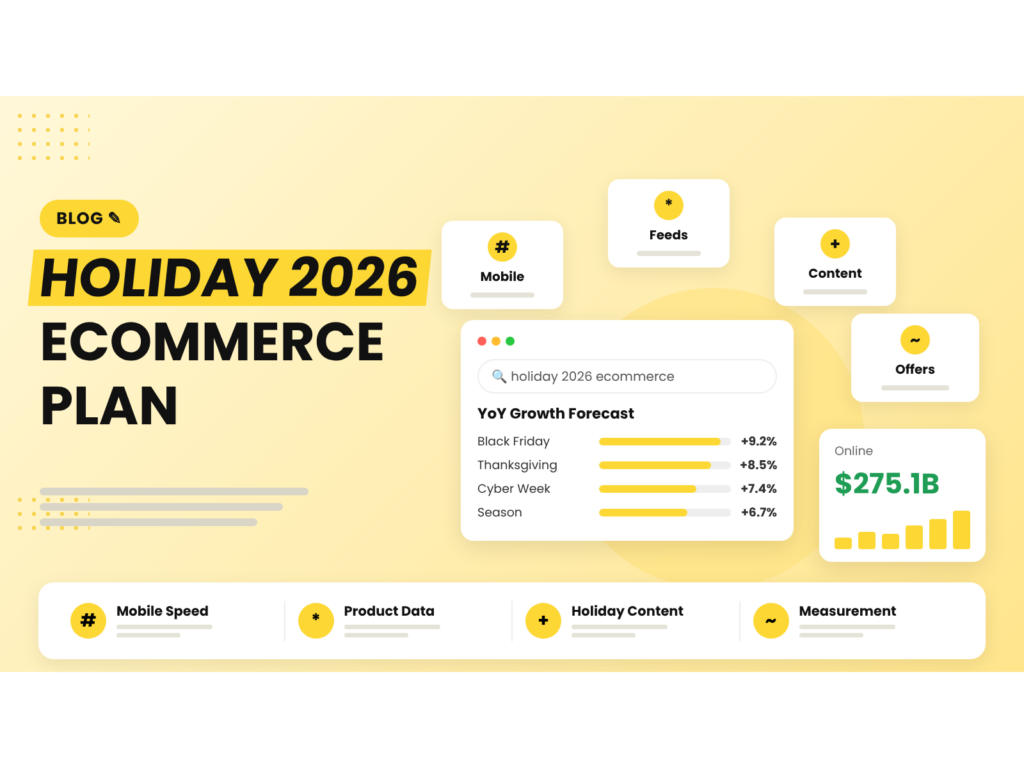
Cyber Monday 2026 falls on 30 November, which means ecommerce brands have roughly five weeks to get ready. Adobe’s holiday forecast, released in late September, expects U.S. online sales between 1 November and 31 December to reach a record $275.1 billion, up 6.7% on last year. It also shows where the growth is: mobile, buy now pay later and traffic coming from AI tools. This plan turns those numbers into actions.
Quick answer: Adobe forecasts $275.1 billion in U.S. online holiday sales (up 6.7%), with Cyber Week at $47.5 billion and AI-driven traffic to retail sites up 130% year on year. Use the next five weeks to fix mobile speed and checkout, clean your product feeds, prepare content AI tools can cite, plan promotions around Black Friday and Cyber Monday, and set measurement before traffic arrives.
The numbers that matter
These are Adobe’s forecast figures for U.S. online spend, so adjust for your own market. Total season spend (1 November to 31 December) is projected at $275.1 billion, up 6.7%. Cyber Week, from Thanksgiving to Cyber Monday, is projected at $47.5 billion, up 7.4%. Cyber Monday itself is forecast at $15.1 billion, up 6.2%, and Black Friday at $12.9 billion, up 9.2%, the fastest-growing of the major days.
Mobile is expected to account for 57.4% of season spend. Buy now pay later is forecast at $21.3 billion for November and December, up 6.6%, with mobile making up 82% of that. Discounts are expected to reach up to 30% during Cyber Week, peaking in electronics. Finally, traffic to U.S. retail sites from AI tools is forecast to be up 130% year on year, with the biggest jump on Thanksgiving at 159%.
What this means for you
Three themes stand out. Shoppers are mobile first, so a slow or awkward mobile checkout is expensive. Flexible payment is mainstream, so showing options early helps. And AI tools are becoming a real source of visits, so product data and content need to be readable by them. See our guide to agentic commerce for how AI shopping agents choose products.
A five-week plan
Week 1: Fix the basics
Test your site on a mid-range phone on mobile data. Check page speed, product pages and checkout steps. Fix broken links, out-of-stock handling and slow images before spending more on traffic.
Week 2: Clean your product data
Review titles, descriptions, prices, availability, shipping and returns information in your feeds and on your pages. Accurate, consistent data helps shopping ads and AI tools alike.
Week 3: Build content that answers holiday questions
Publish gift guides, comparison pages, delivery cut-off dates and returns policies in plain text. Add FAQs. These pages help search and AI answers, and they reduce support questions.
Week 4: Plan offers and payments
Decide your discount depth by product margin, not by what rivals do. Show buy now pay later options and delivery dates early on the product page. Set up email and SMS sequences for early access, reminders and abandoned carts.
Week 5: Set up measurement and run a final test
Confirm tracking for purchases, revenue, new versus returning customers and channel. Place a test order on mobile. Brief your team on who watches what each day. Our guide on AI search visibility tracking can help you watch for AI-driven traffic.
During the peak
Check stock, site speed and ad spend daily. Move budget towards what is converting, and keep one person responsible for customer messages. After the season, export your data and note what worked while it is fresh.
Frequently asked questions
What is Adobe's 2026 U.S. holiday online sales forecast?
Adobe forecasts $275.1 billion in U.S. online sales from 1 November to 31 December 2026, up 6.7% on last year.
When are Black Friday and Cyber Monday in 2026?
Cyber Monday is on 30 November 2026. Adobe forecasts $15.1 billion for Cyber Monday and $12.9 billion for Black Friday.
How important is mobile this season?
Adobe expects mobile to make up 57.4% of season online spend, so mobile speed and checkout quality should be a top priority.
Why is AI traffic mentioned in the forecast?
Adobe forecasts traffic to U.S. retail sites from AI tools to be up 130% year on year, so product data and content should be easy for AI tools to read.
Do these figures apply outside the U.S.?
No. They are U.S. forecasts. Use them as a guide to trends and check local data for your own market.
We design programmatic SEO systems with the data, templates and quality controls needed to grow long-tail traffic safely — without risking a scaled content penalty.

Riya Bhardwaj
Leading content and growth initiatives with a focus on search visibility, audience engagement, and measurable business outcomes. Specialised in SEO, Generative Engine Optimization (GEO), AI search optimisation, and performance-driven content marketing. Passionate about transforming market insights into scalable content strategies that strengthen brand authority and drive sustainable digital growth.