

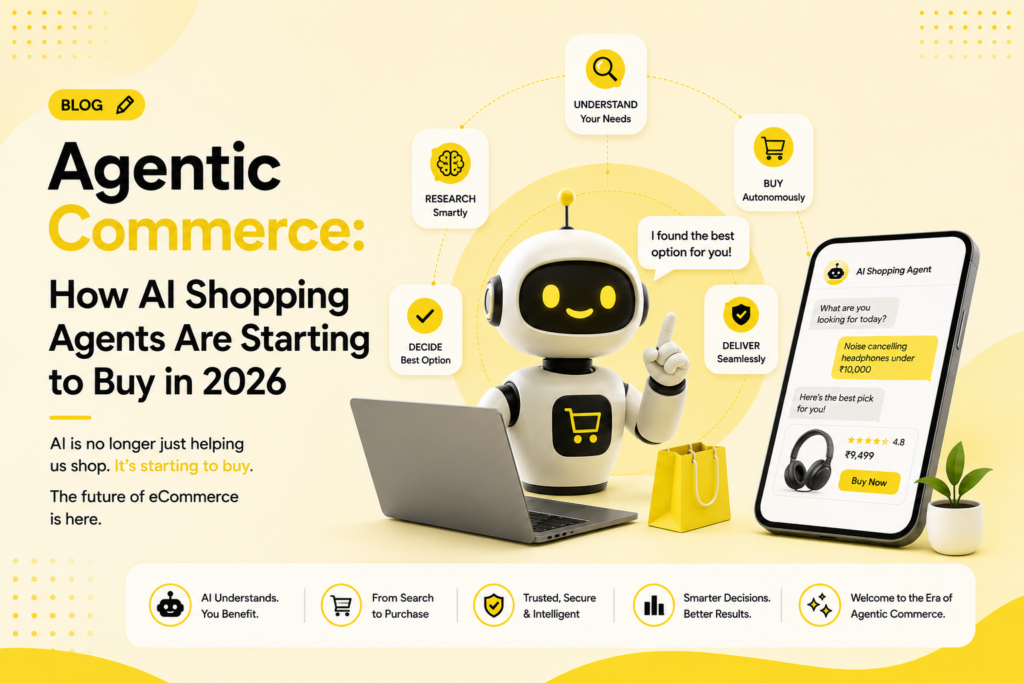
An estimated 63.3 million US consumers are expected to use AI platforms for shopping this year, and in the 2025 holiday season, AI already influenced roughly one in five global retail sales — mostly through customer service, not yet through agents completing purchases on their own. That’s changing fast. Google, OpenAI, and Perplexity are all racing to let an AI assistant browse, decide, and check out on a shopper’s behalf. Here’s where that race actually stands, and what it means if you sell online.
Quick answer: “Agentic commerce” means an AI assistant completing part or all of a purchase for a shopper — not just recommending a product. Google has added checkout inside AI Mode and Gemini using Google Pay (with PayPal support coming), built around the Universal Commerce Protocol (UCP) with Shopify, Etsy, Walmart, and Target. OpenAI is pushing ChatGPT toward in-chat checkout but is reportedly still working through real-time inventory and pricing accuracy. Perplexity is gaining traction for commerce-adjacent queries. Amazon’s “Buy for Me” agent drew complaints over mismatched AI-generated listings during the last holiday season. An estimated 63.3 million US shoppers are projected to use AI platforms to shop this year — the opportunity is real, but the experience is still uneven.
Most coverage of agentic commerce treats it as either inevitable revolution or overhyped vaporware. The realistic middle ground: it’s real, it’s early, and most of the current value is in discovery and customer service — not agents autonomously completing checkout at scale yet.
What to actually do about agentic commerce right now
Make sure your product data is AI-legible. Agents summarize what they’re given. Thin titles and missing attributes produce vague, unconvincing AI answers about your products — the same discipline behind good Google AI Overviews visibility.
Don’t build a single-platform strategy. Google, OpenAI, and Perplexity all have different technical approaches and different levels of checkout maturity. A standard like UCP is designed precisely so you don’t have to pick one winner early.
Track AI referral traffic separately. If you can’t currently distinguish an AI-agent referral from generic direct traffic in GA4, you can’t measure whether any of this is working — see how to track AI referral traffic in GA4.
Treat customer service as the current battleground, not checkout. Most of 2025’s AI holiday influence came from service interactions, not autonomous purchases — that’s the layer worth investing in first.
Who’s doing what in agentic commerce
| PLATFORM | WHAT IT DOES | WHERE IT STANDS |
|---|---|---|
| Google AI Mode / Gemini | Checkout inside AI Mode and Gemini via Google Pay, with PayPal support coming; Direct Offers and a Business Agent for customer service | Furthest along on live checkout; built on the open Universal Commerce Protocol |
| Universal Commerce Protocol (UCP) | Open standard for AI agents to browse, cart and check out across platforms | Co-developed by Google and Shopify; backed by Etsy, Walmart, Target and others |
| ChatGPT (OpenAI) | Pushing toward in-chat checkout | Reportedly still resolving real-time inventory and pricing accuracy issues |
| Perplexity | Commerce-adjacent answers and product research | Gaining traction for research and discovery rather than full checkout |
| Amazon “Buy for Me” | AI agent purchases on a shopper’s behalf within Amazon | Drew complaints over mismatched AI-generated listings during the 2025 holiday season |
Why this is happening now
Every major AI platform has the same problem: users increasingly ask shopping questions inside a chat interface, and whoever can close the loop from question to purchase without sending the user elsewhere captures the transaction. Google’s answer is checkout built into AI Mode and Gemini, on an open protocol it developed with Shopify rather than a closed system — a bet that broad merchant participation matters more than owning the entire stack.
The gap between the pitch and the experience
OpenAI’s reported struggles with real-time inventory and pricing accuracy in ChatGPT, and the complaints around Amazon’s “Buy for Me” agent generating mismatched listings during the 2025 holidays, both point to the same unresolved problem: an AI agent is only as good as the product data and inventory feed behind it. This is a data-quality problem before it’s an AI problem — the same lesson we cover in optimizing your website for ChatGPT.
Where the real volume is today
Of the 20% of 2025 global holiday retail sales AI reportedly influenced, most of that was customer service — answering questions, resolving hesitation, guiding comparison — not agents autonomously placing orders. That’s the layer with real, measurable traffic today, even while the checkout-completing-agent story is still maturing.
What smaller merchants can do that platforms can’t force
You don’t need to wait for a platform decision to benefit from this shift. Clean, structured, accurate product data helps you today in traditional search, and positions you correctly for whichever AI shopping platform ends up mattering most in your category — without requiring you to bet on one now.
The honest part: what the hype skips over
- 63.3 million is a forecast, not a settled fact. Adoption projections for a fast-moving category are directional, not precise — useful for gauging scale, not for exact planning.
- “20% of holiday sales AI-influenced” mostly means customer service. It’s easy to read that stat as “AI agents are already buying for people” — the reporting is clear that most of that influence was pre-purchase assistance, not autonomous checkout.
- Inventory accuracy is an unsolved, unglamorous problem. The gap between “AI can browse your catalog” and “AI can reliably tell a shopper what’s actually in stock at what price” is exactly where agents currently break down.
- Standards adoption takes time. UCP being backed by major names doesn’t mean universal, high-quality implementation happens quickly — early participants often have the roughest experience.
What this means for your business
For a growing business — in India or anywhere else — the sensible move isn’t rushing to build for a hypothetical fully-autonomous AI shopper. It’s making sure your product and content data is clean and specific enough that any AI system, agentic or not, represents you accurately, and putting real measurement behind the AI referral traffic you’re already getting. That’s infrastructure work that pays off regardless of which platform wins the agentic commerce race, and it’s exactly what we help ecommerce and content clients build — structured data, GEO-ready content, and reporting that actually separates this channel from the rest.
Frequently asked questions
What is agentic commerce?
Agentic commerce is an AI assistant completing part or all of a purchase on a shopper’s behalf — browsing, comparing, adding to cart, and checking out — rather than just answering questions or recommending products.
Can ChatGPT actually complete a purchase right now?
Not reliably at full scale yet. OpenAI is pushing ChatGPT toward in-chat checkout, but is reportedly still resolving real-time inventory and pricing accuracy, which limits how much can be trusted to complete automatically today.
What is the Universal Commerce Protocol (UCP)?
UCP is an open standard for how AI agents browse, cart, and check out across commerce platforms. Google co-developed it with Shopify, and it’s backed by Etsy, Walmart, Target and others — aimed at avoiding a separate integration per AI platform.
How many people are actually shopping through AI right now?
An estimated 63.3 million US consumers are projected to use AI platforms for shopping this year, and AI reportedly influenced about 20% of global retail sales during the 2025 holiday season — mostly through customer service rather than autonomous checkout.
Should my business build for AI shopping agents today?
Focus on the fundamentals first: clean, structured, accurate product data and content. That helps regardless of which AI shopping platform ends up mattering most, and it’s far lower-risk than building a bespoke integration for one platform today.
How do I know if AI agents are already sending me traffic?
Check GA4 for AI platform referrals specifically, rather than lumping that traffic into “Direct” or “Organic.” If you can’t currently isolate it, that’s usually a tracking setup issue, not proof it isn’t happening.
The platforms are still working out checkout. Your product data and content don’t have to wait — clean, structured, AI-legible data helps in traditional search today and positions you for whichever agentic platform matters most in your category.

Riya Bhardwaj
Leading content and growth initiatives with a focus on search visibility, audience engagement, and measurable business outcomes. Specialised in SEO, Generative Engine Optimization (GEO), AI search optimisation, and performance-driven content marketing. Passionate about transforming market insights into scalable content strategies that strengthen brand authority and drive sustainable digital growth.