

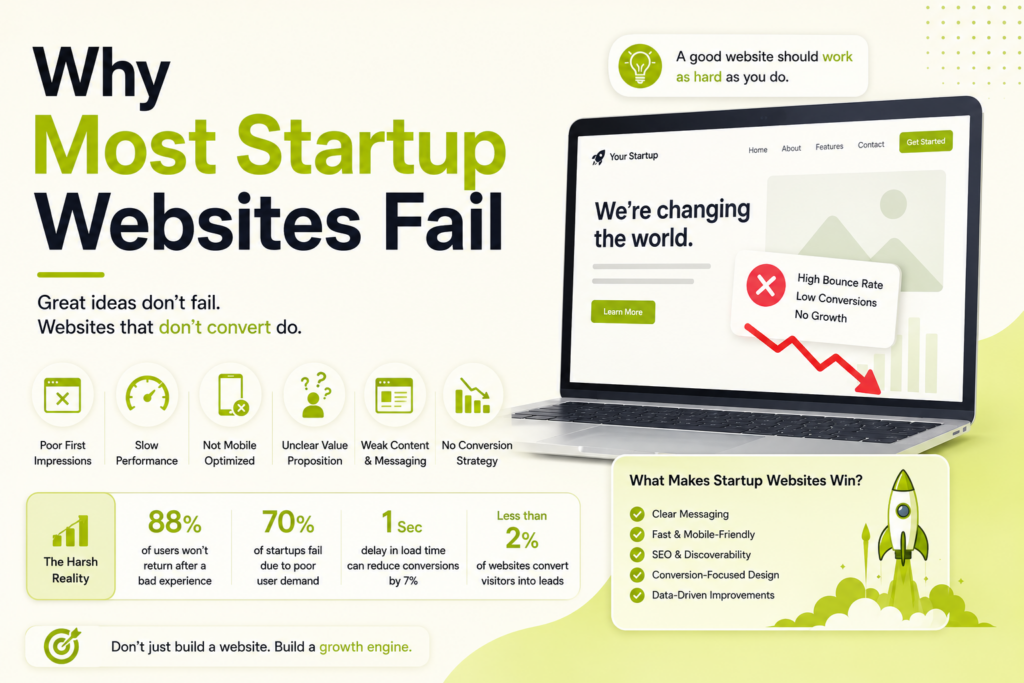
A startup’s website is the first real test of its positioning — and the asset investors, customers, and partners judge hardest. Most fail not because of bad code, but because of the same strategic gaps that sink startups themselves.
Quick answer
Most startup websites fail because of strategy, not technology. The recurring causes are: unclear positioning (visitors can’t tell what you do or who it’s for within seconds), messaging written for founders and investors instead of users, feature-dumping instead of selling outcomes, no traffic or SEO plan (“build it and they will come”), no clear conversion path, missing trust and social proof, slow or over-engineered builds, launching and never iterating, and being invisible in AI search. These mirror the biggest startup killers overall — marketing and messaging failures account for the majority of startup deaths, far more than product or funding alone. Fix positioning and the conversion path first.
Founders obsess over the product and treat the website as a box to tick before launch. But the site is where a stranger decides, in seconds, whether your startup is worth their time, money, or attention. And the data is unforgiving: research consistently finds that marketing-related causes — unclear positioning, weak messaging, and go-to-market gaps — drive a larger share of startup failures than product, funding, or team problems combined. The classic finding that ~42% of startups fail from “no market need” is, more often than not, a messaging and audience-targeting failure in disguise. Your website is where that failure becomes visible first.
Here are the nine reasons most startup websites fail — and how to fix each.
The 9 reasons most startup websites fail
- Unclear positioning — the 5-second test failure
A visitor should know what you do, who it’s for, and why it’s better within about five seconds. Most startup homepages fail this instantly, leading with a vague tagline like “reimagining the future of work” that could belong to a thousand companies. Clarity beats cleverness every time. If a first-time visitor can’t repeat your value proposition back to you, nothing else on the page matters. - Written for founders and investors, not users
Startup sites are often stuffed with insider jargon and buzzwords — “revolutionary AI-powered synergy platform” — that impress a pitch deck but confuse an actual customer. Users don’t care what you built; they care what it does for them. Write in your customer’s language, about your customer’s problem. - Feature-dumping instead of selling outcomes
Listing every feature you shipped is not a value proposition. Buyers convert on outcomes — time saved, money made, pain removed — not on a specifications list. Lead with the result, then let features support it as proof. - “Build it and they will come” — no traffic plan
A beautiful site nobody can find generates nothing. Many founders launch and simply wait, with no plan for organic search, content, or paid acquisition. SEO compounds over months, so starting early means traffic builds while you still have runway — see why SEO isn’t working for the strategy traps to avoid, and build on a real SEO foundation rather than hoping. - No clear conversion path
Traffic without conversion is wasted spend. Startup sites often bury the call to action, offer ten competing next steps, or ask for too much too soon. Every key page needs one obvious action. This is the exact discipline behind why websites fail to generate leads — and it’s usually the fastest win available. - No trust or social proof
New companies have no reputation yet, so the website has to manufacture credibility: real testimonials, recognizable logos, case studies, security badges, a genuine team page. A site with none of this reads like a ghost town, and nobody hands their email or card to a ghost town. A visible, active brand presence — reinforced through social media marketing — makes converting feel safe. - Slow, over-engineered, or not mobile-first
Founders love to over-build — heavy animations, bloated frameworks, clever effects — at the cost of speed. Around 53% of visitors abandon a page that takes more than three seconds to load, and most of your traffic is mobile. Speed is a revenue lever, not a nice-to-have; see why website speed impacts sales and why your website is slow, both grounded in the technical SEO foundation every site needs. - Launch-and-forget — no iteration or measurement
Too many startups ship the site once and never touch it again, flying blind with no analytics on where visitors drop off. Winning founders launch a clear v1 and then iterate continuously on real data — what RCKT aptly calls avoiding “random acts of marketing.” Set up proper tracking, including the growing slice of visitors from AI tools (how to track AI referral traffic in GA4). - Invisible in AI search
Early adopters — exactly the audience startups need — increasingly research and compare tools inside ChatGPT, Perplexity, and Google’s AI Overviews before visiting any website. If your startup isn’t structured to be cited there, you’re cut from the shortlist before the site even loads. Learn to earn placement in AI Overviews and shape how assistants describe you (optimizing for ChatGPT); our GEO and LLM SEO services are built for this.
Quick diagnosis: which failure is yours?
The symptom usually points straight to the cause:
| Symptom | Most likely cause |
|---|---|
| Symptom Most likely cause Visitors leave in seconds | Unclear positioning or slow load |
| Traffic is fine, signups aren't | Weak conversion path or missing trust |
| Almost no traffic at all | No SEO / traffic plan; invisible in search & AI |
| People "don't get" what you do | Founder-speak messaging, feature-dumping |
| Growth stalled after launch | Launch-and-forget; no iteration or analytics |
How to build a startup website that actually works
- Nail positioning first. One clear sentence: what it is, who it’s for, why it’s better. Everything else follows from this.
- Sell outcomes, in the customer’s language. Lead with the result; use features as proof.
- Design one obvious conversion path per page, asking for the minimum commitment that moves the relationship forward.
- Build credibility deliberately
with real proof — testimonials, logos, case studies, a human team. - Make it fast and mobile-first, and get findable across both search and AI.
- Measure and iterate. Ship a clear v1, watch the data, and improve continuously.
If you’re a founder building an online store rather than a SaaS or service, the same principles apply with extra weight on economics and conversion — see why Shopify stores fail and common eCommerce SEO mistakes.
Frequently asked questions
Why do most startup websites fail?
Because of strategy, not code — unclear positioning, founder-focused messaging, feature-dumping, no traffic plan, no conversion path, missing trust signals, slow builds, launching without iterating, and invisibility in AI search. These mirror the messaging and go-to-market gaps that sink startups themselves.
What makes a good startup website?
One that makes what you do, who it’s for, and why it’s better instantly clear, then guides the visitor to a single obvious action — loading fast on mobile, proving credibility with real social proof, findable in search and AI, and iterated based on real behavior rather than launched and forgotten.
How important is a website for a startup?
It’s often the first real test of your positioning and the asset customers, investors, and partners scrutinize most. Since marketing and messaging failures cause a large majority of startup deaths, a site that can’t communicate value and convert is a direct threat to traction.
Should a startup invest in SEO early?
Yes. SEO compounds over months, so starting early means organic traffic builds while you’re still running paid channels. Relying solely on ads means renting all your traffic; layering SEO underneath creates durable, lower-cost acquisition for when runway matters most.
Does my startup website need to be perfect at launch?
No — but it must be clear, fast, and conversion-focused. The bigger mistake than an imperfect launch is treating the site as finished. Launch a clear v1 and iterate continuously on analytics and user feedback.
Most startup website problems are diagnosable in an afternoon — positioning, conversion path, speed, and search visibility. Get a free audit and we’ll show you exactly where your site is losing signups, and how to fix it before it costs you runway.

Riya Bhardwaj
Leading content and growth initiatives with a focus on search visibility, audience engagement, and measurable business outcomes. Specialised in SEO, Generative Engine Optimization (GEO), AI search optimisation, and performance-driven content marketing. Passionate about transforming market insights into scalable content strategies that strengthen brand authority and drive sustainable digital growth.