

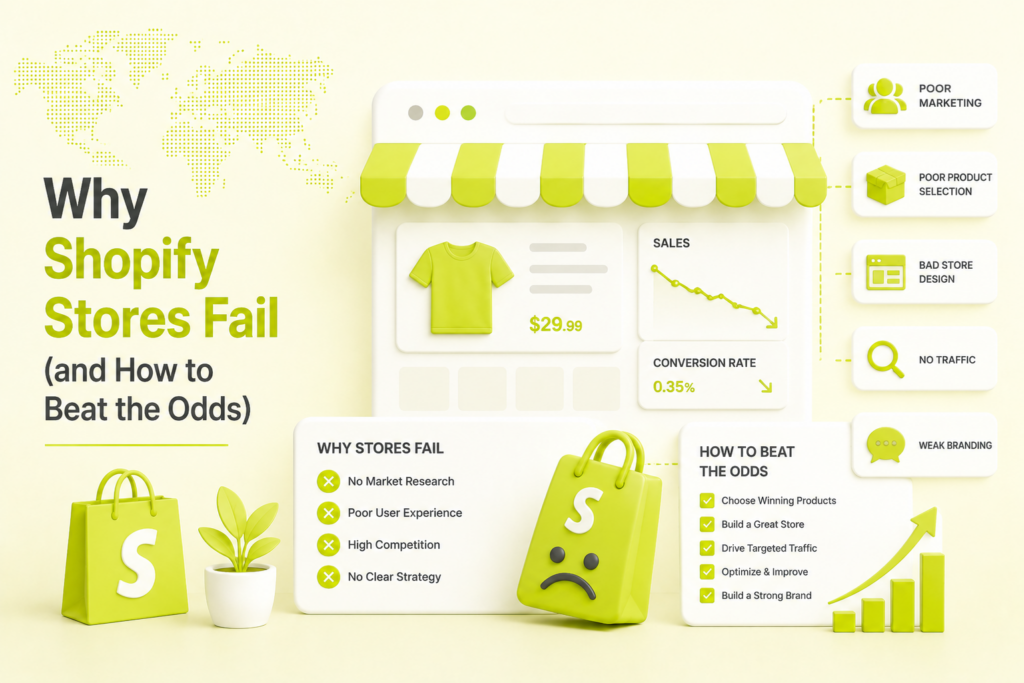
Shopify removed almost every technical barrier to launching a store — which is exactly why so many fail. The platform is rarely the problem. Here’s what actually is, and how to fix it.
Quick answer
Only about 5–10% of Shopify stores reach lasting profitability — but they rarely fail because of Shopify. They fail for predictable, fixable reasons: no traffic (“build it and they will come”), weak product-market fit or a saturated niche, broken unit economics where customer acquisition cost exceeds customer value, poor conversion and heavy cart abandonment (the global average is over 70%), over-reliance on paid ads with no organic or brand foundation, no customer retention, flying blind without tracking key metrics, and — increasingly in 2026 — being invisible across search and AI. Fix the economics and the funnel before you spend another rupee on ads.
If you’ve spent any time on YouTube or TikTok, you’ve heard that opening a Shopify store is a cheat code for passive income. The data says otherwise. Industry estimates consistently put long-term Shopify profitability at roughly 5–10% of stores. But here’s the part that should actually encourage you: that failure rate is almost identical across every ecommerce platform, and it’s broadly in line with general small-business survival — U.S. Bureau of Labor Statistics data shows only about a third of new businesses survive a decade. In other words, this isn’t a Shopify problem. It’s a business problem, and business problems can be diagnosed and fixed.
At Nowoka Digital, the failure patterns repeat across stores and niches. Here are the nine that matter most.
The 9 real reasons Shopify stores fail
- “Build it and they will come” — no traffic plan
The most common killer. Founders pour weeks into the theme and product photos, launch, and wait for sales that never come because nobody knows the store exists. A store with no traffic strategy is a shop in a desert. You need a real plan for organic search, paid acquisition, and social — starting with ecommerce SEO so buyers find you when they search for what you sell. And no, the answer isn’t to skip search because “AI killed it” — see whether SEO is dead in 2026. - Weak product-market fit or a saturated niche
Chasing a “winning product” you saw go viral usually means entering a bidding war against 50 other stores selling the same item with the same ad creative. Trends fade; validated demand and a clear audience don’t. Successful stores start with a specific customer and a genuine unique value proposition, not a random trending gadget. - Broken unit economics (CAC > customer value)
This is the silent bankruptcy. If your customer acquisition cost plus product cost, shipping, and fees exceeds your average order value — and your repeat-purchase rate is too low to recover the loss — you lose money on every sale, and scaling ads only speeds up the bleeding. With acquisition costs rising sharply in recent years, the math has to work before you scale. Get your paid channels run against real ROAS targets with managed PPC and paid advertising. - A slow, clunky, non-mobile store
Around 79% of Shopify traffic and roughly 69% of orders come from smartphones — yet many stores are still built desktop-first with bloated themes and heavy apps. Slow, hard-to-use mobile stores bleed conversions and rankings at the same time. Fix speed and mobile experience as a priority (see why your website is slow), often with dedicated technical SEO. - Poor conversion and heavy cart abandonment
The average Shopify store converts at around 2–3%, and the global cart abandonment rate is over 70%. The usual culprits are unexpected costs at checkout, forced account creation, and product pages missing reviews, clear shipping times, and return policies. This is the same conversion discipline behind why websites fail to generate leads — traffic without conversion is just expensive window-shopping. A store audit pinpoints exactly where the funnel leaks. - Total dependence on paid ads
Renting all your traffic is fragile. When ad costs rise or an account gets restricted, revenue vanishes overnight. Durable stores blend paid with owned and earned channels — organic search, an engaged social community via social media marketing, email, and content — so no single channel can sink the business. - No retention — every sale starts from zero
Acquisition is expensive; repeat customers are where margin lives. Stores that never build email/SMS flows, post-purchase sequences, or loyalty incentives have to re-buy every customer at full price. Retention-focused stores survive at a far higher rate precisely because they maximize lifetime value instead of chasing endless new clicks. - Flying blind — not tracking the numbers
Many owners operate on vibes, never watching add-to-cart rate, checkout abandonment, conversion by device, or ROAS. You can’t fix a funnel you can’t see. Set up proper analytics and conversion tracking — and separate out the growing slice of buyers arriving from AI tools, using how to track AI referral traffic in GA4. - Invisible in the new AI shopping era
Shoppers increasingly research and compare inside ChatGPT, Google AI Overviews, and other assistants before they ever reach a store. If your brand and products aren’t structured to be cited there, you’re cut from the shortlist silently. Learn to earn placement in Google’s AI Overviews and to shape how assistants describe you (optimizing for ChatGPT); for done-for-you help, see our GEO services and LLM SEO services. This is the same structural shift covered in why SEO isn’t working.
The benchmarks every Shopify owner should know
If your numbers fall short of these, you’ve found a leak worth fixing:
| Metric | Typical benchmark | What it tells you |
|---|---|---|
| Conversion rate | ~2–3% (top stores 4%+) | Funnel & trust health |
| Cart abandonment | ~70%+ globally | Checkout friction & cost surprises |
| Mobile share of traffic | ~79% | How mobile-first you must be |
| Long-term profitability | ~5–10% of stores | How much execution matters |
| Unit economics | AOV > CAC + COGS + shipping + fees | Whether you profit per order |
How to tell why your store is failing
Diagnose before you spend. The symptom usually points to the cause:
- Little or no traffic → visibility problem: SEO, paid, social, and AI-search presence.
- Traffic but no sales → conversion problem: page speed, mobile UX, trust signals, checkout friction.
- Sales but no profit → unit-economics problem: CAC, margins, and repeat rate.
- Good first orders, no repeat buyers → retention problem: email/SMS, loyalty, post-purchase flows.
How to beat the odds (in priority order)
- Validate demand and a specific audience before scaling — build a brand, not a random product page.
- Make the math work. Confirm AOV covers CAC, COGS, shipping, and fees, with a realistic repeat rate.
- Fix the mobile funnel. Speed, clean product pages, trust signals, and a frictionless checkout.
- Diversify traffic. Layer SEO and content under your paid ads so you’re not renting every visitor.
- Get visible in AI search so you’re recommended where buyers now research.
- Invest in retention — email, SMS, and loyalty compound margin over time.
- Track everything and let the data, not hype, decide where you double down.
Frequently asked questions
Why do most Shopify stores fail?
Because of strategy and execution, not the platform. The common causes are no traffic, weak product-market fit, broken unit economics where acquisition cost exceeds customer value, poor conversion and cart abandonment, over-reliance on paid ads, no retention, and operating without tracking key metrics — all predictable and fixable.
What percentage of Shopify stores are successful?
Industry estimates consistently put long-term profitability at roughly 5–10% of stores. This isn’t unique to Shopify — the rate is similar across ecommerce platforms and in line with small-business survival data, where only about a third of new businesses survive a decade.
Why is my Shopify store getting traffic but no sales?
That almost always signals a conversion, trust, or friction problem, not a product problem. The global cart abandonment rate is over 70%, driven by unexpected costs at checkout, forced account creation, slow mobile load times, and product pages missing reviews, shipping clarity, and return policies.
How long does it take for a Shopify store to become profitable?
It varies, but most sustainable stores take several months to a year to reach consistent profitability, and usually need budget for testing plus time to build organic traffic and repeat customers. Founders who expect profit in weeks tend to quit before the store has a fair chance.
Is Shopify still worth it in 2026?
Yes. Shopify remains one of the strongest ecommerce platforms and keeps growing. The low odds reflect how easy it is to start a store versus how hard it is to run a real business — success comes down to product-market fit, sustainable economics, visibility across search and AI, and retention.
Most Shopify failures are diagnosable long before the money runs out. Get a free store audit and we’ll pinpoint whether your problem is traffic, conversion, unit economics, or AI-search visibility — then hand you a prioritized plan to fix it.

Riya Bhardwaj
Leading content and growth initiatives with a focus on search visibility, audience engagement, and measurable business outcomes. Specialised in SEO, Generative Engine Optimization (GEO), AI search optimisation, and performance-driven content marketing. Passionate about transforming market insights into scalable content strategies that strengthen brand authority and drive sustainable digital growth.