

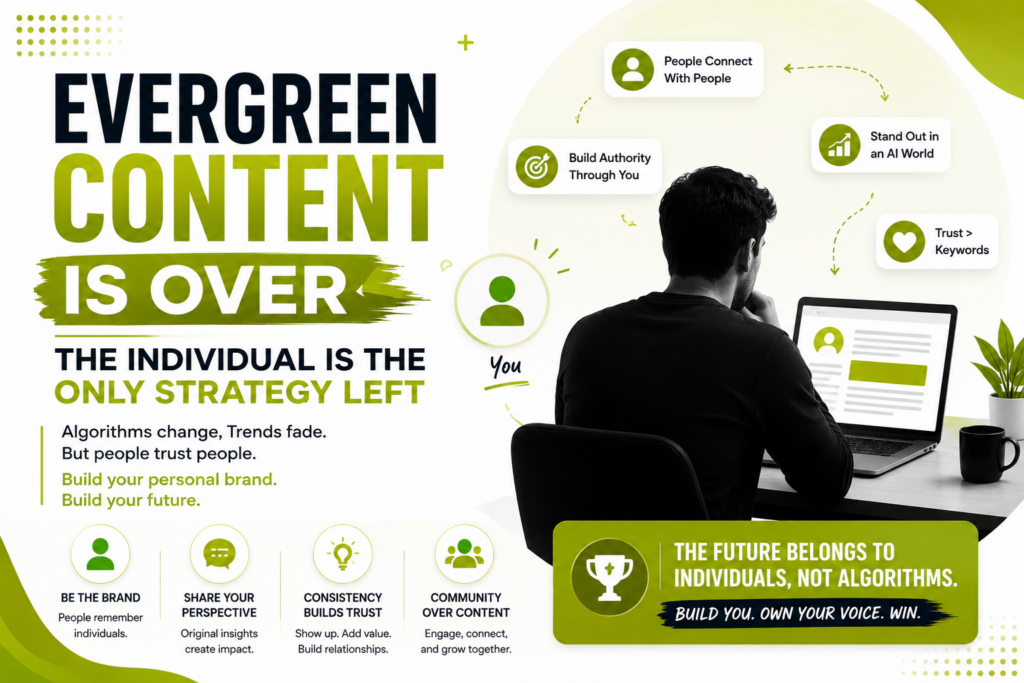
A provocative thesis is spreading through the search world: AI has stripped commodity content of its moat, and what’s left is expertise, direct audiences, and being the source. Here’s the argument — and where it goes too far.
Quick answer
The argument goes like this: AI can now assemble and summarize any “commodity” content — anything built from publicly available information — which strips generic, keyword-first evergreen content of its value. What survives is “non-commodity” content: things you’ve actually done, know firsthand, or hold a real, expert opinion about. But that content doesn’t come with the built-in distribution keyword content used to, so the winning strategy pairs expertise-as-the-product with a direct audience — subscribers, followers, people who search for you by name. The honest caveat: “evergreen is over” is a provocation. Evergreen created just for SEO is what’s dying; genuinely useful, experience-rich content still works, and brands still have scale individuals can’t match. The real shift is that trust is moving from brands to people.
The most interesting work in search and publishing right now isn’t coming from the big brand titles — it’s coming from individuals. That observation has hardened into a thesis making the rounds in the SEO world: evergreen content is over, and the individual is the only strategy left. It’s deliberately overstated, but the pressure behind it is real. Let’s take the argument seriously, then pressure-test it, then make it useful for an actual business.
The split that changed everything: commodity vs non-commodity content
The core idea is a division. On one side sits commodity content — anything an AI can assemble from public information. Generic “what is X” explainers, definitions, listicles, the how-to posts that made up most of the SEO content ever published. On the other sits non-commodity content — material that requires you to have actually done something, to know something firsthand, or to hold a genuine opinion grounded in expertise.
AI Overviews and answer engines devastate the first category almost by definition. As Duane Forrester has put it, content that can be fully replaced by a summary has no moat — the summary becomes the product, and your page becomes raw material a system processes and discards. Google’s own Danny Sullivan has drawn the same line, describing non-commodity content as unique, specific, and authentic, and commodity content as generic and replicable. When both Google and its critics agree on the distinction, it’s worth listening.
If your page can be replaced by a two-sentence summary, you were never the destination — you were the training data.
Why "just show expertise" isn't enough — the distribution problem
Here’s the part most “create great content” advice skips. Keyword-first content came with a distribution model built in: rank for the term, get the traffic. Expertise content doesn’t. You can write the most insightful, experience-rich piece in your industry and it can sit unread, because the old pipe — informational search traffic — is being intercepted by the machine.
So the argument’s real conclusion isn’t just “be more expert.” It’s that publishing now requires a direct audience: newsletter subscribers, followers, members, people who come looking for you by name. This is why the migration to newsletters and the death of keyword evergreen are the same story. Expertise isn’t an E-E-A-T checkbox you tick for Google; in this model, expertise is the product, and a direct audience is how it reaches anyone.
The reverse halo effect: trust is moving from brands to people
Publisher-strategist Harry Clarkson-Bennett calls the shift a “reverse halo effect.” It used to be that working for a big masthead — the Times, the BBC — lifted the individual journalist; the brand conferred the credibility. Increasingly it runs the other way: the identifiable expert confers credibility on the brand. Trust attaches to people. The data echoes it — the Reuters Institute’s 2026 journalism trends report found publishers sharply deprioritizing evergreen content, by around 32 percentage points, in favour of original investigation. The content that wins is the content that could only have come from one person, one dataset, one set of lived experiences.
Where the thesis goes too far
Now the pressure test — because a provocation is not a plan. A few honest caveats:
- “Evergreen is over” is rhetorical. Even the people making the argument concede evergreen isn’t dead — what deserves killing is evergreen created purely for SEO. A genuinely useful, experience-rich evergreen guide still earns its place.
- Brands still have real advantages. Reach, resources, and the ability to showcase expertise at a scale no solo individual can match. The balance has shifted; it hasn’t flipped entirely.
- Not every business is a publisher. The thesis is built from the world of media and informational content. Transactional, commercial, and local intent behave differently — a “plumber near me” search or a product page isn’t summarized out of existence the way a definition is. For most businesses, those pages still convert.
- Direct audiences are slow to build. “Just build a newsletter” is not a switch you flip. It’s a multi-year asset, and it doesn’t replace search visibility so much as complement it.
So the accurate version isn’t “individuals hold all the power.” It’s that the direction of travel is unmistakable: commodity content is being devalued, and trust and attention are consolidating around identifiable expertise. This is the same structural shift we unpack in why SEO isn’t working and whether SEO is dead in 2026 — search isn’t dying, its rules are being rewritten.
What this actually means for your business
You don’t need to be a Substack star to act on this. Translate the thesis into five moves:
| Stop doing | Start doing |
|---|---|
| Generic "what is X" posts AI can answer | Content only you could write — original data, case studies, real process |
| Publishing anonymously "for the brand" | Putting named experts and a real point of view front and center |
| Renting all attention from search | Building a direct audience — email, community, followers |
| Optimizing to rank | Optimizing to be the source AI cites |
| Measuring keyword rankings alone | Measuring branded search, audience growth, and conversions |
Concretely: audit your content and cut or consolidate the commodity pages that add nothing AI can’t. Reinvest that effort into proprietary insight — your data, your client results, your founder’s genuine opinions. That expertise-led content is also exactly what gets you cited in AI answers, which is the whole point of ranking in AI Overviews and being recommended by ChatGPT — the discipline behind our GEO and LLM SEO work. Avoid the trap of thin, generic AI-written pages, one of the most common SEO mistakes businesses make.
Then rebuild measurement. If keyword traffic is being intercepted, branded search and direct-audience growth become the signals that matter — the same reason attribution is moving toward things like branded-search and long-horizon metrics. Start by tracking AI referral traffic in GA4, and pair the whole effort with a solid SEO foundation — because being the source still requires being findable.
The blunt takeaway: if your content could have been written by anyone — or generated by anything — it no longer competes. The moat is being the person, or the business, that others quote.
Frequently asked questions
Is evergreen content really dead?
Not literally — it’s a provocation. What’s dying is generic, keyword-first evergreen made “just for SEO,” because AI can assemble and summarize that information instantly. Evergreen built on real first-hand experience, original data, or genuine expertise still works.
What's the difference between commodity and non-commodity content?
Commodity content is anything an AI can assemble from public information — generic explainers anyone could write. Non-commodity content requires having done something, knowing it firsthand, or holding a real expert opinion. Google frames the same split as generic/replicable versus unique/specific/authentic.
What does "the individual is the only strategy left" mean?
The argument that trust now attaches to identifiable people over faceless brands, and that winning content is content only one person — with their specific experience, data, and view — could produce, paired with a direct audience since it no longer has built-in distribution.
Does this mean SEO is dead?
No. Commodity SEO content is losing value while SEO evolves toward expertise-led content, direct audiences, and being the cited source. Technical fundamentals, transactional and local search, and findability still matter — the strategy shifts, it doesn’t vanish.
How should businesses adapt their content strategy for AI search?
Stop publishing content AI can summarize; invest in content only you could create — original data, case studies, first-hand process, real opinions. Build a direct audience, aim to be the source AI cites, and measure branded search, audience growth, and conversions over rankings alone.
What is the "reverse halo effect"?
A term from publisher-strategist Harry Clarkson-Bennett for how trust has flipped: a big brand used to elevate the writer beneath it, but increasingly the individual expert elevates the brand. Trust travels with the person now, not just the masthead.
We help businesses move from commodity content to expertise-led, citable content — and get it seen across search and AI. If your traffic is being intercepted by the machines, let’s rebuild the strategy around what only you can offer.

Riya Bhardwaj
Leading content and growth initiatives with a focus on search visibility, audience engagement, and measurable business outcomes. Specialised in SEO, Generative Engine Optimization (GEO), AI search optimisation, and performance-driven content marketing. Passionate about transforming market insights into scalable content strategies that strengthen brand authority and drive sustainable digital growth.