

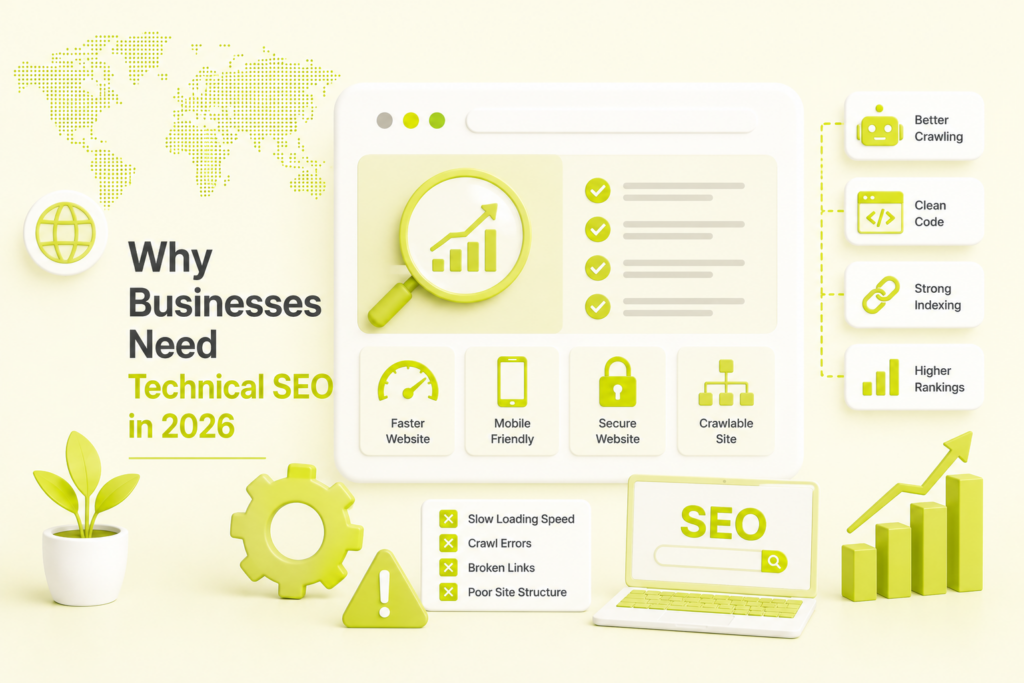
You can write the best content and buy the best ads, but if search engines can’t crawl, index, or trust your site, none of it reaches its potential. Technical SEO is the foundation everything else is built on.
Quick answer
Businesses need technical SEO because search engines follow a strict sequence — crawl, index, then serve — and if your site fails at the technical layer, your content, backlinks, and ad spend can’t reach their potential. Organic search drives roughly 53% of all website traffic, and technical SEO is what makes that traffic possible: it gets your pages crawled and indexed, speeds them up (which lifts both rankings and conversions), makes them mobile-ready, and structures them so both Google and AI systems can understand and cite you. In 2026 it’s not optional maintenance — it’s the infrastructure your entire digital presence stands on.
Most businesses that feel their SEO “isn’t working” have a technical problem they can’t see. The content team is publishing, the marketing team is running ads, and yet rankings stall and leads stay flat — because search engines are struggling to crawl, index, or trust the site underneath it all. Technical SEO is the layer that decides whether any of your other marketing effort ever pays off.
What is technical SEO?
Technical SEO is the practice of optimizing your website’s infrastructure so search engines can efficiently crawl, index, render, and trust it. It’s the plumbing and foundation of your online presence — crawlability, site architecture, page speed, mobile readiness, structured data, and clean URLs — as opposed to the content (what your pages say) or off-page authority (who links to you). Get the foundation wrong and everything built on top of it underperforms.
Why do businesses need technical SEO?
- If Google can’t crawl and index you, nothing else matters
Google works in three stages: crawl, index, serve. A page that can’t be crawled never gets indexed, and a page that isn’t indexed can’t rank — no matter how good it is. Broken architecture, blocked resources, crawl-budget waste, and indexing errors quietly keep your best pages invisible. Technical SEO clears that path first, which is why it’s the starting point of any serious SEO strategy. - Speed drives both rankings and revenue
Core Web Vitals — LCP under 2.5s, INP under 200ms, CLS under 0.1 — are a confirmed ranking signal and a direct conversion lever. A slow, unstable page loses rankings and buyers at the same time. This double loss is exactly why speed can’t be an afterthought; see why your website is slow for the full breakdown. - Most of your traffic is mobile — and Google indexes mobile-first
Google evaluates the mobile version of your site as the primary version. If your mobile experience is slow, cramped, or hard to use, your rankings and conversions suffer everywhere. Mobile-first technical health isn’t a nice-to-have; it’s the default reality of how your site is judged. - It’s now the foundation for AI visibility (GEO)
AI systems can only cite content they can crawl, render, and parse — and structured data has become a primary way they extract and validate information. Clean architecture, fast pages, and correct schema make your site “AI-ready.” In other words, technical SEO has become a generative engine optimization tool. It’s the groundwork behind ranking in Google’s AI Overviews and being recommended by assistants (optimizing for ChatGPT), and it underpins our GEO and LLM SEO work. - It plugs silent revenue leaks
Duplicate content, index bloat, orphan pages, broken links, redirect chains, and mishandled parameters bleed rankings without any obvious symptom. To put the scale in perspective, industry data shows roughly a third of pages on the web still lack proper canonical tags — a single fix that resolves most duplicate-content problems. These are invisible from the front end but obvious in a crawl. - It protects the ROI of everything else
Every rupee you spend on content, links, and ads assumes the pages behind them work. If they don’t load, don’t index, or don’t convert, you’re paying to send traffic into a leaky bucket — the same dynamic behind why websites fail to generate leads. Technical SEO is the multiplier that makes all your other marketing more efficient. - It’s a durable, compounding competitive edge
Most competitors — especially smaller and local businesses — have done little to no technical SEO. A fast, clean, well-structured site is a lasting advantage that keeps paying off, quarter after quarter, long after the work is done. Treat it as infrastructure you build once and maintain, not a one-off campaign.
What does technical SEO include?
A complete technical SEO program touches the systems that decide whether search engines can find, understand, and trust your site:
| Area | What it does | Business impact |
|---|---|---|
| Crawlability & indexing | Ensures search engines can reach and store your pages | Pages become eligible to rank at all |
| Site architecture & internal linking | Logical structure and link paths | Authority flows to key pages; nothing is orphaned |
| Page speed & Core Web Vitals | Fast, stable, responsive pages | Higher rankings and conversions |
| Mobile-first readiness | Great experience on the version Google judges | Protects rankings for most of your traffic |
| Structured data (schema) | Machine-readable | meaning for pages Rich results and AI citations |
| Canonicals & duplicate control | Consolidates signals to the right URL | Stops self-competition and index bloat |
| Sitemaps, robots & HTTPS | Crawl guidance and secure delivery | Efficient crawling and baseline trust |
Signs your business needs technical SEO now
- Traffic and rankings are flat or slipping despite publishing content — often a hidden crawl or index issue, a pattern explored in why SEO isn’t working.
- Your pages load slowly or fail Core Web Vitals in Search Console.
- Search Console shows indexing errors, “crawled – currently not indexed,” or coverage warnings.
- You recently redesigned, migrated, or changed platforms.
- You run an online store with filters, large catalogs, or duplicate product pages — see common eCommerce SEO mistakes.
- Competitors with weaker content consistently outrank you.
Is technical SEO worth the investment?
Yes — because it’s the highest-leverage SEO work you can do. Organic search remains the largest traffic source for most businesses and one of the highest-ROI channels available, with organic leads widely reported as higher quality than paid. But that return only materializes when the technical foundation is sound. Fixing technical issues doesn’t just add a little; it unlocks the full value of every other investment you’ve already made in content and marketing. And unlike ads, the gains persist: a well-built site keeps earning long after the work is finished.
Frequently asked questions
What is technical SEO?
Technical SEO is the practice of optimizing a website’s infrastructure so search engines can efficiently crawl, index, render, and trust it — covering crawlability, architecture, speed and Core Web Vitals, mobile readiness, structured data, canonicalization, sitemaps, security, and JavaScript rendering. It’s the foundation content and links build on.
Why is technical SEO important for business?
Because if search engines can’t crawl, index, or trust your site, none of your content, backlinks, or ad spend can reach its potential. Organic search drives roughly 53% of website traffic, and technical SEO makes that traffic possible — while also improving conversions through speed and providing the foundation for AI-search visibility.
What is the difference between technical SEO and regular SEO?
Technical SEO focuses on infrastructure — crawlability, indexing, speed, structure, and schema. On-page and content SEO focus on the relevance of individual pages, and off-page SEO builds authority through links and mentions. Technical SEO is the foundation the other two depend on.
How often does a business need technical SEO?
It’s ongoing, not a one-time fix. Run a deep audit at least once or twice a year, plus after any redesign, migration, or platform change, and monitor indexing, Core Web Vitals, and crawl errors continuously so issues are caught before they suppress rankings.
Does technical SEO help with AI search and AI Overviews?
Yes. AI systems can only cite content they can crawl, render, and parse, and structured data has become a primary way they extract and validate information. Clean architecture, fast pages, and correct schema make your site AI-ready, so technical SEO now doubles as a GEO lever.
Most technical SEO problems are invisible from the front end but obvious in a crawl — and fixing them often unlocks growth a site has been leaving on the table for months. Get a free audit and we’ll surface your biggest technical wins with a prioritized plan.

Riya Bhardwaj
Leading content and growth initiatives with a focus on search visibility, audience engagement, and measurable business outcomes. Specialised in SEO, Generative Engine Optimization (GEO), AI search optimisation, and performance-driven content marketing. Passionate about transforming market insights into scalable content strategies that strengthen brand authority and drive sustainable digital growth.