

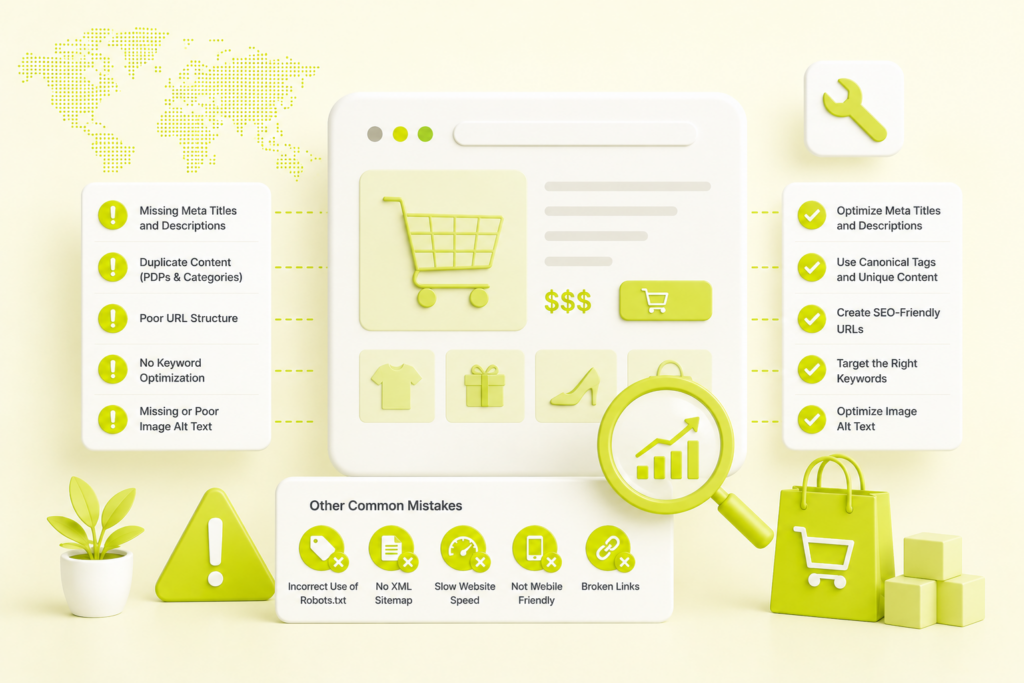
Organic search drives roughly a third of all eCommerce traffic — more than paid, email, and social combined. Yet most stores quietly sabotage it with the same handful of mistakes. Here they are, and how to fix each.
Quick answer
The most common eCommerce SEO mistakes are: neglecting category pages while over-optimizing product pages; letting faceted navigation generate thousands of duplicate URLs; using manufacturer (duplicate) product descriptions; skipping or misconfiguring structured data; ignoring site speed, Core Web Vitals, and mobile; mishandling out-of-stock and discontinued products; weak internal linking and site architecture; mismatching keywords to the wrong page type; publishing no supporting content connected to the catalog; and optimizing only for Google while staying invisible in AI shopping. Fix the technical foundation and category pages first — that’s where the biggest wins hide.
eCommerce SEO is a different sport from content SEO. You’re optimizing thousands of templated pages, a product feed, and a faceted navigation system that can either multiply your reach or drown your site in duplicate URLs. The fundamentals overlap, but the scale and the failure modes are unique — and they repeat across almost every store we audit at Nowoka Digital. Here are the ten mistakes costing you the most.
The 10 most common eCommerce SEO mistakes
- Neglecting category pages – Most brands pour effort into product pages and treat category pages as an afterthought — often a bare product grid with no copy. That’s backwards. Category pages sit at the intersection of high search volume, commercial intent, and internal link authority, and they typically drive three to five times more organic revenue than product pages. The fastest win in eCommerce SEO is usually adding 200–400 words of original, genuinely useful copy to your primary category pages so search engines and shoppers understand the product group.
- Letting faceted navigation run wild – Filters for size, color, brand, and price are great UX and the single most dangerous SEO trap. A store with a few thousand products and a handful of filters can generate millions of near-duplicate URLs, and on unmanaged sites 40–60% of crawl budget gets wasted on filter pages that should never be indexed. Fix it deliberately: allow and canonicalize single-facet pages with real search demand (e.g. “black maxi dresses”), apply
noindex,followor block crawling once two or more filters combine, and never let empty parameters like?size=&color=create indexable URLs. This crawl-and-index control is core technical SEO work. - Using manufacturer (duplicate) product descriptions – Pasting the manufacturer’s copy onto your product page means dozens of stores publish the identical text — thin, duplicate content with no reason to rank you over anyone else. Write unique descriptions that answer real buyer questions: fit, materials, use cases, what’s in the box, and how it compares. This is also what makes a page quotable to AI answer engines.
- Skipping or botching structured data – Product, Offer, AggregateRating, BreadcrumbList, and FAQ schema turn a plain blue link into a rich result with price, stars, and availability — which can lift click-through meaningfully and feeds the structured data AI engines pull from. Two cautions: schema is not a direct ranking signal, and marking up ratings you don’t actually have is a risk, not a shortcut. Validate everything with Google’s Rich Results Test, and connect an accurate product feed to Google Merchant Center.
- Ignoring site speed, Core Web Vitals, and mobile – Most store traffic is mobile and Google indexes mobile-first, yet many stores are slow, bloated, and desktop-built. Get Core Web Vitals into the green — LCP under 2.5s, INP under 200ms, CLS under 0.1 (note INP replaced FID, so older checklists are wrong here). Speed is both a ranking factor and a conversion lever; see why your website is slow for the full breakdown.
- Mishandling out-of-stock and discontinued products – When products sell out or get retired, most stores let the pages 404 silently, throw soft 404s, or leave dead URLs collecting link equity that goes nowhere. Handle them on purpose: keep and update seasonal items, redirect discontinued products to the closest alternative or parent category, and return a real 410 when something is truly gone — never by accident.
- Weak internal linking and site architecture – Products buried many clicks deep, orphan pages with no internal links, and deep pagination all starve your best pages of crawlability and authority. Link from navigation to top categories, from categories to subcategories and key products, and from blog content to relevant categories with descriptive anchor text. Avoid auto-generated “SEO footer” link dumps — they read as thin doorway pages.
- Mismatching keywords to page types – Different queries deserve different pages. Broad commercial terms (“men’s trail running shoes”) belong on category pages; refined intent (“waterproof trail running shoes”) on subcategories; specific SKUs on product pages; and informational queries on content. Trying to rank a product page for a head term — or stuffing five intents into one page — satisfies none of them.
- No supporting content connected to the catalog – Stores that publish nothing but product and category pages miss the pre-purchase questions shoppers actually search. Buying guides, size and fit guides, comparison articles, and care instructions capture earlier-funnel demand, earn links, and internally link to your commercial pages. Notably, support articles and guides account for a large share of the pages AI answers cite — so this content does double duty across classic and AI search.
- Optimizing only for Google — invisible in AI shopping – Shoppers increasingly research and compare inside AI before they click. AI Overviews reached roughly 14% of shopping queries by March 2026, up sharply in just a few months, and assistants like ChatGPT and Perplexity now shape shortlists. Accurate product data, clean structured content, and quotable answers decide who gets cited. Learn to earn placement in Google’s AI Overviews and shape how assistants describe you in optimizing for ChatGPT; for done-for-you work, see our GEO services and LLM SEO services. This is the same shift behind why traditional SEO feels like it’s not working.
Match the query to the right page type
Get this mapping right and most of your keyword and internal-linking decisions become obvious:
| Search query | Intent | Best page type |
|---|---|---|
| "running shoes" | Broad commercial | Category / collection page |
| "waterproof trail running shoes" | Refined commercial | Subcategory or indexed facet |
| "Nike Pegasus Trail 5 size 10" | Transactional (SKU) | Product page |
| "how to choose trail running shoes" | Informational | Guide / blog content |
How to fix eCommerce SEO (in priority order)
Work the layers that touch the most URLs and the most revenue first:
- Technical foundation. Control faceted navigation, canonicals, pagination, out-of-stock handling, and crawl budget.
- Category pages. Add unique copy and target the high-volume commercial head terms first.
- Product pages. Unique descriptions, complete Product schema, real reviews, and clear specs.
- Speed & mobile. Get Core Web Vitals green on real mobile field data.
- Content & internal links. Buying and fit guides that connect to and reinforce commercial pages.
- AI & off-page. Structured, quotable content plus authority so you’re cited across AI surfaces, not just ranked.
A slow, hard-to-navigate store also converts poorly even when it ranks — the same conversion discipline behind why websites fail to generate leads and why Shopify stores fail. Fixing SEO and conversion together is where the compounding growth lives, and it starts with a solid SEO foundation.
Frequently asked questions
What is the most common eCommerce SEO mistake?
Neglecting category pages while over-investing in product pages. Category pages combine high search volume, commercial intent, and internal link authority, and typically drive several times more organic revenue — yet most stores leave them as a bare product grid with no descriptive copy.
Are category pages or product pages more important for SEO?
Category pages usually matter more for rankings — they target broad, high-volume commercial queries and often generate three to five times more organic revenue. Product pages are where traffic converts, so both matter, but category and collection pages are the priority landing pages for non-branded search.
How do I fix faceted navigation SEO problems?
Decide which filtered URLs deserve indexing. Allow and canonicalize single-facet pages with real search demand, and apply noindex,follow or block crawling once two or more filters combine. Point canonicals on filtered variations to the main category, and never let empty filter parameters create indexable URLs.
Do I need schema markup for my online store?
Yes. Product, Offer, AggregateRating, BreadcrumbList, and FAQ schema enable rich results that can lift click-through and feed the data AI engines cite. Schema isn’t a direct ranking signal, so validate it with Google’s Rich Results Test and never mark up ratings you don’t have.
How do I optimize product pages for AI Overviews?
Make pages indexable and snippet-eligible, add complete Product and FAQ structured data, and write genuine, quotable answers to real buyer questions. AI answers frequently cite support articles, size guides, and buying guides too — so supporting content connected to your catalog is a major part of AI shopping visibility.
Most of these issues are invisible from the front end but obvious in a crawl. Get a free eCommerce SEO audit and we’ll surface your biggest wins — faceted navigation, category pages, schema, speed, and AI visibility — with a prioritized plan to fix them.

Riya Bhardwaj
Leading content and growth initiatives with a focus on search visibility, audience engagement, and measurable business outcomes. Specialised in SEO, Generative Engine Optimization (GEO), AI search optimisation, and performance-driven content marketing. Passionate about transforming market insights into scalable content strategies that strengthen brand authority and drive sustainable digital growth.