
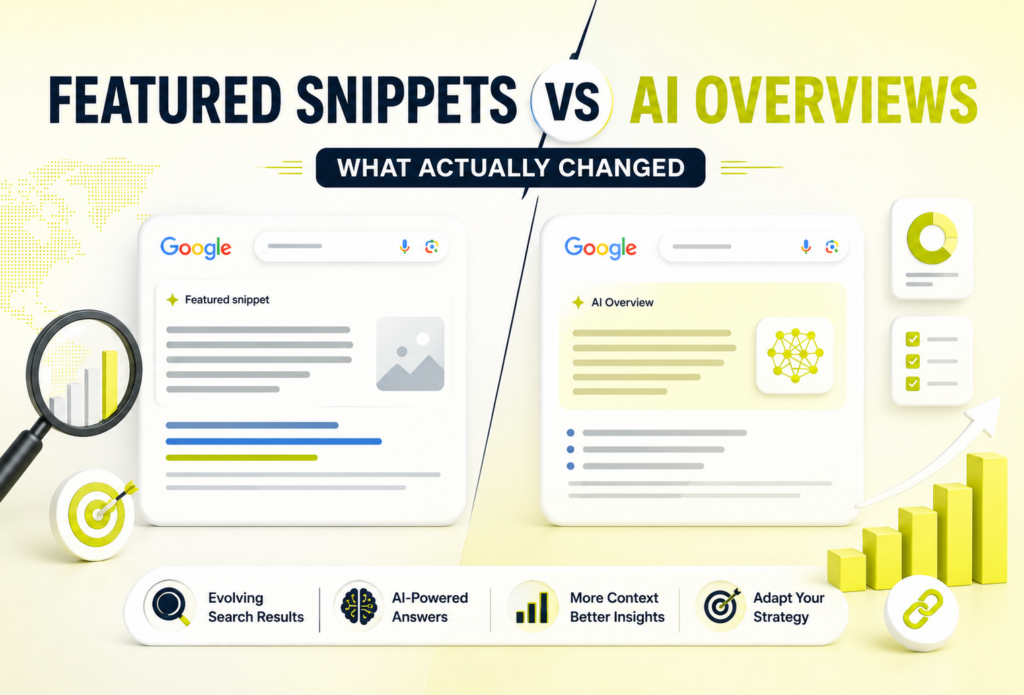
One quotes a single page. The other writes a fresh answer from a dozen. Understanding that one distinction explains almost everything about how search visibility works now — and why the old “position zero” playbook needs a rewrite, not a funeral.
Quick answer
A featured snippet is a passage lifted almost word-for-word from one page that already ranks, shown in a box with that page’s link — high click-through when it appears, because it points at a single source. An AI Overview is a Gemini-generated summary that blends many sources into one answer with citation links — far fewer clicks per source, but real brand reach. Since AI Overviews arrived in 2024 (now on roughly 45–58% of searches, depending on the study), they’ve swallowed most informational snippets, which shrank from a peak near 15–24% of queries to somewhere around 5–8%. Here’s the twist that matters: snippets didn’t die — the pages that win them are now the ones most likely to get cited in AI Overviews. So you don’t choose. You do the same answer-first work and win the whole stack. Product and transactional searches, notably, still belong to snippets and classic SEO.
If you’ve stared at a Google results page lately and felt slightly disoriented, you’re not imagining it. The top of the page — the part that used to be ten blue links — is now a stack: an AI Overview writing you a paragraph, maybe a featured snippet, a “People Also Ask” cluster, and only then the first real link, often sitting below the fold. We’ve spent the last two years watching this reshuffle happen across client accounts, and the single most useful thing we can tell you is that “featured snippets vs AI Overviews” is the wrong framing. They’re not fighting over your content. They’re two doors into the same room, and the key that opens one increasingly opens the other. Let me show you what I mean.
So what's the actual difference?
Strip away the jargon and it comes down to one thing: extraction versus generation.
A featured snippet is Google being lazy in the good way. It finds a page that already ranks well, decides that page answers the question cleanly, and quotes it — almost verbatim — in a box up top, with the page title and a clickable link. One source. Word-for-word. You can point at the exact sentence it pulled.
An AI Overview is a different animal. Gemini reads across a spread of sources and writes something new — a synthesized, conversational answer that may not match any single page’s wording, with a little cluster of citation links off to the side. It behaves less like a quote and more like a research assistant who skimmed ten tabs and gave you the gist.
The cleanest way I’ve heard it put: featured snippets reward precision; AI Overviews reward depth. Ask “what is technical SEO,” and a snippet grabs a tidy definition from one strong page. Ask “how does technical SEO affect my rankings and what should I fix first,” and that sprawling, multi-part question is exactly the kind of thing an AI Overview is built to chew on.
The shift nobody in SEO could ignore
Google switched on AI Overviews in the US in May 2024, and the ground moved fast. By early-to-mid 2026, depending on whose tracking you trust, AI Overviews show up on somewhere between about 42% and 58% of searches — and the trend line only points up.
Featured snippets took the hit. Ahrefs tracked snippet visibility falling from around 15% of queries in January 2025 to roughly 5.5% by that June — a decline of about two-thirds in half a year. Other researchers pegged the “replacement rate” at something like 83% over eight months, with a near-perfect correlation between snippets disappearing and AI Overviews appearing. Whatever the exact figure — and the figures genuinely vary by dataset — the direction isn’t in dispute. Google systematically swapped single-source answer boxes for multi-source AI summaries on informational queries.
If you’d built your whole strategy on owning position zero, that stretch of 2025 probably felt like the floor gave way. Plenty of teams we talked to assumed featured snippets were finished. They were wrong, but understandably so.
The twist: snippets didn’t die, they became fuel
Here’s the part that changes how you should actually work. Those featured snippets didn’t vanish into the void — they became building blocks for AI Overviews. Study after study in 2026 lands on the same finding: the pages that previously won featured snippets are strongly over-represented among the pages Gemini cites inside AI Overviews.
Winning the snippet is now the highest-correlation path there is to getting cited by the AI. Same work, two payoffs.
It makes intuitive sense once you sit with it. What earns a snippet? A clear, self-contained answer, well structured, from a page Google already trusts. What does an AI Overview want to quote? A clear, self-contained answer, well structured, from a page Google already trusts. Google didn’t invent a brand-new content standard for the AI era — it reused the one it already had. So the teams panicking about snippets dying and the teams obsessing over AI citations were, without realizing it, chasing the exact same thing.
Which one actually sends you traffic?
Now the uncomfortable bit. Because everyone eventually asks: fine, but which one puts humans on my website?
When a featured snippet shows up, it wins on clicks, and it isn’t close. A single prominent source pulls a big share of the attention — Seer Interactive has clocked featured-snippet click-through north of 40%. A single citation buried in an AI Overview? Closer to 1%. That gap is the whole reason people mourned the snippet’s decline.
But raw click-through is only half the story, and the honest version has more texture. AI Overviews are ruthless on clicks overall — Ahrefs found they cut position-one CTR by around 58%, and Seer measured roughly a 61% organic CTR drop on queries where an Overview appears (with a partial rebound into 2026). Zero-click search now sits near 65% of all searches, and where an Overview shows, closer to 83% never click anything. That’s the reality, and pretending otherwise helps no one.
And yet — being in the Overview still matters, a lot. Seer also found that brands cited as sources earn something like 35% more organic clicks than uncited competitors on the same queries, and the visitors who do come through tend to arrive warmer, having already seen you vouched for by the AI. So the scoreboard reads: snippets win direct traffic; AI Overviews win reach, brand familiarity, and qualified attention. If you’re keeping score properly, you want both — which, conveniently, is exactly what the previous section says you can have.
When you’ll actually see each one
They don’t show up randomly. Intent decides, and once you know the pattern you can predict which battle you’re fighting before you write a word:
| Query type | What usually shows | Why |
|---|---|---|
| Definitions ("what is X") | Snippet, often + AI Overview | Clean one-line answers extract easily |
| How-to / step-by-step | Snippet stays strong | Ordered-list snippets still win, and still get clicked |
| Complex, multi-part questions | AI Overview | Synthesis across sources is the whole point |
| Long or conversational queries (7+ words) | AI Overview (~46% of the time) | Google leans AI for messy, natural questions |
| Comparisons ("X vs Y") | Table snippet + often AIO | A clean table gets lifted almost as-is |
| Product / ecommerce | Mostly neither (AIO ~4%) | Purchases need a click; Google knows it |
That last row deserves a highlight if you sell things online. AI Overviews trigger on informational intent almost exclusively — by one analysis, essentially all AIO-triggering keywords are informational — and have actually retreated on product searches, from around 29% at launch down to roughly 4%. Google clearly figured out that people buying a coffee grinder need to reach a store, not read a summary. So if your revenue lives on product and category pages, breathe out: classic SEO and featured snippets still drive it. The AI-citation scramble is a fight for your informational content — the blog, the guides, the FAQs.
How to win both (it’s honestly the same work)
This is where the “versus” framing fully collapses. The structural moves that earn a snippet are, give or take, the same ones that earn an AI Overview citation. Do them once:
- Answer first, then elaborate
Put the direct, self-contained answer in the opening sentence under the relevant heading — the old inverted-pyramid trick from journalism. Bury the answer under a 200-word wind-up and you lose both the snippet and the citation. Say the thing, then earn the read. - Write headings as the questions people ask
Question-shaped H2s and H3s map your page directly onto queries. It’s not a coincidence that this article’s headings are questions. - Keep the core answer tight — roughly 40–60 words
That’s the sweet spot Google tends to lift for paragraph snippets. Long enough to be complete, short enough to quote whole. - Match the format to the query
A “how to” wants a real numbered list. A “best” or “X vs Y” wants a table. Answer a list query in one dense paragraph and you’ll watch a competitor’s cleaner formatting take the box. Use actual list and table markup, not fake ones built from line breaks. - Rank first, format second (for snippets)
Google pulls snippets almost only from page one. If you’re sitting on page two, no amount of clever formatting saves you — close the ranking gap first, then out-format whoever currently holds the box. - Build authority and put a name on it (for AI Overviews)
Citations skew toward sources that look trustworthy: real expertise, named authors, topical depth across a cluster of related pages rather than one lonely post. Anonymous content rarely gets quoted by the AI. Add schema (FAQ, HowTo) so parsers understand what they’re reading. - Hedge the zero-click reality
Since many of these answers resolve without a click, give people a reason to come anyway: answer enough to be useful but tease the depth (“there are three main causes — here’s how to fix each”), and park a genuine draw next to the answer, like a tool, template, or calculator the summary can’t hand them.
None of that is exotic. It’s disciplined, answer-first writing — the same foundation behind answer engine optimization and the detail in our guide to ranking in AI Overviews. Get the structure right once and a single page can now stack across the AI Overview, the snippet, People Also Ask, and organic — visibility that simply wasn’t available a couple of years ago.
How to actually measure any of this
Fair warning: the measurement tooling hasn’t fully caught up. In Search Console, watch for the tell-tale pattern of a strong ranking position paired with a weirdly low click-through — that’s usually an Overview or snippet answering for you. Remember that a snippet can lift your impressions while flattening CTR; that’s the zero-click trade, not a failure, so judge snippet work on capture, not clicks alone. For snippet ownership and AIO presence per keyword, lean on Semrush, Ahrefs, or Moz, because as of now Google still doesn’t cleanly separate AI-Overview clicks from ordinary organic ones. And track your AI referral traffic properly while you’re at it — we walk through that in tracking AI referral traffic in GA4.
What I’d actually do about it
If you take one thing from all this, make it this: stop treating it as a war between two features and start treating it as one visibility problem with two payoffs. Write genuinely useful, answer-first content with a real point of view and a real name attached. That wins snippets today, earns AI citations tomorrow, and — because being repeatedly named as the source is how brand authority compounds — quietly builds the one moat that’s getting harder to fake. Let your product pages relax; they were never the battleground. Point your energy at the informational content, where the citations are won or lost. The businesses that come out ahead here aren’t the ones gaming a format. They’re the ones that were worth quoting all along — which is the whole story of how AI is changing marketing, and the thinking behind our GEO and LLM SEO work.
Frequently asked questions
What's the difference between a featured snippet and an AI Overview?
A featured snippet quotes one page almost word-for-word in a box with that page’s link. An AI Overview is a Gemini-written summary blending several sources, with citation links to multiple pages. One quotes a single page; the other writes a new answer from many. Snippets reward precision; Overviews reward depth and authority.
Are AI Overviews replacing featured snippets?
Largely, for informational queries — snippet visibility fell sharply (roughly 15% of queries to about 5–8%) after Overviews launched. But snippets persist for definitions, how-tos, comparisons, and simple facts, and the pages that win them are strongly correlated with AI Overview citations, so the two are now linked rather than purely rival.
Do featured snippets still matter in 2026?
Yes. When they appear they still drive strong clicks from a single prominent source, and winning them is the highest-correlation path to AI Overview citation because both reward the same answer-first structure. Optimizing for snippets is optimizing for AI visibility.
Which drives more traffic, featured snippets or AI Overviews?
Snippets drive more direct clicks when they appear (one source, far higher CTR than a single AIO citation). AI Overviews send fewer clicks per source but reach more searches and build brand presence, and being cited earns meaningfully more clicks than being left out. Snippets win direct traffic; Overviews win reach and authority — earn both.
How do I optimize for both?
Same core work: a direct answer in the first sentence under a question heading, ~40–60 word paragraph answers, real lists and comparison tables matched to the query, FAQ/HowTo schema, and genuine topical authority with named authors. For snippets specifically, rank top 10 and out-format the current holder; for AI Overviews, add E-E-A-T, clusters, and off-site citations.
Do AI Overviews appear on product or ecommerce searches?
Rarely — they trigger almost entirely on informational, question-based queries, and have dropped to around 4% of ecommerce searches. Google seems to recognize purchases need a click. So product pages still rely on classic SEO and snippets, while informational content is where the AI-citation battle happens.
Featured snippets, AI Overviews, and AI answers all reward the same thing: clear, credible, answer-first content from a brand worth citing. That’s exactly what we build. Get a free audit and we’ll show you which queries you could be winning — and aren’t yet.

Riya Bhardwaj
Leading content and growth initiatives with a focus on search visibility, audience engagement, and measurable business outcomes. Specialised in SEO, Generative Engine Optimization (GEO), AI search optimisation, and performance-driven content marketing. Passionate about transforming market insights into scalable content strategies that strengthen brand authority and drive sustainable digital growth.