

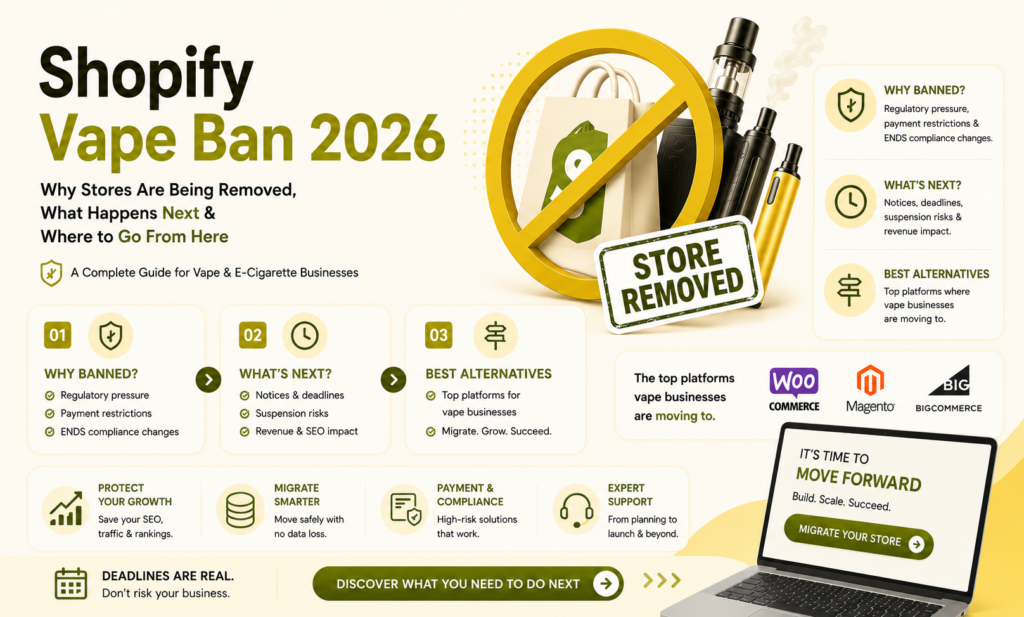
Shopify Vape Store Shutdowns: What Happened, Why Stores Were Removed, What Merchants Should Do Next, and the Best Shopify Alternatives in 2026
Vape and e-cigarette merchants running stores on Shopify have spent the last week dealing with a problem that has nothing to do with marketing, conversion rates, or ad spend: staying on the platform at all. Beginning in late June 2026, Shopify started sending direct notices to U.S.-based ENDS (Electronic Nicotine Delivery Systems) sellers, informing them that vape products are no longer supported on the platform and must be removed by a fixed deadline or the store risks suspension.
This isn’t a policy rumor circulating in vape industry forums. It’s a confirmed enforcement action, reported by Reuters and corroborated by merchant notices reviewed by industry compliance firms, following more than a year of pressure from state law enforcement and the payments industry. If you run a vape brand, e-liquid business, smoke shop, or any storefront that includes nicotine vaping products, this affects your operations directly — whether or not you’ve personally received a notice yet.
This guide lays out exactly what happened, what’s confirmed versus speculative, why Shopify made this decision, who is affected, what happens during a suspension, and how to evaluate and execute a migration to an alternative platform without losing the SEO equity and revenue you’ve already built.
Quick Answer
Shopify has begun enforcing a platform-wide prohibition on ENDS product sales for U.S. merchants, requiring affected stores to remove vape products — including e-cigarettes, e-liquids, vaporizers, parts, and refills — by July 7, 2026 (UTC), or face account suspension. The action follows over a year of pressure from a 25-state attorney general coalition and, more recently, the payments industry. Shopify has not issued one comprehensive public announcement; enforcement is happening through individual merchant notices, first publicly reported by Reuters on June 23, 2026.
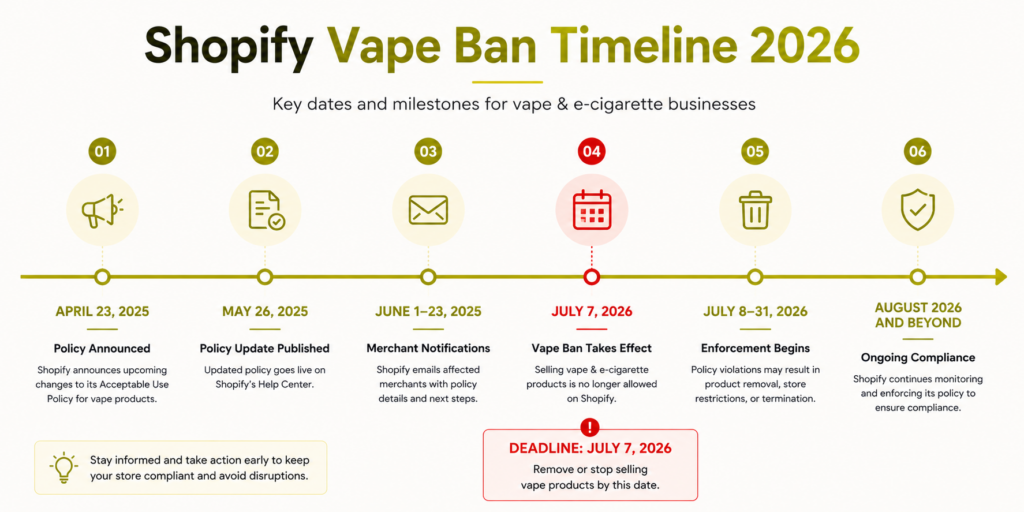
Timeline of Events
Understanding how this policy escalated requires looking at the full sequence — from early enforcement against individual sellers to a category-wide prohibition.
| Date | Event | Source Type |
|---|---|---|
| April 2025 | Shopify removed specific vape sellers flagged directly by the California Attorney General's office. | Confirmed action |
| November 2025 | California AG Rob Bonta and the City of New York co-led a coalition of 25 state attorneys general in a letter urging Shopify to cut off merchants selling illegal tobacco products, identifying 29 active illegal vape sites and over 200 additional websites known to sell illegal tobacco products. | Official letter |
| April 2026 | The same coalition sent letters to nine major card networks and payment processors — including Visa, Mastercard, Stripe, and PayPal — urging tighter restrictions on payment processing for illegal vape merchants. | Official letter |
| June 23, 2026 | Reuters reported, citing two sources familiar with the matter, that Shopify was preparing to ban all U.S. vape sales platform-wide, regardless of FDA authorization status. A Shopify spokesperson confirmed the company "always prohibited illegal activity" but did not publicly confirm scope or timing. | Media report, company statement |
| Late June 2026 | Shopify began sending direct notices to ENDS merchants stating that ENDS products are no longer supported, regardless of nicotine content. | Merchant notices reviewed by Token of Trust |
| July 7, 2026 (UTC) | Deadline for merchants to remove flagged products or submit a successful appeal, or risk account suspension. Merchant notice |
What Actually Happened?
Quick Answer: Shopify is enforcing a category-wide prohibition on ENDS/vape product sales for U.S. merchants through individual compliance notices, not a single public announcement. The change covers e-cigarettes, e-liquids, vaporizers, parts, and refills, and applies even to FDA-authorized products.
There’s a meaningful difference between what’s been publicly confirmed and what’s circulating as merchant speculation, and it’s worth separating clearly:
Confirmed facts:
- Shopify has sent direct merchant notices requiring removal of ENDS products by July 7, 2026 UTC.
- The policy follows letters from a 25-state AG coalition (November 2025) and payment-network pressure (April 2026).
- The expected policy covers all vape products, including those with FDA marketing authorization.
- Shopify Plus merchants are reportedly being offered the option to exit their contracts early without penalty.
Not yet confirmed:
- Whether the prohibition extends to international stores or non-U.S.-directed sales.
- Whether Shopify will issue a single comprehensive public policy update, or continue enforcing solely through individual notices.
- The exact mechanics of the appeals process and approval criteria.
Common misconception worth correcting: Many merchants assume that because their product has FDA marketing authorization, they’re exempt. Industry reporting directly contradicts this — the expected policy applies to all vape products sold through Shopify-powered stores, including FDA-authorized SKUs, because distinguishing compliant from non-compliant inventory at scale across thousands of merchants created legal exposure that a blanket category ban eliminates.
Shopify’s own published policy language, which predates this enforcement wave, states that ENDS products are regulated in most countries, and that if a merchant violates an ENDS law in any jurisdiction where they conduct business, Shopify might remove products or terminate the store. That existing language remains technically accurate, but the current enforcement represents a significantly stricter, category-wide application of it specifically for U.S. merchants — regardless of individual compliance status.
Myth vs. Fact
Myth: “If my vape products are FDA-authorized, Shopify can’t remove my store.”
Fact: Reporting indicates the policy applies to all vape products, authorized or not, because Shopify is enforcing at the category level, not the SKU compliance level.
Myth: “This is just a rumor until Shopify makes a public announcement.”
Fact: Merchants are already receiving direct compliance notices with a hard deadline — enforcement has begun regardless of whether a single public press release follows.
Why Were Vape Stores Removed?
Quick Answer: Shopify’s enforcement responds to three converging pressures: a coordinated 25-state attorney general campaign, a federal FDA authorization gap that makes most flavored vape products technically “adulterated” under U.S. law, and payment-network pressure that puts Shopify Payments’ underlying card-network relationships at risk.
Coordinated State Attorney General Pressure
The November 2025 letter to Shopify was substantive, not symbolic. It was co-led by California Attorney General Rob Bonta and the City of New York, joined by attorneys general from 25 states. The coalition identified 29 active illegal vape sites hosted on Shopify’s infrastructure at the time, along with an exhibit listing more than 200 additional websites known to sell illegal tobacco products.
Individual officials made the stakes explicit. Arizona Attorney General Kris Mayes stated that the trade represented “blatant law-breaking and a danger to the young people and teens” who shouldn’t have access to these products. Connecticut Attorney General William Tong welcomed Shopify’s eventual decision, noting his office had separately investigated 12 Connecticut smoke shops and convenience stores, plus two wholesalers, for selling illegally imported, youth-targeted disposable e-cigarettes — an investigation he described as active and ongoing. Illinois Attorney General Kwame Raoul characterized the coalition’s work as a continuing, bipartisan effort rather than a single action, signaling that platform-level scrutiny isn’t ending with this enforcement wave.
The FDA Authorization Gap
This is the legal mechanism that explains why the ban is categorical rather than selective. The FDA has authorized only a small number of e-cigarette products — reporting cites figures between 39 and 45 depending on the date of the source — and none in any flavor beyond tobacco and menthol. That means nearly every flavored disposable vape sold through online channels is technically classified as “adulterated” under federal law, and interstate delivery of adulterated tobacco products is illegal.
That exposure doesn’t stop at the seller. Facilitating platforms carry legal risk too, which is precisely why attempting to verify FDA status SKU-by-SKU across thousands of merchant stores became operationally and legally unworkable for Shopify. A blanket category prohibition removes that ambiguity entirely.
Payment Gateway and Processor Pressure
Regulatory pressure didn’t stop with Shopify. In April 2026, the same AG coalition wrote directly to nine major card networks and payment processors — Visa, Mastercard, Stripe, and PayPal among them — pushing for tighter restrictions on payment processing tied to illegal vape sales. Mastercard subsequently advised acquiring institutions to strengthen merchant oversight by reviewing product inventories and monitoring transaction patterns more closely.
This matters structurally: Shopify Payments operates on top of this same card-network infrastructure. If Visa and Mastercard tighten merchant category enforcement upstream, Shopify inherits that risk regardless of its own internal policy stance — which is one reason the platform’s enforcement escalated when it did, rather than staying at the case-by-case level used in 2025.
Shopify’s Existing Enforcement Philosophy
This shift is consistent with how Shopify says it generally operates. Its Acceptable Use Policy states merchants can’t use the platform for anything illegal where they do business, and that Shopify will typically give notice, grant opportunities to self-remediate, default to product-level enforcement first, and treat account-level termination as a last resort. The escalation from individually flagged removals (as happened with California-identified sellers in April 2025) to a blanket prohibition reflects the coalition’s argument that reactive, case-by-case enforcement wasn’t sufficient given the scale of non-compliant merchants continuing to operate.
Summary Table:
| Pressure Source | Action Taken | Date |
|---|---|---|
| State AG coalition (25 states) | Letter demanding platform-wide cutoff of illegal tobacco sellers | November 2025 |
| Payment networks (Visa, Mastercard, Stripe, PayPal) | Letters urging tighter restrictions on illegal vape merchant processing | April 2026 |
| FDA regulatory framework | Limited authorized SKUs; most flavored disposables technically "adulterated" | Ongoing |
| Shopify enforcement | Direct merchant notices requiring ENDS removal by July 7, 2026 | June 2026 |
Which Businesses Are Affected?
Quick Answer: Any U.S.-based Shopify merchant selling ENDS products is affected, regardless of business model. The policy is enforced at the product-category level, meaning dropshippers, wholesalers, manufacturers, and subscription businesses are all in scope equally — fulfillment method and buyer type don’t create an exemption.
| Merchant Type | Impact Level | Detail |
|---|---|---|
| Direct-to-consumer vape brands | High | Core target; full catalog typically affected |
| Dropshippers (vape niche) | High | Affected regardless of who fulfills the order |
| Wholesale / B2B vape sellers | High | No exemption for B2B-only storefronts |
| Manufacturers selling D2C | High | FDA-authorized SKUs are reportedly included |
| International sellers | Uncertain | Scope outside the U.S. not officially confirmed |
| Subscription vape/e-liquid clubs | High | Recurring billing model doesn't change classification |
| CBD businesses (no nicotine) | Low | Not targeted by this specific policy; subject to separate hemp/CBD rules |
| Smoke shops (mixed inventory) | High for vape SKUs only | Non-vape accessories generally unaffected |
| Shopify Plus merchants | High, with an offramp | Reportedly offered early contract exit without penalty |
Decision Snapshot: If ENDS products represent more than an incidental share of your catalog, treat this as a near-certain platform exit event rather than a policy dispute to negotiate.
Warning Signs Your Store Is At Risk
Quick Answer: Your store is at elevated risk if you sell any ENDS products to U.S. customers, rely on Shopify Payments rather than a dedicated high-risk processor, lack robust age verification, or have already received any compliance-related communication from Shopify.
Checklist
- You sell e-cigarettes, e-liquids, vaporizers, parts, or refills to U.S. customers
- You’ve received any email or in-admin notice referencing ENDS, vape, or tobacco compliance
- You’re using Shopify Payments rather than a dedicated high-risk gateway (Shopify Payments already excludes vape transactions from supported categories)
- Your checkout lacks robust age-verification
- Your listings don’t clearly disclose nicotine content or FDA authorization status
- You ship across state lines without reviewing PACT Act and state-specific ENDS shipping restrictions
- You haven’t reviewed Shopify’s Acceptable Use Policy or ENDS compliance page since June 2026
Common Mistakes Merchants Make
- Assuming FDA authorization is protective.
It currently isn’t, based on the scope described in merchant notices. - Waiting for a public announcement instead of checking direct notices.
Many affected merchants are unaware their account has already been flagged, since enforcement is happening individually rather than through a single press release. - Treating product removal as a complete fix.
Removing SKUs may satisfy an immediate notice but doesn’t resolve underlying payment-processing risk or long-term platform fit. - Underestimating payment-side exposure independent of Shopify.
Card networks tightening merchant category oversight can freeze payouts even outside of Shopify’s own enforcement timeline.
What Happens If Shopify Suspends Your Store?
Quick Answer: Suspensions typically progress through notice, a self-remediation window, product-level delisting, payment holds, and — if unresolved — full account suspension that locks admin access, freezes payouts, and can trigger SEO de-indexing within days to weeks.
| Stage | What Happens |
|---|---|
| Notice | Merchant receives a compliance notice with a remediation deadline |
| Self-remediation window | Per Shopify's Acceptable Use Policy, merchants are generally given an opportunity to resolve issues before account-level action |
| Product-level enforcement | Specific listings are hidden, delisted, or removed from sales channels |
| Payment holds | Payouts may be frozen pending compliance review |
| Account suspension | Admin access is locked; checkout is disabled store-wide |
| Domain/data access | Storefront goes dark; data export windows may become time-limited |
Business Impact Breakdown
- Frozen orders: Pending and in-transit orders may pause or require manual processor intervention.
- Payment holds: Funds already collected can sit in reserve during a compliance review period.
- Customer data access: Export tools for customer lists, order history, and analytics aren’t available indefinitely — proactive exports are essential.
- SEO impact: A suspended storefront returns crawl errors to search engines, which can trigger de-indexing within days to weeks. This is one of the most underestimated, hardest-to-reverse consequences of a forced suspension.
- Revenue impact: Beyond the immediate sales gap, rebuilding domain authority and rankings after a prolonged outage is significantly harder than migrating proactively before a deadline hits.
- Domain: Domains registered externally and simply pointed at Shopify are generally easier to redirect elsewhere than domains purchased directly through Shopify.
Expert Tip: Export your full customer list, order history, product catalog, and theme/code assets now — before any deadline passes, not after a suspension notice arrives. Self-service export tools may become unavailable once an account is locked.
Can Your Store Be Recovered?
Quick Answer: Recovery is realistic when the issue involves a removable product category and action is taken before or shortly after a deadline. Recovery becomes unlikely once a full account-level suspension occurs for a categorically prohibited product type like ENDS, because the underlying business model — not a single violation — is what conflicts with the platform’s terms.
When Recovery Is Realistic
- You’ve received a notice (not yet a suspension) and can fully remove affected SKUs before the deadline
- The issue is a documentation or labeling gap rather than a categorical prohibition
- You can demonstrate compliance — age verification, licensing, accurate product classification — through Shopify’s appeal process
When Migration Is the Better Option
- ENDS products are your core business, meaning compliance equals discontinuing your primary revenue line
- You’ve already been suspended at the account level, not just the product level
- Shopify Plus has offered you an early contract exit, signaling the platform doesn’t intend to continue supporting your business model long-term
Decision Tree
- Did you receive a notice? No → monitor official Shopify policy pages and prepare a contingency data export. Yes → continue.
- Is ENDS your primary product category? No → remove affected SKUs, document compliance, remain on Shopify. Yes → continue.
- Can your business operate without ENDS products? Yes → adjust catalog, stay on Shopify. No → migrate to an alternative platform.
For most dedicated vape, e-cigarette, and ENDS-focused merchants, migration — not appeal — is the realistic path, since the policy targets the product category itself rather than individual violations.
Best Shopify Alternatives
Quick Answer: WooCommerce is the strongest general-purpose alternative for vape merchants because it imposes no platform-level product restrictions and gives full control over payment gateway selection. Magento/Adobe Commerce and BigCommerce suit larger or more complex catalogs; Shift4Shop, OpenCart, and PrestaShop fit smaller or budget-conscious operations.
| Platform | Pros | Cons | Pricing | Scalability | SEO |
|---|---|---|---|---|---|
| WooCommerce | Full ownership, no platform-level product bans, large plugin ecosystem | Requires managing hosting and maintenance | Free plugin; hosting from ~$10–50/mo | High | Excellent — full control of URLs, schema, content |
| Magento / Adobe Commerce | Enterprise-grade, highly customizable, strong B2B tools | Steep learning curve, higher development cost | Open Source free; Adobe Commerce custom-quoted | Very high | Strong, requires technical SEO expertise |
| BigCommerce | Native multi-channel selling, solid built-in features | Some category restrictions still apply; hosted platform constraints | Plans from ~$39–$400+/mo | High | Good, built-in SEO tools |
| Shift4Shop | Free plan available, historically more permissive with regulated categories | Smaller plugin ecosystem, dated interface | Free with Shift4 Payments, or paid tiers | Moderate | Decent |
| OpenCart | Lightweight, open-source, low cost | Smaller community/support base | Free core; hosting/extensions extra | Moderate | Decent with manual optimization |
| PrestaShop | Open-source, strong in European markets | Smaller U.S. ecosystem, module costs add up | Free core; hosting + modules extra | Moderate-high | Decent |
| Custom Laravel / Headless Commerce | Total control, no inherited platform policy | Highest cost, longest build time | Custom-quoted | Very high | Excellent if built correctly |
Pros & Cons at a Glance — Hosted vs. Self-Hosted Hosted (Shopify, BigCommerce, Shift4Shop): Faster setup, less technical overhead, but subject to the platform’s own acceptable-use policy and risk tolerance. Self-hosted (WooCommerce, Magento, OpenCart, PrestaShop, custom builds): More setup responsibility, but no central company can issue a category-wide removal notice for your entire product line.
Why WooCommerce Is Becoming the Preferred Alternative
Quick Answer: WooCommerce is gaining traction among displaced vape merchants because it’s self-hosted software, not a centralized service — meaning there’s no platform-level acceptable-use policy that can override a merchant’s compliant business. Compliance becomes a matter of law and payment-processor terms, not platform discretion.
Ownership. Your store lives on infrastructure you control. No central company can issue a removal notice for your entire product category, because WooCommerce is software you install, not a service that can revoke access.
Flexibility. You choose your theme, age-verification plugin, shipping rules, and tax logic without waiting on a platform’s roadmap or risk appetite for your industry.
Compliance. Your obligations come from law — FDA rules, state ENDS regulations, PACT Act shipping requirements — and your payment processor’s terms, not an additional, stricter platform policy layered on top.
Hosting control. You select hosting providers comfortable supporting regulated commerce, rather than being subject to one company’s enterprise risk tolerance for your entire industry.
Plugin ecosystem. WooCommerce’s marketplace includes mature solutions for age verification, high-risk payment gateway integration, subscription billing, and tax compliance — several purpose-built for regulated product categories.
Performance. With proper hosting and caching, WooCommerce stores can match or exceed hosted-platform load times, which matters directly for Core Web Vitals and rankings.
SEO advantages. Because you control the full codebase, you can implement custom schema, canonical structures, and URL architecture matched precisely to your existing Shopify store — critical for preserving rankings during migration.
Migration ease. WooCommerce runs on WordPress, the most widely used CMS globally, giving it the deepest pool of available developers and the most mature migration tooling of any alternative on this list — which materially reduces both migration cost and risk.
How Nowoka Helps Affected Shopify Merchants
If your vape or e-cigarette business is facing a Shopify removal deadline, the priority is a controlled, fully mapped migration — not a rushed scramble that risks breaking SEO, losing customer records, or interrupting revenue. Nowoka works specifically with merchants navigating forced platform transitions in regulated product categories, including:
- Emergency migration services for merchants facing imminent suspension deadlines
- Shopify to WooCommerce migration, including full theme rebuilds matched to existing brand identity
- Shopify to Magento/Adobe Commerce migration for larger catalogs and B2B operations
- Custom ecommerce development (including headless/Laravel builds) for brands wanting complete platform independence
- SEO migration management, including 301 redirect mapping, URL structure preservation, and ranking-loss mitigation
- Product, customer, and order data migration with full historical integrity
- Blog and content migration, preserving publish dates, authorship, and internal linking
- Metadata and schema migration, so structured data survives the platform change
- Speed and Core Web Vitals optimization on the new platform
- Security hardening for self-hosted environments
- Hosting setup and management with providers experienced in regulated ecommerce
- Compliance consulting for age verification and checkout-flow requirements
- High-risk payment gateway integration, connecting merchants with processors that explicitly support ENDS/vape categories
- Ongoing technical support post-migration
The Migration Process, Step by Step
- Audit. Full inventory of the current Shopify store — products, URLs, theme assets, apps, customer data, and existing organic rankings.
- Platform selection. Based on catalog size, B2B vs. D2C model, and budget, the team recommends the best-fit alternative (commonly WooCommerce).
- Staging build. The new store is built in a staging environment without affecting the live Shopify store’s uptime.
- Data migration. Products, customers, order history, and content are transferred with verification checks at each step.
- SEO mapping. Every existing Shopify URL is mapped to its new equivalent, with 301 redirect rules prepared before launch.
- Payment and compliance integration. A high-risk-friendly payment gateway is connected and age-verification workflows are configured.
- QA and testing. Checkout, shipping rules, tax calculation, and mobile performance are tested before go-live.
- DNS cutover. The domain switches to the new platform during a low-traffic window to minimize disruption.
- Post-launch monitoring. Search Console is tracked for crawl errors, redirect issues, and ranking movement for 30–90 days post-migration.
SEO Migration Best Practices
Quick Answer: Preserving rankings during a platform migration depends on five things done correctly: full URL mapping with 301 redirects, metadata continuity, structured data reconstruction, internal link updates, and prompt reconnection of Search Console and Analytics at launch.
- URL preservation: Match new URL structures to old ones wherever possible to reduce the number of redirects needed.
- Redirect strategy: Map every old URL to its single correct new destination — avoid redirect chains (A→B→C), which slow crawling and dilute equity.
- Metadata: Carry over title tags and meta descriptions manually; auto-generated defaults from a new platform almost always underperform.
- Canonical URLs: Configure canonical tags correctly on the new platform to avoid duplicate-content issues, especially with variant or parameter-based URLs.
- Internal links: Update every internal link pointing to old URL structures to prevent internal 404s.
- Images: Preserve file names and alt text during re-upload to retain image-search visibility.
- Structured data: Rebuild product, review, and FAQ schema manually — most non-Shopify platforms don’t carry this over automatically.
- Google Search Console: Submit an updated XML sitemap immediately at launch and monitor the Coverage report daily for the first two weeks.
- Google Analytics: Reconnect tracking before launch, not after, to avoid a data blind spot during the most critical monitoring window.
- Core Web Vitals: Benchmark current scores before migration and retest immediately after launch to catch performance regressions early.
Migration Checklist
Before Migration
- Export full product catalog (titles, descriptions, images, variants, SKUs)
- Export complete customer list and order history
- Export all blog content with publish dates and authors
- Document current URL structure
- Pull top-performing pages from Google Search Console
- Save copies of all current product/review/FAQ schema
- Record current Core Web Vitals scores as a benchmark
- Back up theme files and custom code
During Migration
- Build the new store in staging, not live
- Map every old URL to a new URL (301 redirect plan)
- Recreate schema markup on the new platform
- Set up a high-risk payment gateway and test transactions
- Implement age verification at checkout
- Test shipping rules against state-level ENDS shipping restrictions
After Migration
- Submit updated sitemap to Google Search Console
- Verify all 301 redirects are functioning (no chains or loops)
- Reconnect Google Analytics and Search Console
- Monitor crawl errors daily for the first two weeks
- Monitor keyword rankings weekly for 90 days
- Audit page speed and Core Web Vitals on the new platform
Common Migration Mistakes
Quick Answer: The most damaging migration mistakes are broken or missing 301 redirects, lost image metadata, missing schema markup, orphaned internal links, duplicate content from misconfigured canonicals, and failing to promptly reconnect Analytics and Search Console.
- Lost rankings from unmapped URLs: Every page without a corresponding redirect loses its accumulated backlink and ranking equity.
- Broken redirects: Redirect chains or loops slow crawling and can cause search engines to drop pages from the index entirely.
- Missing metadata: Title tags and descriptions not carried over cause click-through-rate drops even when rankings hold steady.
- Image issues: Re-uploaded images without preserved file names and alt text lose image-search visibility.
- Duplicate content: Misconfigured canonical tags on the new platform create indexing conflicts, especially with variant URLs.
- Schema errors: Skipping structured-data reconstruction forfeits rich-result eligibility in search.
- Analytics mistakes: Delayed reconnection of tracking tools creates a data blind spot during the most critical post-migration window.
- Indexing problems: Failing to submit an updated sitemap at launch slows discovery of the new site structure.
Expert Recommendations
What merchants should do immediately
- Check whether you’ve received a direct compliance notice from Shopify.
- Export all store data — products, customers, orders, content — regardless of notice status.
- Begin evaluating alternative platforms now rather than after a forced suspension.
What to avoid
- Don’t wait for a public Shopify announcement before acting; enforcement is already happening via individual notices.
- Don’t assume FDA authorization protects your store from this policy.
- Don’t attempt a rushed, unplanned migration without a redirect and SEO strategy.
When to migrate If ENDS products are core to your business and you’ve received any compliance-related communication — or even if you haven’t but want to de-risk operations — beginning migration planning now is the lower-risk path compared to waiting for a forced suspension.
How to reduce SEO loss Build a complete URL-to-URL redirect map before launch, preserve metadata and schema manually, and monitor Search Console daily for the first two weeks post-migration.
How to maintain compliance Diversify away from single-platform dependency, secure a high-risk payment gateway independent of any single ecommerce platform’s payment product, and maintain a recurring data-backup schedule going forward.
Future Outlook
Quick Answer: Industry analysis suggests the coordinated, multistate enforcement model used against Shopify could extend to other regulated ecommerce categories over time, while payment processors are independently tightening merchant oversight regardless of any single platform’s policy stance.
The coordinated approach used against Shopify — targeting platform infrastructure rather than only individual sellers — represents a meaningful enforcement precedent. Illinois AG Kwame Raoul’s framing of the coalition’s work as ongoing, not one-off, suggests continued monitoring of platform compliance in this category specifically.
Expect payment processors and card networks to continue tightening merchant category oversight independently of any single ecommerce platform’s policy, given the direct letters sent to Visa, Mastercard, Stripe, and PayPal in April 2026.
Self-hosted solutions like WooCommerce are likely to see continued adoption growth among regulated-product merchants specifically because platform independence reduces categorical policy risk going forward — a structural advantage that hosted SaaS platforms can’t fully replicate.
On the regulatory side, FDA authorization status for e-cigarette products remains the variable most worth watching. Expanded federal authorizations could eventually narrow the gap between what’s legally sellable and what’s currently enforced against — though no such expansion has been announced, and this remains a forward-looking consideration rather than a confirmed development.
Frequently Asked Questions
Why is Shopify banning vape sales?
Shopify is removing ENDS products following sustained pressure from a 25-state attorney general coalition and payment-network risk management, targeting the illegal e-cigarette market in the U.S.
When does the Shopify vape ban take effect?
Merchants who received notices were instructed to remove affected ENDS products by July 7, 2026 UTC or submit a successful appeal.
Does the ban apply to FDA-authorized vape products?
Yes. Reporting indicates the policy applies to all vape products sold through Shopify-powered stores, including FDA-authorized SKUs.
Is this ban officially confirmed by Shopify in a public statement?
Shopify has not issued one comprehensive public press release; the policy is being enforced through individual merchant notices and was first publicly reported by Reuters on June 23, 2026.
Does this affect CBD-only stores?
Not directly — this policy targets ENDS/nicotine vape products specifically. CBD-only merchants remain subject to Shopify’s separate hemp/CBD compliance rules.
Can I appeal Shopify's removal notice?
Merchants can submit an appeal before the deadline, but because the policy is categorical rather than violation-specific, appeals are unlikely to succeed for merchants whose core business is ENDS sales.
What happens if I miss the deadline?
Affected products risk removal, and continued non-compliance can lead to account-level suspension, including frozen payouts and locked admin access.
Are Shopify Plus merchants treated differently?
Reportedly, yes — Shopify Plus merchants have been offered the option to exit their contracts early without penalty if they choose to move to another platform.
What is the best Shopify alternative for vape stores?
WooCommerce is widely considered the strongest option because it’s self-hosted with no platform-level product-category restrictions; BigCommerce and Magento are also viable depending on catalog size.
Can I still use Shopify Payments for vape products?
No — vape products have already been excluded from Shopify Payments’ supported categories, requiring a separate high-risk payment gateway even before this broader policy change.
Will I lose my SEO rankings if I migrate platforms?
Not necessarily, if migration includes full 301 redirect mapping, schema preservation, and metadata continuity — but rushed or DIY migrations frequently cause significant ranking loss.
How long does a Shopify-to-WooCommerce migration take?
Timelines vary by catalog size and complexity, but a well-planned migration for a mid-size store typically takes several weeks from audit to full cutover.
Can dropshippers selling vapes be affected too?
Yes — the policy applies at the listing/category level regardless of fulfillment model, so dropshipped ENDS products are equally affected.
What products count as ENDS under this policy?
E-cigarettes, e-liquids/e-juice, vaporizer hardware, replacement parts, coils, and refill cartridges.
Is vaping illegal in the U.S.?
No — vaping is legal for adults where state law permits it, but only a small number of specific e-cigarette products are FDA-authorized; most flavored disposables are technically unauthorized under federal law.
Why did payment processors get involved?
State attorneys general extended pressure to major card networks and processors in April 2026, pushing them to restrict payment processing for illegal vape merchants.
What's the difference between a product-level removal and an account suspension?
A product-level removal hides or delists specific items; an account suspension restricts access to your entire store, including admin, payouts, and customer data.
Can I export my customer data after a suspension?
Data export access can become limited or require a support request after suspension — exporting proactively, before any deadline, is strongly recommended.
Should I migrate preemptively even if I haven't received a notice?
If ENDS products are central to your business, proactive migration planning reduces risk regardless of whether you’ve personally received a notice yet.
What's the safest payment gateway for vape ecommerce?
High-risk-specialized payment processors that explicitly support vape/ENDS merchant categories are necessary, since major standard gateways generally exclude this category.
Does WooCommerce require more technical maintenance than Shopify?
Yes — self-hosting requires managing updates, security, and hosting infrastructure, which is the tradeoff for the platform independence it provides.
Can Magento support a large vape wholesale catalog?
Yes — Magento/Adobe Commerce is well-suited to large, complex B2B catalogs with multiple price tiers and customer groups.
Will BigCommerce also restrict vape sales eventually?
There’s no confirmed policy change from BigCommerce as of this writing; merchants should monitor each platform’s individual Acceptable Use Policy.
What is the PACT Act and why does it matter for vape shipping?
The PACT Act governs interstate shipping restrictions for tobacco and vape products in the U.S.; compliance is required regardless of which ecommerce platform a merchant uses.
How do I preserve my Google rankings during migration?
Map every old URL to its new equivalent with 301 redirects, preserve metadata and schema, and monitor Search Console closely for the first 90 days post-launch.
Is age verification required at checkout for vape products?
Yes — age verification is both a legal requirement in most jurisdictions and increasingly a payment-processor requirement for regulated nicotine products.
Can I keep selling non-vape products on Shopify while migrating my vape SKUs elsewhere?
Yes — a hybrid approach, splitting a catalog across two platforms during a transition period, is common and workable.
What happens to my Shopify domain if my store is suspended?
Access depends on where the domain is registered; domains registered externally and simply pointed at Shopify are generally easier to redirect to a new platform than domains purchased directly through Shopify.
Is this Shopify vape ban likely to expand to other regulated categories?
Industry analysis suggests the precedent — coordinated state pressure compelling category-wide platform policy change — could be applied to other regulated verticals over time, though this is forward-looking analysis, not a confirmed plan.
Who should affected merchants talk to before migrating?
An experienced ecommerce migration partner familiar with regulated/high-risk categories, SEO preservation, and compliant payment gateway integration — such as Nowoka’s migration assessment team.
Final Thoughts and Next Steps
This enforcement wave shows how quickly platform policy can override a business model that’s been operating compliantly for years — regardless of individual merchant history. For vape, e-cigarette, and ENDS businesses, the safer path isn’t waiting to see how strictly Shopify enforces this policy. It’s building platform independence before a deadline forces the decision for you.
If your Shopify store sells vape, e-cigarette, or ENDS products, don’t wait for a suspension notice to start planning. Nowoka offers migration assessments built specifically for vape and e-cigarette businesses moving off Shopify — preserving SEO rankings, customer data, and revenue continuity throughout the transition. Reach out for a migration assessment and a clear, deadline-aware action plan.

Riya Bhardwaj
Leading content and growth initiatives with a focus on search visibility, audience engagement, and measurable business outcomes. Specialised in SEO, Generative Engine Optimization (GEO), AI search optimisation, and performance-driven content marketing. Passionate about transforming market insights into scalable content strategies that strengthen brand authority and drive sustainable digital growth.