

For three years, marketers have asked the same question about ChatGPT: how do we get in front of the people asking it for recommendations? In 2026 there is finally a paid answer. OpenAI has started showing sponsored placements inside ChatGPT, opened a self-serve Ads Manager, and begun courting advertisers who want to appear at the exact moment someone is comparing products, tools or services. If you run paid media, this is the first genuinely new ad channel since TikTok, and the brands that learn it early will set the benchmarks everyone else copies.
This guide walks through everything you need before you spend a rupee or a dollar: who actually sees ChatGPT ads, how placements are chosen, what they cost, which categories are blocked, how to launch a first campaign step by step, and how to measure whether it works. We have kept it practical, and where the public information is still thin or contradictory, we say so.
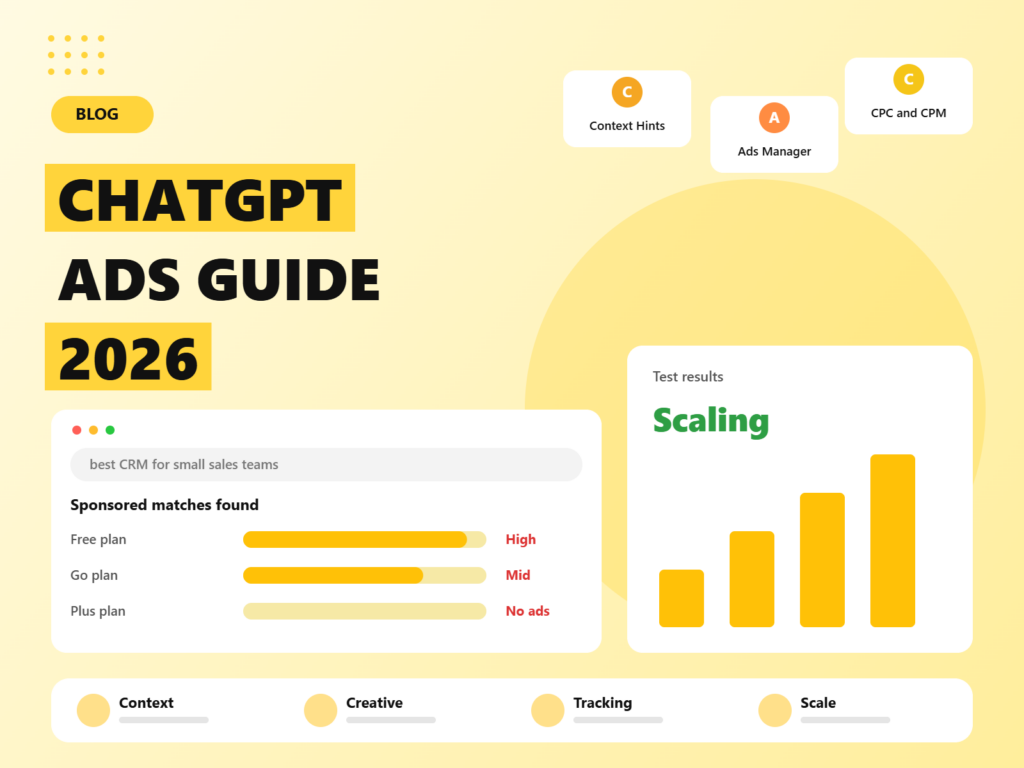
Quick answer: ChatGPT ads are clearly labelled sponsored placements that appear below ChatGPT’s answer for users on the Free and Go plans. They are matched to the conversation’s context and intent, not to keywords or personal profiles, and advertisers never see chat content. OpenAI began testing them in the US on 9 February 2026 and opened a self-serve Ads Manager on 5 May 2026. Reported pricing starts around a $60 CPM or a $3 to $5 CPC, so start with a small, tightly themed test, write context hints in natural language, and track conversions with the pixel or Conversions API.
What are ChatGPT ads (and what they are not)?
ChatGPT ads are sponsored units that appear beneath ChatGPT’s response, clearly labelled as sponsored and visually separated from the answer. OpenAI first set out its approach on 16 January 2026, and began testing in the US on 9 February 2026. The company has been consistent about four principles, and they shape how you should plan campaigns:
- Answer independence: ads do not influence ChatGPT’s answers. They run on separate systems from the chat model, and advertisers cannot shape, rank or alter responses.
- Conversation privacy: OpenAI says it does not share conversations with advertisers or sell user data. Advertisers receive only aggregated, non-identifying performance information.
- User choice: people can dismiss ads, turn off personalisation, see why they were shown an ad, and clear ad data.
- Trust over revenue: sensitive moments are protected, so ads do not appear near personal health, mental health or political conversations.
It helps to be clear about what this is not. It is not a way to buy a recommendation inside the answer itself. If ChatGPT recommends your brand organically, that comes from the model’s training data and the sources it retrieves, which is the territory of generative engine optimisation. Paid ads sit next to that, not inside it. The two work best together: the organic mention builds trust, and the sponsored card gives interested people a click-through. If you want to understand the organic side first, read our guide on tracking your brand visibility in ChatGPT, Perplexity and Google AI Overviews.
Who actually sees ChatGPT ads?
Not every ChatGPT user is part of the audience, and this matters for forecasting reach.
- Plans: ads are shown to people on the Free plan and the lower-priced Go plan. Plus, Pro, Business, Enterprise and Edu accounts are ad-free.
- Age: OpenAI does not show ads to accounts identified as belonging to users under 18.
- Surfaces: ads do not appear in Temporary Chats or in the ChatGPT Atlas browser, according to OpenAI’s help centre.
- Opt-out: users can choose an ad-free option in exchange for reduced message limits, or upgrade to a paid plan.
- Markets: testing started in the United States. Self-serve access opened to US businesses, and various reports list Canada, Australia, New Zealand and a few other markets as the programme expands. Confirm eligibility for your business location inside Ads Manager rather than trusting a blog post, including this one.
The practical takeaway: your audience skews towards free and lower-cost users, which is a broad consumer base but not the premium subscriber segment. That affects product fit. A budget meal-kit service, a consumer app or a mass-market retailer sits comfortably in this audience. A high-end B2B platform may still find buyers, because plenty of professionals use free accounts for research, but you should test rather than assume. For a sense of how large the AI assistant audience is compared with search engines, see our breakdown of AI search market share in 2026.
How ChatGPT decides which ad to show
Traditional search ads match a keyword to a query. ChatGPT works differently because the “query” is often a long, multi-turn conversation. OpenAI says its system considers the context and intent of the current conversation, the ad’s landing page, title and copy, and the advertiser’s targeting settings. Where a user has personalisation switched on, signals from wider ChatGPT use can also inform selection. When several ads are eligible, they are ranked by relevance and advertiser bids.
In practice, advertisers describe the targeting layer as context hints: plain-language descriptions of the conversations where your ad would be useful, set at campaign or ad group level. Instead of listing keywords such as “CRM software”, you describe a situation: sales teams comparing CRM tools that connect with their email and want to cut manual reporting. The system uses relevance-weighted matching rather than exact matches, so the quality of your description and landing page content decides how often you are eligible. We cover how to write these in detail in the strategy section below.
What do ChatGPT ads look like?
The standard unit, as described in launch coverage of the Ads Manager, includes the advertiser name, a favicon, a short title, a short description, an image and a landing page URL. OpenAI’s guidance, as reported, discourages using a logo as the primary visual. The copy limits are tight, so every word has to work. Think of it as a very short helpful suggestion rather than a banner.
OpenAI has also signalled that formats will keep evolving. Expect richer product-led units over time, especially for shopping and image-related conversations. Because the format is still maturing, avoid building a campaign that depends on one specific layout. Build assets that can be adapted: a clear value statement, a clean product or lifestyle image, and a landing page that answers the question the user was asking.
ChatGPT ads pricing and budgets in 2026
Pricing is the area with the most noise, so here is what is reasonably well reported, with the usual caution that auction prices move.
- CPM: early coverage of the Ads Manager reported a default CPM of about $60 for reach-style objectives. Some later guides describe a wider range of roughly $25 to $60 depending on competition.
- CPC: when OpenAI added click-based bidding in May 2026, advertisers were pointed to starting bids of roughly $3 to $5 per click, with a relevance-weighted auction in which creative quality and landing page fit influence delivery alongside the bid.
- Minimum spend: early pilots reportedly required six-figure commitments. By April 2026, reports put the minimum at $50,000, and the self-serve opening in May widened access to US businesses of all sizes. Because this has changed several times, check the current terms in Ads Manager before planning.
- Recommended test budget: agencies that have run early campaigns suggest budgeting roughly $10,000 to $25,000 per month for a proper test, enough to learn which context hints and creatives deliver, without over-committing.
If those numbers feel high, compare them with what you already pay. A $60 CPM works out to six cents per impression. That is comparable with premium social and well above typical display, which tells you OpenAI is pricing on intent and attention, not on volume. A $3 to $5 click is also well within the range of competitive Google Ads categories such as software, finance and legal services. The real question is not the sticker price but whether the visitors convert better than your paid search or paid social traffic. OpenAI has published a few early customer results, such as a wellness brand where most incremental purchases came from new customers, but those are vendor-selected examples. Treat them as encouraging, not as a benchmark for your account.
ChatGPT ad policies: what is allowed and what is not
OpenAI has published ad policies, and it pays to read them before you build creative, because rejections cost time. In summary:
Prohibited categories
Adult content, alcohol and tobacco, counterfeit goods, gambling, graphic sexual or violent content, political advertising, recreational drugs including cannabis, scams and fraud, and ads that exploit tragedies or contested social issues.
Restricted categories
Financial services, health services and legal services are handled case by case, and OpenAI’s policy lists them as US-only categories at present. If you advertise loans, supplements, clinics or law firms, expect extra review and be ready with licences and substantiation.
Creative and landing page rules
Ads must be truthful and not misleading, use professional language, be clearly distinguishable from the ChatGPT interface, and lead to a destination that accurately represents the advertiser. An approved ad cannot send people to content that would itself be disallowed.
Placement rules
Ads should not appear in personal, high-stakes or emotionally vulnerable conversations, or in mental health discussions. That means you cannot buy your way into sensitive moments, and you should not design campaigns that rely on them.
One technical point deserves its own warning. Advertisers who have run early campaigns report that ChatGPT needs to be able to read your landing page. If your robots.txt blocks OpenAI’s crawlers, such as OAI-SearchBot or ChatGPT-User, delivery can suffer, because the system uses landing page content as a relevance signal. Many sites blocked AI crawlers in 2024 and 2025 and forgot about it. Our guide to managing GPTBot, ClaudeBot and PerplexityBot explains how to allow the ones you want without opening everything.
How to launch your first ChatGPT ad campaign: step by step
Step 1: Decide whether you are a fit
ChatGPT ads work best for considered purchases where people ask for help choosing: software, travel, home services, education, consumer electronics, finance products where policy allows, and subscription brands. They are weaker for pure impulse purchases or categories that are blocked. A good test is to open ChatGPT and ask the question your buyer would ask. If the conversation naturally ends with a recommendation or comparison, you are in the right place.
Step 2: Get access and set up the account
Apply through OpenAI’s Ads Manager. Expect to verify your business, agree to the ad policies and add billing details. Plan for the verification step to take a few days, and do not wait until your campaign deadline to start it.
Step 3: Fix the landing page first
The landing page is part of the targeting signal, so it has to earn its place. Make sure it is crawlable, loads quickly, and answers the question a ChatGPT user would have asked. A user arriving from a conversation about “the best way to automate weekly reporting” should see that exact topic addressed above the fold, not a generic homepage. If you do not have a dedicated page, build one. Our free website analysis is a quick way to spot speed, crawlability and content gaps before you pay for traffic.
Step 4: Choose one objective per campaign
Practitioners report better results from a single, clear objective per campaign rather than mixed goals. Use a reach objective with CPM bidding if you are building awareness, and a click or conversion objective with CPC bidding if you want visits and sales. Keep brand and non-brand themes in separate campaigns, so you can read results cleanly.
Step 5: Write context hints for each ad group
Group ads by theme and write two to four context hints per ad group. Each should describe a person, a need and a moment. We give examples in the next section.
Step 6: Build two or three creative variants
Write helpful, conversational copy that answers the likely question, pair it with a clean image, and vary one element at a time. Resist the urge to test ten angles on a small budget. You will not collect enough data to learn anything.
Step 7: Install tracking before you launch
Add UTM parameters to every landing page URL and install the OpenAI pixel or connect the Conversions API, so you can see leads and sales, not just clicks. We cover measurement in more detail below.
Step 8: Launch small, review weekly, then scale
Start with a modest daily budget, review delivery, click-through rate, cost per click and conversion rate weekly, and pause the weakest hints and creatives. Only increase spend once you have a few weeks of stable data.
How to write context hints that get your ad shown
Context hints are the closest thing ChatGPT ads have to keywords, but they behave differently. A keyword is a string. A context hint is a description of a situation. The easiest way to write a good one is to combine four ingredients: who the user is, what they need, the context they are in, and the moment of intent they have reached.
Here are a few weak versus strong examples:
- Weak: “CRM.” Strong: “Sales teams comparing CRM tools that connect with email and automate pipeline reporting.”
- Weak: “Running shoes.” Strong: “Beginners training for their first 10K who want cushioned shoes for road running under a set budget.”
- Weak: “Accounting software.” Strong: “Freelancers in India who need to send GST-compliant invoices and want a tool they can set up in one afternoon.”
Notice how the strong versions carry constraints: budget, location, skill level, a deadline. Those details are exactly what people type into ChatGPT, and they let you be relevant in the long, specific conversations that no keyword list could cover. Use high-intent verbs such as compare, evaluate, replace, switch, choose and implement. Segment hints by buying stage too: early-stage conversations about understanding a problem, mid-stage ones comparing options, and late-stage ones about pricing, setup or migration.
Finally, keep your landing page aligned with the hints. If the hint talks about GST invoicing for freelancers, the landing page headline should too. Misalignment is the most common reason new advertisers see low delivery or weak conversion.
Creative that works in a conversational environment
People are in problem-solving mode when they see these ads. They have just read an answer, and they are deciding what to do next. That changes what good creative looks like.
- Lead with usefulness, not discounts. Early practitioner reports suggest conversational, helpful copy outperforms promotional urgency. Answer the next question the user will have.
- Use clean, recognisable visuals. A clear product shot or simple branded image tends to beat text-heavy graphics, particularly at small sizes.
- Be specific. “GST invoicing in five minutes” beats “The smarter way to bill.”
- Keep claims substantiated. Policy requires truthful ads, and users arrive with a sceptical mindset.
- Refresh regularly. With a small ad surface and repeat exposure, fatigue arrives quickly. Plan a new variant every few weeks.
Measuring ChatGPT ads: what you can track
Measurement is the area where the platform is still catching up, so build your own safety net. At the time of writing, advertisers report impressions, clicks, spend, click-through rate and average cost in Ads Manager, with a pixel and Conversions API available for downstream conversions. Attribution partners and incrementality testing options are being added.
We recommend a three-layer setup:
- Platform data: impressions, clicks, spend and the conversions OpenAI can see through the pixel or API.
- Your analytics: consistent UTM parameters so that Google Analytics 4 can attribute sessions, engagement and goal completions to the campaign. Create a distinct channel or campaign naming convention just for ChatGPT.
- Your CRM or order system: the final source of truth for revenue. For lead generation, close the loop by passing the campaign source into your CRM so sales can report on lead quality, not just volume.
Remember that ChatGPT influence is not limited to the click. Someone who sees your ad and later searches your brand name will appear as branded search or direct traffic. Watch branded search volume and direct traffic trends during your test, and consider a simple holdout comparison: run the campaign in some regions or time windows and not others. Our write-up on AI search ads and qualified future conversions shows how Google is thinking about the same problem, and the ideas transfer well.
Is ChatGPT advertising right for your business right now?
Here is a simple framework. You are a good early candidate if you can say yes to most of these:
- Your buyers research before they buy, and they ask comparison questions.
- Your category is not on the prohibited list, and restricted-category approval is realistic for you.
- You already have a strong landing page and tracking in place.
- You can afford a test budget of a few thousand dollars a month without hurting existing campaigns that are working.
- You are comfortable with incomplete reporting for a while.
You should probably wait if your business depends on instant, last-click return on ad spend, if your product is aimed at premium users who are unlikely to be on free plans, or if your tracking is not reliable yet. There is no prize for being first with a broken measurement setup.
Common mistakes to avoid
- Treating context hints like keywords. Short phrases give the system little to work with.
- Sending traffic to the homepage. The landing page is both a relevance signal and a conversion page. Use a specific one.
- Blocking OpenAI’s crawlers. Check your robots.txt and firewall rules.
- Judging results in a week. Auction learning and creative testing both need time.
- Ignoring organic visibility. If ChatGPT already recommends your competitors in answers, a sponsored card alone will not fix that. Work on both.
- Overreaching on claims. Policy review and sceptical users both punish exaggeration.
A 90-day plan for your first ChatGPT ads test
Days 1 to 15: foundations. Get account access, review the policies, audit crawlability, build or refine one landing page per theme, and set up UTMs, the pixel or Conversions API, and a reporting dashboard.
Days 16 to 45: controlled test. Launch two or three ad groups with distinct context hints and two creative variants each. Keep the budget modest. Review weekly, and do not change more than one thing per ad group at a time.
Days 46 to 75: optimise. Pause the weakest hints, rewrite the best performers with more specific constraints, and test new creative angles based on what the data shows. Compare conversion quality with your other paid channels.
Days 76 to 90: decide. Calculate cost per qualified lead or customer, factor in assisted conversions and branded search lift, and decide whether to scale, hold or stop. Document what you learned. The playbook you write now will be valuable when ChatGPT ads mature and competition rises.
The bigger picture: ads and AI visibility work together
ChatGPT ads are part of a larger shift in how people discover brands. More research happens inside AI assistants, more answers end without a click, and the platforms are experimenting with monetisation. Our analysis of zero-click searches in 2026 shows how much traffic is already changing, and our piece on agentic commerce explains where shopping is heading next. The sensible plan for most brands is to invest in three things at once: organic AI visibility through strong content and structured data, paid placements where they make commercial sense, and measurement that connects both to revenue.
If you want help planning that mix, our team at Nowoka Digital offers PPC management and LLM SEO services built for exactly this shift. We can audit your landing pages and crawlability, shape your context hints and creative, and set up tracking that holds up when the budget grows.
Frequently asked questions
What are ChatGPT ads?
ChatGPT ads are clearly labelled sponsored placements that appear below ChatGPT’s response for users on the Free and Go plans. They are selected using the context and intent of the conversation, the ad’s landing page and copy, and the advertiser’s targeting, and they do not change ChatGPT’s answers.
How much do ChatGPT ads cost?
Who can see ChatGPT ads?
Can advertisers see what users say to ChatGPT?
Which industries are not allowed to advertise on ChatGPT?
Do I need to allow OpenAI crawlers on my website to run ChatGPT ads?
We audit your landing pages and crawlability, shape your context hints and creative, and set up tracking so you can see what ChatGPT ads really deliver for your business.

Riya Bhardwaj
Leading content and growth initiatives with a focus on search visibility, audience engagement, and measurable business outcomes. Specialised in SEO, Generative Engine Optimization (GEO), AI search optimisation, and performance-driven content marketing. Passionate about transforming market insights into scalable content strategies that strengthen brand authority and drive sustainable digital growth.