
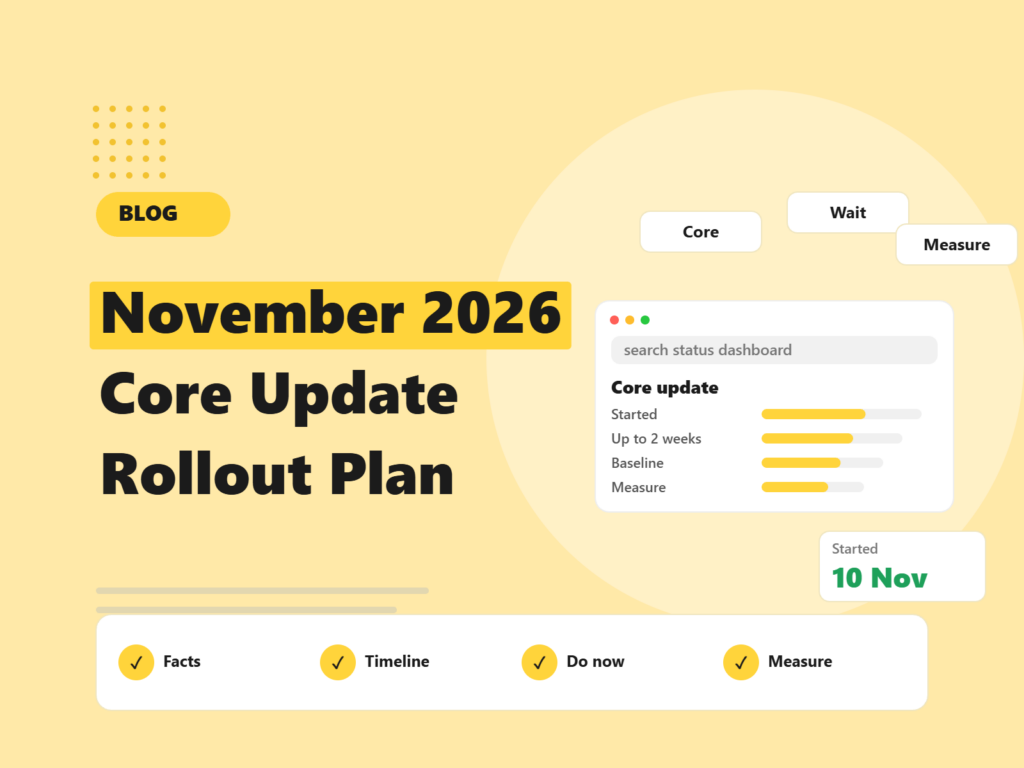
Google confirmed the November 2026 core update on Tuesday 10 November 2026, shortly after 10 a.m. Pacific time. It is a global update that applies to all languages, and Google says it may take up to two weeks to roll out. If your rankings or traffic move over the next few days, do not panic and do not start rewriting pages. Here is what Google said, what the rollout may look like, and a calm plan for the days ahead.
Quick answer: The Google November 2026 core update started on 10 November and may take up to two weeks. Google calls it a regular update designed to better surface relevant, satisfying content from all types of sites. Do not make big changes mid-rollout. Wait until it finishes, then wait at least a full week and compare against the week before 10 November.
What did Google announce?
Based on Google’s Search Status Dashboard entry and its social post, as reported by Search Engine Roundtable and Search Engine Journal:
- Google released the November 2026 core update, which applies globally and to all languages.
- Google describes it as “a regular update designed to better surface relevant, satisfying content for searchers from all types of sites.”
- The rollout may take up to two weeks to complete.
- Google says core updates do not target specific sites or pages, and are meant to keep its systems current.
- Google will update its ranking release history page when the rollout is complete.
Google did not list specific goals for this update, and the Search Central blog had no post about it at the time of the reports.
How long will it take?
Google says up to two weeks. The previous 2026 core updates ran from 27 March to 8 April and from 21 May to 2 June, about 12 days each. SEJ notes that a full two-week rollout would finish around 24 November. That date is an estimate, not a Google statement.
What should you do during the rollout?
- Save a baseline. Export your Search Console performance data for the week before 10 November, which is Google’s suggested baseline.
- Do not make big changes. Rewriting titles, merging pages or changing templates during the rollout makes it hard to know what caused what.
- Note volatility, but do not act on it. Rankings can move up and down while the update is rolling out.
- Keep publishing useful content. Normal, planned work is fine. Just avoid panic edits.
- Check your tracking. Make sure rank tracker gaps are not distorting your view. See our post on rank tracker data gaps.
How should you measure the impact?
Google’s core update documentation advises waiting until the rollout is complete, and then waiting at least a full week before analysing. Then compare that week with the baseline week before the update started.
- Look at clicks, impressions and average position by page group, not only at the site total.
- Check your top queries and your top landing pages.
- For ecommerce, remember seasonality (see below).
What about Black Friday and the holidays?
This is our own note, not a Google statement. The rollout and the weeks after it overlap with Thanksgiving, Black Friday and Cyber Monday. If your business sells to US shoppers, a normal week and a holiday week are not the same, so a post-update comparison can mix seasonality with update effects. Compare against the same period last year as well as the pre-update week. Our holiday 2026 ecommerce plan covers the marketing side.
If you lose traffic, what then?
Google says core updates are not penalties, and recovery is not instant. At a Search Central Live event on 2 October, Gary Illyes shared a typical core update recovery range of 3 to 6 months, as reported by SEJ. We explain the ranges in our indexing and recovery timelines guide.
- Wait for the rollout to end, plus a week.
- Find which pages and queries dropped, and by how much.
- Ask honestly whether those pages are the best answer available. Read Google’s core update advice.
- Improve the pages with real substance: original insight, clearer answers, better evidence.
- Be patient. Improvements may not show until a later update.
Common mistakes during a core update
- Changing a lot of pages in the first week.
- Blaming a single factor without data.
- Comparing a holiday week with a normal week.
- Assuming a drop means a penalty. Check for manual actions in Search Console to be sure, and see our Google penalty recovery services if you find one.
Final thoughts
Core updates are stressful because they are unannounced in detail and slow to resolve. The best response is steady: record a baseline, wait, measure properly and improve what deserves it. If you want expert help reading your data once the rollout ends, request a free website audit.
Frequently asked questions
When did the Google November 2026 core update start?
Google confirmed it on Tuesday 10 November 2026, shortly after 10 a.m. Pacific time.
How long will the November 2026 core update take?
Google says it may take up to two weeks. A full two weeks would end around 24 November, according to SEJ’s estimate.
Does the update apply to all countries and languages?
Google says it applies globally and to all languages.
When should I check my results?
After the rollout is complete, wait at least a full week, then compare that week with the week before 10 November.
Is a core update a penalty?
No. Google says core updates do not target specific sites or pages. Manual actions are separate and show in Search Console.
We compare your before and after data, separate update effects from seasonality, and tell you what to fix first.

Riya Bhardwaj
Leading content and growth initiatives with a focus on search visibility, audience engagement, and measurable business outcomes. Specialised in SEO, Generative Engine Optimization (GEO), AI search optimisation, and performance-driven content marketing. Passionate about transforming market insights into scalable content strategies that strengthen brand authority and drive sustainable digital growth.