
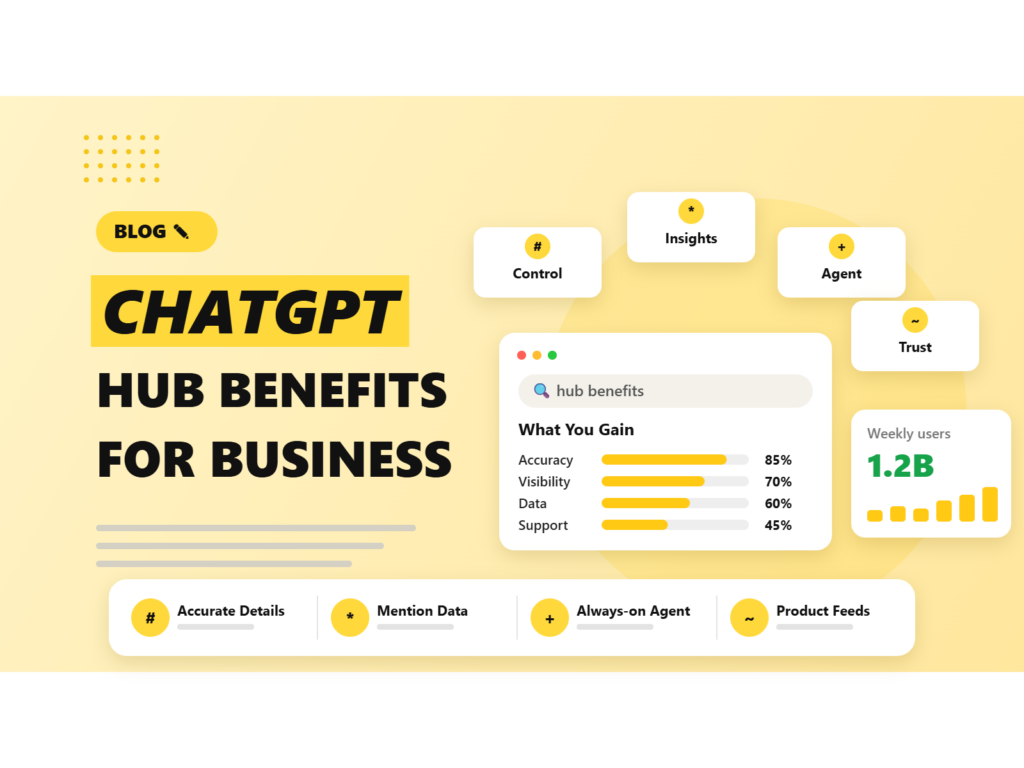
Everyone is talking about the new ChatGPT Business Hub, but the question that matters to an owner is practical: what do I get out of it? OpenAI launched Businesses in ChatGPT in beta on 10 November 2026, and with about 1.2 billion weekly users reported for ChatGPT, even a small improvement in how it describes your business can matter. This post explains the real benefits, the limits you should know about, and a simple plan to get value from it. If you want the feature list first, read our ChatGPT Business Hub overview.
Quick answer: ChatGPT Business Hub is useful because it lets you control the facts ChatGPT may use about your business, shows how often you are mentioned and clicked, lets eligible US ecommerce and online service businesses launch a Business Agent, and gives product sellers a feed for prices and availability. It does not guarantee more recommendations, and the data comes from OpenAI. Treat it as a way to be accurate and measurable, not as a shortcut to ranking.
Why ChatGPT Business Hub matters
People now ask ChatGPT questions they used to type into Google: who is the best supplier, what does this company sell, is this store trustworthy. The answer is a short summary, and the summary is only as good as the sources behind it. If your opening hours, prices or services are wrong on a third-party site, ChatGPT can repeat the error with confidence. Until now you had little say in that.
The Business Hub changes this by giving you a verified place to state the facts. TechCrunch notes it works much like the business profiles that Google and other search engines already offer. The difference is the setting. A Google profile sits next to ten blue links. A ChatGPT profile can sit inside a conversation where the user is comparing you with competitors in a single reply.
The main benefits of ChatGPT Business Hub
1. More accurate answers about your business
Once verified, you can edit the core details: name, address, phone, email, category, description, and delivery and return policies. OpenAI says ChatGPT may use this information. Even with that caveat, a verified source you control is better than leaving the job to scattered directories.
2. First-party data on mentions and clicks
Business Insights shows how often ChatGPT mentioned your business, how many clicks went to your website and the discovery topics behind those mentions. PPC Land reports 7-day and 28-day views. Discovery topics are the most useful part for content teams, because they show what real people are asking when your site comes up. Use them to plan new pages and FAQs.
3. A product feed for sellers
Retailers can add self-service product feeds with pricing and availability, and Shopify merchants can connect a store. If your prices or stock change often, this is a cleaner route than hoping ChatGPT reads your site correctly.
4. An always-on Business Agent (for eligible businesses)
A Business Agent answers questions about your products, compares specifications and handles follow-ups at any hour, using the information and rules you give it. Conversations are labelled and separate from regular ChatGPT answers. For now, only eligible ecommerce and online service businesses in the US can create one, so check your eligibility before you plan around it.
5. A paid option when you want it
You can sponsor an agent as a destination for ChatGPT Ads. Search Engine Journal’s walkthrough saw an offer of a $500 advertising credit on the setup screen, which has its own eligibility and redemption terms. Ads are optional, and the profile itself does not depend on them.
6. A trust signal
OpenAI verifies ownership and runs an identity check, which helps prevent scams and takeovers of listings. A verified profile tells users that the details come from the business itself.
The honest limits of ChatGPT Business Hub
The benefits are real, but so are the limits. Read these before you promise anything to your boss or client.
- No guaranteed placement. Claiming a profile is not said to affect ranking or how often you are mentioned. ChatGPT still makes its own recommendations and comparisons.
- The data comes from OpenAI. Inc. warns that the visibility numbers are reported by the platform itself, so cross-check them with your own analytics.
- Clicks are not sales. OpenAI’s own wording is that clicks do not confirm visits or conversions. Data also appears only above a volume threshold, so small sites may see empty charts at first.
- You are building on someone else’s platform. Rules, features and fees can change. Inc. advises keeping your own email list, direct customer relationships and reputation.
- It is a beta. Rollout is gradual, some claims are waitlisted and agents are limited to eligible US businesses.
- It only covers ChatGPT. It has no link to Gemini, Claude, Copilot or Google AI Overviews.
Who gets the most value?
Ecommerce stores gain the most today: product feeds, a Shopify connection and the chance of a Business Agent. Online service businesses in the US can also qualify for agents. Local businesses such as stores and restaurants can claim existing US listings, according to Search Engine Journal, which also warns that physical-location profiles may be waitlisted. Publishers and B2B sites are less clear. PPC Land noted the sign-up looks aimed at product sellers, but Search Engine Journal created a profile for a magazine publisher and saw mention and click data.
That example is worth a note. Over 14 October to 10 November 2026, the publisher’s dashboard showed 353,356 mentions and 2,663 website clicks, as reported by Search Engine Journal. Mentions are far more common than clicks, so measure success by clicks and by the leads that follow, not by mentions alone.
ChatGPT Business Hub vs Google Business Profile
They solve a similar problem in different places. Google Business Profile is mature, tied to Search and Maps, and built around reviews, photos and local actions. ChatGPT Business Hub is new, still in beta, and built around verified facts, product feeds, Insights and agents. You need both. Keep your name, address, phone number, hours and prices identical in each, because inconsistent details make it harder for any AI system to trust you.
A practical 30-day plan to get value from ChatGPT Business Hub
Week 1: Audit what ChatGPT says today
Ask ChatGPT 15 to 20 questions your customers would ask, including your brand name, your category and “best [service] in [city]”. Write down what it says about you, what is wrong and which competitors appear. Check that your name, address, phone number, hours and prices match on your website, Google Business Profile and main directories.
Week 2: Apply and verify
Prepare your documents, then apply. Our step-by-step guide on how to claim your business profile in ChatGPT Business Hub covers the claim route, and our guide to submitting your website to ChatGPT Business Hub covers DNS and identity checks.
Week 3: Fill in the profile and feed
Write a plain-language description, complete every field, and add products with prices and availability, or connect Shopify. Preview the result and fix anything that reads oddly. Keep delivery and return answers short and exact.
Week 4: Measure and improve
Check Insights and compare it with Google Analytics 4 and Search Console. Note the discovery topics, then turn them into new pages, FAQs and comparison content. If you are eligible and the numbers justify it, test a Business Agent or a small ads budget.
What to track
- Mentions and website clicks from Business Insights, week on week.
- Discovery topics, as a list of content ideas.
- Branded search and direct traffic in your own analytics.
- Leads or sales that follow visits from ChatGPT, where you can attribute them.
How Nowoka can help
A verified profile works best when your website and content back it up. Our GEO services, AEO services and local SEO services help you become the business AI tools describe correctly. For more on measuring AI visibility, read how to reset your AI citation baseline and the ethical GEO guide.
Sources: Inc., PPC Land, Search Engine Journal, TechCrunch, AIN. The feature is in beta and details may change.
Frequently asked questions
Is ChatGPT Business Hub worth it for a small business?
If you are eligible, it is worth the setup time. OpenAI has not stated a fee for claiming a profile, and it gives you control over key details plus mention and click data. Just do not expect guaranteed recommendations or sales.
Will ChatGPT Business Hub replace Google Business Profile?
No. They work in different places, and you should keep both accurate and consistent. Google still dominates search, and ChatGPT Business Hub only covers ChatGPT.
Can I see who chatted with my business in ChatGPT?
No. Business Insights is aggregated and shows mentions, website clicks and discovery topics. You cannot see individual user conversations or agent chat transcripts.
Does ChatGPT Business Hub help SEO?
It is not described as a ranking factor in Google or in ChatGPT. It helps with accuracy and AI visibility measurement, so classic SEO and good content still matter.
What should I do before applying?
Check how ChatGPT describes you today, make your name, address, phone and prices consistent everywhere, and prepare DNS access, a government ID and your legal business details.
We help you prepare your profile, website and content for AI search, then track which mentions and clicks turn into real enquiries.

Riya Bhardwaj
Leading content and growth initiatives with a focus on search visibility, audience engagement, and measurable business outcomes. Specialised in SEO, Generative Engine Optimization (GEO), AI search optimisation, and performance-driven content marketing. Passionate about transforming market insights into scalable content strategies that strengthen brand authority and drive sustainable digital growth.