
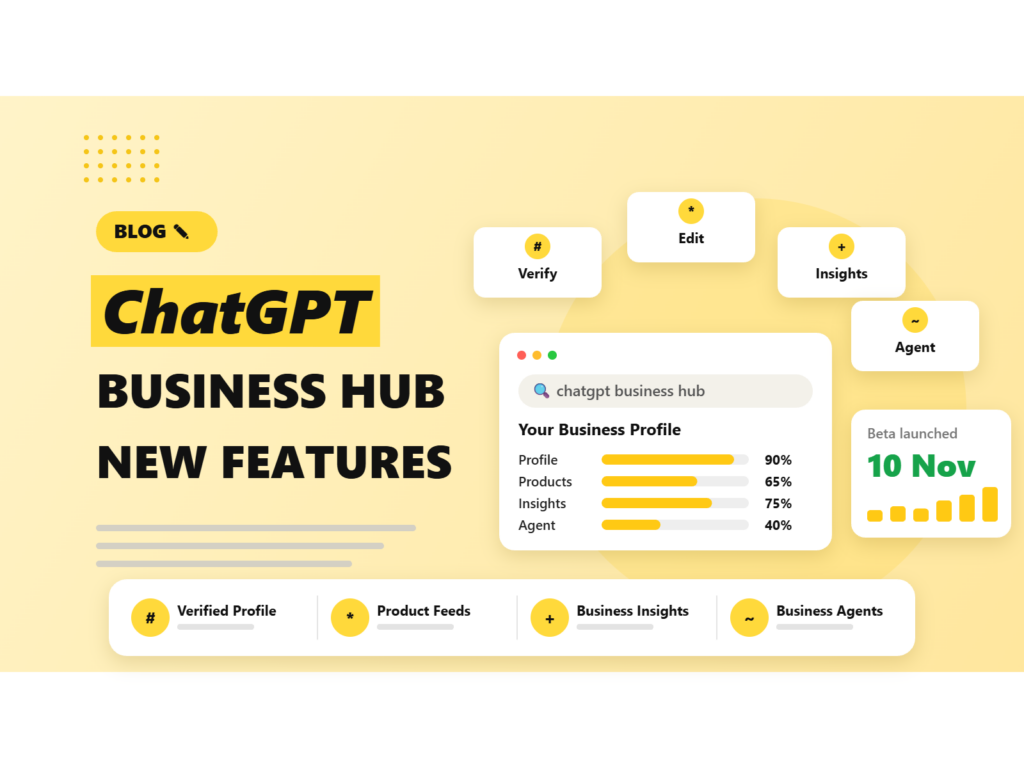
On 10 November 2026, OpenAI opened a beta of Businesses in ChatGPT. At the centre of it is a new area called the ChatGPT Business Hub. In simple terms, it is a place inside ChatGPT where a company can claim its profile, fix the details ChatGPT uses about it, and see how often it shows up in answers. Reports put ChatGPT at about 1.2 billion weekly users, so this is not a small side feature. It is the first real attempt to give businesses a say in how an AI assistant describes them.
Quick answer: ChatGPT Business Hub is OpenAI’s new section for managing how your business appears in ChatGPT. It went live in beta on 10 November 2026. It has four main parts: verified business profiles, product feeds, Business Insights (mentions, website clicks and discovery topics) and Business Agents, which are limited to eligible US ecommerce and online service businesses for now. Claiming a profile does not guarantee more mentions or more sales.
What is ChatGPT Business Hub?
ChatGPT Business Hub is the control panel for what OpenAI calls Businesses in ChatGPT. A company uses it to prove that it owns or represents a business, then manages the profile ChatGPT can draw on when people ask about it. Until now, ChatGPT built its picture of a business from whatever it could find on the open web: your website, reviews, directories and news stories. If any of those sources were out of date, ChatGPT could repeat the mistake. The Hub gives the business a direct way to say, “these are our current details.”
Most coverage compares it to Google Business Profile. TechCrunch said it makes ChatGPT a little more like Google, where people already go to learn about a company before they buy. Inc. called it a Google Business Profile for the AI era. The comparison is fair, with one big difference. A Google profile feeds a list of search results. A ChatGPT profile feeds a conversation, where the assistant may describe you, compare you with other businesses and answer follow-up questions in a single reply.
When did ChatGPT Business Hub launch?
OpenAI rolled out Businesses in ChatGPT on Tuesday 10 November 2026, and it is still in beta. The rollout is gradual. Some businesses can start straight away, while others are placed on a waitlist or cannot see the Hub yet. Eligibility depends on industry, location and verification checks. Profile claiming is open in markets where ChatGPT is available, but some features, such as agents, are much narrower (more on that below).
It also helps to know what came before. According to TechCrunch, OpenAI tried an in-chat shopping checkout with commission fees and retired that effort in March 2026 after it failed to gain traction. The Business Hub takes a different route. Instead of taking a cut of each sale, it asks businesses to keep their information accurate, then offers measurement, agents and paid placements on top.
The new ChatGPT Business Hub features, one by one
1. Verified business profiles
The profile is the base for everything else. You search for your business, claim an existing listing or create a new one, and prove you are allowed to manage it. OpenAI says it uses several verification methods, which differ by business type and market. Early reports mention a call or text to the main business number, a DNS record on your domain, and a government ID check before you can edit or publish. We walk through each step in our guide on how to claim your business profile in ChatGPT Business Hub.
2. Editable business details
Once verified, you can update the core facts about your business. Forbes lists the fields as business name, address, phone, email, category, description, and delivery and return policies. OpenAI says ChatGPT “may use” this information, not that it always will. Treat the profile as a strong signal you control, not as a switch that forces ChatGPT to repeat your wording.
3. Product feeds and Shopify connection
Retailers can add self-service product feeds with pricing and availability. Shopify merchants get a shortcut: they can connect a store through the Shopify admin or through the Hub, and product data flows in through Shopify Catalog. For stores with hundreds of products, this is the feature that saves the most manual work.
4. Business Insights
Insights is the measurement side. It reports how often ChatGPT mentions your business, how many clicks go to your website, and the discovery topics, which are the themes of conversations where ChatGPT cited your site. PPC Land reports views for the last 7 and 28 days, split into Brand insights and Agent insights tabs. The data is aggregated and appears only above a volume threshold, and you cannot see individual chats.
Keep the limits in mind. A click is not a confirmed visit or a sale, early dashboards showed a reporting delay of at least a day, and OpenAI has not published exactly how a mention is counted. Use the numbers to spot trends, not to report revenue.
5. Business Agents
A Business Agent is a specialised AI assistant that people can open from your profile. It can answer questions about your products and services, compare specifications and handle follow-ups, using the information and guidelines you give it. Agent chats are clearly labelled and kept separate from normal ChatGPT answers. Verified companies that meet OpenAI’s requirements can create, test and launch an agent, but for now this is limited to eligible ecommerce and online service businesses in the US. OpenAI plans to widen access to other countries and categories, with no timeline given.
6. Ads and sponsored agents
Companies can sponsor an agent and use it as a destination for ChatGPT Ads. These placements are labelled so users can tell them apart from regular answers. OpenAI has not stated a fee for claiming a profile, but sponsored placements are clearly a paid layer on top of it.
Who can use ChatGPT Business Hub, and what are the limits?
As of 13 November 2026, this is what has been reported:
- Profile claiming: open to eligible businesses in markets where ChatGPT is available, subject to verification.
- Business Agents: select US ecommerce and online service companies only.
- OpenAI Enterprise customers and advertisers: should work with their OpenAI representative instead of using the Hub sign-up.
- Publishers and non-product sites: early reports are mixed. PPC Land noted the sign-up looks aimed at businesses selling products, while Search Engine Journal set up a profile for a magazine publisher.
There are also real caveats. Claiming a profile does not guarantee better placement, because ChatGPT still makes its own recommendations. The visibility data comes from OpenAI itself. Forbes points out that claiming a listing binds you to the Businesses in ChatGPT terms, so it is worth having someone read them first. And this is an OpenAI feature only: it has no link to Gemini, Claude or Copilot.
What should you do now?
- Ask ChatGPT the questions your customers ask, such as “best [your service] in [your city]”, and note what it says about you and whether it is correct.
- Check that your name, address, phone number, hours and prices match across your website, Google Business Profile, directories and social pages.
- Gather what you will need: access to your domain’s DNS, a government ID for the person verifying, and your legal business details.
- Apply through the Hub and complete verification. Our guide to submitting your website to ChatGPT Business Hub covers the website route in detail.
- Check Insights weekly, and compare it with your own analytics. Our post on why the Hub is useful for your business explains how to read the numbers.
How Nowoka can help
A verified profile is only one input. ChatGPT also relies on your website, your reviews and the wider web. If you want help becoming the business AI assistants mention, our GEO services and AEO services cover content, structured data and citation tracking. For related reading, see how to reset your AI citation baseline and how to find AI citation gaps.
Sources: TechCrunch, AIN, PPC Land, Forbes, Inc.. The feature is in beta and details may change.
Frequently asked questions
What is ChatGPT Business Hub?
It is OpenAI’s new section of ChatGPT where businesses claim and verify a profile, update their details, add product information and see mention and click data.
When did ChatGPT Business Hub launch?
OpenAI launched Businesses in ChatGPT, including the Business Hub, in beta on Tuesday 10 November 2026. Rollout is gradual.
Is ChatGPT Business Hub free?
OpenAI has not stated a fee for claiming a profile, and reports describe it as free. Sponsoring a Business Agent through ChatGPT Ads is a separate, optional paid layer.
Who can create a Business Agent?
For now, verified businesses that meet OpenAI’s requirements, limited to eligible ecommerce and online service companies in the US. OpenAI plans to expand access but has given no dates.
Will claiming a profile make ChatGPT recommend my business more?
Not by itself. OpenAI says ChatGPT may use your profile information, but it still makes its own recommendations. A profile helps accuracy and measurement more than ranking.
We help brands get their website, content and business profiles ready for AI search, so ChatGPT and other assistants describe them the right way and send the right visitors.

Riya Bhardwaj
Leading content and growth initiatives with a focus on search visibility, audience engagement, and measurable business outcomes. Specialised in SEO, Generative Engine Optimization (GEO), AI search optimisation, and performance-driven content marketing. Passionate about transforming market insights into scalable content strategies that strengthen brand authority and drive sustainable digital growth.