
Quick answer
Semrush confirmed on October 27, 2026 that Google is sometimes sending “poisoned” results to automated rank trackers. These pages look normal, but some results are wrong or only loosely related to the keyword. Ahrefs, AccuRanker, BrightLocal, SISTRIX and other tools have reported the same thing, so this is an industry-wide issue, not a Semrush bug.
Semrush says it now filters out clearly invalid results, has adjusted some data sources, and has added checks that flag suspect results and collect them again. Its advice is simple: if a ranking jumps or drops for no clear reason, compare it with Google Search Console before you change anything.
The short version:
- A sudden drop or gain in a rank tracker may be bad data, not a real ranking change.
- Most bad pages fix themselves in about three days, based on Nozzle’s data.
- Treat Search Console as your source of truth for clicks, impressions and average position.
- Hold client reports and big SEO changes until you have confirmed the move.
What did Semrush confirm about poisoned Google results?
In a post dated October 27, 2026, called Poisoned SERPs: An update on Google ranking data in Semrush, Semrush said some automated Google requests return a results page that looks normal but is not what a regular user sees. It described two versions of the problem:
- The whole page is off. Results do not match the query, even on page one.
- The top looks fine, the bottom does not. The first results seem right, but lower results only loosely match the keyword.
Semrush shared a simple example. A search in Brazil for a specific stroller model returned a dental supply store, because both pages use the Portuguese word “carrinho”.
Semrush also called this an industry-wide issue and noted that “Google hasn’t commented publicly”.
How big is the problem?
Semrush did not publish any numbers. Other companies did:
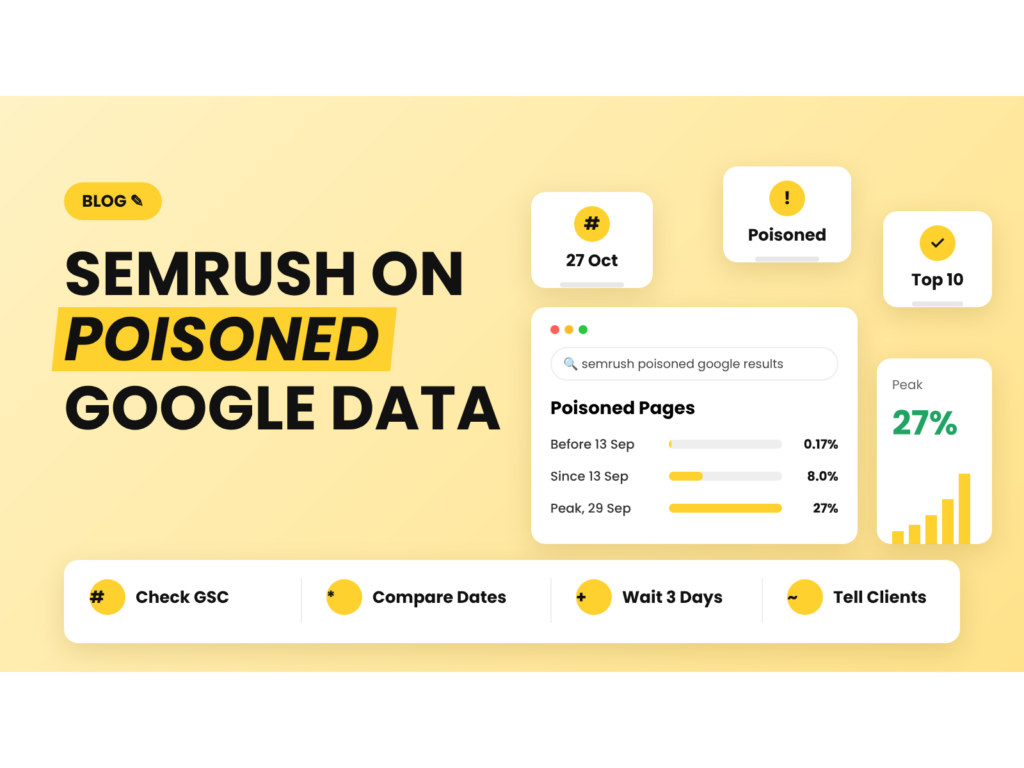
- Nozzle: 8.0% of pages collected since September 13 were poisoned, up from 0.17% before. It peaked at about 27% on September 29. (Search Engine Roundtable, PPC Land)
- Ahrefs: between 5% and 20% of results affected, depending on the data provider. (PPC Land)
- Semrush (to Search Engine Roundtable): impact on tracked rankings has been limited, with no service interruptions.
These numbers come from different tests and baselines, so do not compare them directly. None has been independently audited.
What do poisoned results look like?
Nozzle found that the swapped-in results lean towards social and forum sites. Reddit’s share of the top 10 on poisoned pages rose from 20.8% to 28.8%, and Facebook, LinkedIn, Instagram and Quora all gained too. On poisoned pages, the tracked site itself was missing from the top 10 in 58.6% of cases, compared with 2.7% normally. That is why a poisoned page can look like a real ranking crash.
Why is Google poisoning results for rank trackers?
Google has not explained. Semrush points to discussion that the likely cause is an effort to limit large-scale data collection for AI systems. Barry Schwartz of Search Engine Roundtable makes a similar guess: the target is AI bots and scraping services like SerpApi, and SEO tools got caught in the crossfire.
According to Nozzle’s Derek Perkins, Google is using three tactics: wide IP blocking aimed at residential proxy networks, more CAPTCHAs, and injecting wrong results into suspect pages. Google has not confirmed any of this. Nozzle’s short summary of the pattern: Google blocked first, then poisoned.
Here is how the story built up, newest first:
| Date | What happened | Source |
|---|---|---|
| Oct 27, 2026 | Semrush publishes its poisoned SERPs update | Semrush |
| Oct 22, 2026 | Ahrefs says 5% to 20% of results are affected and starts cleaning past data | PPC Land |
| Oct 16, 2026 | BrightLocal warns that Local Rank Tracker is affected | BrightLocal |
| Oct 10–12, 2026 | Nozzle publishes its study: 8.0% of pages poisoned | Search Engine Roundtable |
| Sep 27–29, 2026 | Poisoning peaks at roughly 25% to 27% of pages in Nozzle’s data | PPC Land |
| Sep 24 – Oct 8, 2026 | Google’s September spam update rolls out; some trackers show changes real searchers never saw | AI Eating the World |
| Sep 20, 2026 | First poisoned pages appear in Nozzle’s data | PPC Land |
| Sep 13, 2026 | Requests to Google start failing in large numbers | PPC Land |
| Sep 14, 2025 | Google drops the num=100 parameter, so tools need many more requests to see deep results | PPC Land |
The spam update overlap matters. If your rankings moved in late September, part of it may be a real update effect and part may be bad tracker data. Do not assume it is all one or the other.
Which SEO tools are affected?
Almost every tool that collects Google results by automation. Semrush is not alone, and the tools differ in how they say they handle it:
| Tool | What it says | Source |
|---|---|---|
| Semrush | Impact on tracked rankings is limited; invalid results excluded, extra validation checks added, flagged results collected again | Semrush |
| Ahrefs | 5% to 20% of results affected depending on the provider; filters abnormal results, requests replacements, cleaning past data | PPC Land |
| AccuRanker | Discards short result pages and re-fetches in a new browser session; compares page 1 with the previous days’ sites | Search Engine Journal |
| BrightLocal | Local Rank Tracker affected, Local AI Visibility partly affected; Map Pack and Maps results less affected; added more data providers | BrightLocal |
| SISTRIX | Narrowed its tracking to the top 10, saying deeper positions can no longer be compared reliably over time | PPC Land |
| SE Ranking | Said about 2% of tracked results were still affected and shrinking | Search Engine Roundtable |
| SEOmonitor | Re-fetches suspect results before saving them; estimates about 8% of daily results need this | Search Engine Journal |
DataForSEO, Advanced Web Ranking, Morningscore and DemandSphere have also posted notices, per Search Engine Roundtable and PPC Land.
One practical point from BrightLocal: if you run several rank trackers, you may see the same odd results in all of them, because they depend on the same Google behavior.
How is Semrush fixing it?
Semrush described four changes in its update:
- Detection during collection. Systems spot clearly invalid results and keep them out of the database.
- New data sources. Semrush adjusted its sources based on data quality.
- Validation checks. Results that look potentially inaccurate are flagged and collected again.
- Ongoing refinement. Semrush says it will keep improving these processes.
What Semrush did not say matters too. The post has no percentages or counts, and it does not describe a broader backfill of older data. It also does not split the problem into page one versus deeper pages. Search Engine Roundtable quotes Semrush saying issues may occur beyond page one, which fits what BrightLocal and Nozzle report.
If you see odd data, Semrush asks you to contact support with the domain and keywords so the team can review it with you.
How can you check if your rankings data is affected?
Use this quick routine before you react to any big move in Semrush or any other tracker:
- Note the window. Most trouble sits between mid-September and late October 2026, with a peak around September 27–29.
- Look for unrelated keywords moving together. If a mix of unrelated keywords all drop at once, suspect bad data first.
- Open Google Search Console. Go to Performance, pick the same dates, and compare clicks, impressions and average position for the page or query. Average position can vary by device, location and timing, so use it as supporting evidence, not as an exact match.
- Check the device and country. AccuRanker reported more bad results on mobile at times, and Nozzle saw big differences between countries.
- Search it yourself. Run the keyword in a clean browser window. If the live page shows your site where the tracker says it vanished, the tracker is wrong.
- Look for odd URLs. Poisoned pages often show unrelated social profiles or forum threads where normal results used to be.
- Wait two or three days. In Nozzle’s data, 80% of poisoned spells lasted a single collection, and on most affected pages the usual sites came back within three days.
- Still unsure? Contact support. Send Semrush the domain and keywords so the team can review the data with you.
Rule of thumb: if Search Console clicks and impressions are steady and only the tracker moved, treat it as a data issue. If Search Console moves too, it is likely a real change and worth digging into.
What does this mean for SEO agencies and in-house teams?
The biggest risk is not the bad data itself. It is acting on it. A panicked rewrite, a wrong report or a lost client conversation can cost more than the data glitch.
Here is what to do this week:
- Audit your recent reports. Look at anything you sent covering mid-September to late October. Ask your tool vendor whether stored data for those dates was updated, and compare older exports with current numbers before you resend anything.
- Add a note to reports. One line saying that third-party rank data was affected by an industry-wide Google issue builds trust and heads off awkward questions.
- Lead with Search Console and business metrics. Clicks, leads and revenue do not depend on a scraper.
- Pause big changes. Do not rewrite pages, disavow links or change strategy because of one tracker move.
- Keep a log. Write down dates when your tools reported problems so future drops can be explained quickly.
This also changes how you talk about rankings with clients. A single keyword position was always a rough signal. Now it is a rough signal with a known data-quality caveat, which makes trends, clicks and conversions a safer story.
If you want a second pair of eyes on your ranking and reporting data, the team at Nowoka Digital is happy to help.
What else has Semrush launched in 2026?
The poisoned SERP update is not the only Semrush news this year. These are the main launches listed on the Semrush product news page, newest first:
| Date | Update | What it does |
|---|---|---|
| Aug 26, 2026 | Official Connector for Claude | Brings Semrush search and market intelligence into Claude for marketing workflows |
| Aug 11, 2026 | Crazy Egg in the App Center | Adds Crazy Egg visitor insights and website analytics inside Semrush |
| Jun 17, 2026 | Adobe Brand Visibility | Joint solution that mixes Semrush AI visibility data with Adobe content optimization |
| Jun 11, 2026 | Traffic Insights | AI-powered insights in Traffic Analytics that explain why competitor traffic spikes or drops |
| Jun 3, 2026 | MCP Connector in Perplexity | Lets Perplexity users access Semrush search intelligence through the Model Context Protocol |
| May 27, 2026 | Unified content optimization for Enterprise | Shared workflows across SEO and AI search optimization |
| May 14, 2026 | AI Visibility Database in 32 countries | Adds 17 markets; the prompt database now has over 261 million LLM prompts |
The pattern is clear. Semrush is moving from classic keyword tracking towards AI search visibility and connected workflows, with connectors that let you pull its data into the AI tools your team already uses. That makes data quality even more important, because the numbers now feed automated workflows, not just dashboards.
How do you build rank tracking you can trust?
No single tool is a perfect mirror of Google right now. A more resilient setup uses a few simple habits:
- Use two or three sources. Pair your rank tracker with Google Search Console and a manual spot check on your most important keywords.
- Focus on the top 10. Deeper positions are where poisoned results show up most. SISTRIX has already narrowed its tracking to the top 10 for this reason.
- Track trends, not single days. A one-day swing that reverses within a few days is likely noise.
- Watch clicks and conversions. These come from your own analytics, not from a scraper.
- Annotate your data. Mark the September to October 2026 window in your reports so nobody misreads it later.
- Ask vendors the right questions. Does the tool re-check suspect results? Was stored history corrected? Are page-two results reliable?
Do not forget AI search visibility
Rankings are only one view of search now. People also get answers from AI Overviews, ChatGPT, Perplexity and Claude. So add a second layer to your reporting:
- Track whether your brand is mentioned or cited for your key questions in AI answers.
- Check which sources AI tools pull from in your niche. Forums and social platforms show up a lot.
- Write pages that answer one clear question in the first lines, then add depth, data and sources. This helps both Google and AI engines pick your content up.
Semrush’s own direction supports this. Its AI Visibility Database now covers 32 countries and more than 261 million prompts, so tracking how you appear in AI answers is becoming a normal part of SEO reporting.
Frequently asked questions
What are poisoned Google search results?
Poisoned results are search pages that look normal but contain wrong or loosely related results. Google appears to send them to automated tools it suspects of collecting data at scale. Real users searching in a browser do not see them.
Did Semrush confirm the poisoned SERP issue?
Yes. Semrush published an update on October 27, 2026 confirming that some automated Google requests return results that differ from what typical users see, and described the checks it added in response.
Is my Semrush ranking data wrong?
Probably not for most keywords. Semrush says the impact on tracked rankings has been limited. But if you see sudden unexplained drops or gains, especially across unrelated keywords, check them against Google Search Console first.
Which tools are affected besides Semrush?
Ahrefs, AccuRanker, BrightLocal, SISTRIX, SE Ranking, SEOmonitor, DataForSEO and others have reported or posted notices about the issue.
How long do poisoned results last?
In Nozzle’s data, 80% of poisoned spells lasted a single collection, and on most affected pages the usual results returned within three days, with a median of two days.
Why is Google doing this?
Google has not said. The common theory is that it is limiting large-scale data collection for AI systems, and SEO tools are collateral damage. That is an industry theory, not a Google statement.
Should I change my SEO strategy because of this?
No, not because of tracker data alone. Confirm any big move in Search Console and your analytics before you change content, links or client plans.
Where can I see the latest Semrush product updates?
On the Semrush product news page.
Final thoughts
The Semrush confirmation is a useful reminder: rank trackers measure what Google chooses to show them, and right now that is not always the truth. Semrush, Ahrefs, AccuRanker, BrightLocal, SISTRIX and others are all working on fixes, but none claims a perfect one.
Your best move is calm and practical. Cross-check with Google Search Console, give odd data a few days, annotate your reports, and judge SEO by traffic, leads and revenue. Then add AI search visibility to your reporting so you are not relying on rankings alone.
Data above is current as of October 28, 2026, and the situation is still moving, so check each vendor’s status page for fresh updates.