

Every few years a new ad channel arrives and the same argument starts in every marketing meeting: do we move budget, or do we wait? In 2026 the channel is ChatGPT, and the incumbent it is being compared with is Google Ads. One platform has two decades of data, mature tooling and a place in every media plan. The other has a self-serve Ads Manager that opened in May, limited reporting and a lot of curiosity.
This guide is a decision tool, not a hype piece. We compare the two across audience, targeting, formats, pricing, measurement and creative; show you how to calculate cost per qualified lead on both so the numbers are comparable; map the choice to six common business types; and finish with a budget framework and a clean way to test. If you want the mechanics of ChatGPT ads first, start with our complete guide to advertising on ChatGPT, then come back here to decide where the money should go.
Quick answer: Google Ads captures people who already know what to search for, at huge scale, with mature targeting and measurement. ChatGPT ads reach people while they are working through a decision in conversation, but with smaller reach, less reporting and fewer controls. For most businesses, Google stays the base and ChatGPT is a controlled test. A sensible starting point is to keep your proven Google campaigns untouched and fund a separate ChatGPT test from incremental budget, judged on cost per qualified lead and new-customer rate rather than clicks.
The core difference: keywords versus conversations
Google Ads is built on a query. A person types a few words, Google matches them to your keywords or, increasingly, to the intent behind your landing pages and product feed, and an auction decides who appears. The ad answers a short, explicit request: “running shoes for flat feet”, “GST software”, “plumber near me”.
ChatGPT works on a conversation. Someone may spend ten minutes explaining their situation, asking follow-up questions and narrowing options before they are ready to act. OpenAI says its system looks at the context and intent of the conversation, plus the ad’s landing page, title and copy, and ranks eligible ads by relevance and advertiser bids. Instead of keywords, advertisers write plain-language context hints describing the situations where their ad would be useful.
That difference changes what each channel is good at:
- Google is strongest at capturing demand that has already formed. The user knows the category and often the brand. Your job is to be present, relevant and priced competitively.
- ChatGPT is strongest at influencing a decision while it is being made. The user is still comparing, weighing constraints and asking for guidance. Your job is to be a useful next step.
Neither is better in the abstract. They sit at different points in the same journey, and Google itself is blurring the line by placing ads inside AI Overviews and AI Mode. We cover that in our write-up on how Google is approaching AI search ads.
Side-by-side comparison
Audience and reach
Google Ads: reaches people across Search, Shopping, YouTube, Maps, Gmail, Discover and the Display network, in virtually every market. Reach is enormous and predictable, and you can forecast it with Keyword Planner.
ChatGPT ads: reach is limited to people on the Free and Go plans. Paid tiers such as Plus, Pro, Business, Enterprise and Edu are ad-free, ads are not shown to accounts identified as under 18, and ads do not appear in Temporary Chats or in the Atlas browser. Availability started in the United States and is expanding, so your target market may not be covered yet. Reach is smaller, but the audience is actively using an AI assistant to research. For a sense of how large that audience is relative to search, see our analysis of AI search market share in 2026.
Targeting
Google Ads: a deep toolkit. Keywords with match types, negative keywords, audiences, demographics, location, device, remarketing lists, customer match, Performance Max signals and AI Max for Search. You can control who sees the ad with a lot of precision, and you can see exactly which search terms triggered it.
ChatGPT ads: contextual only. You describe the conversation topics where you want to appear, and the system uses relevance-weighted matching. There is no keyword list to inspect, no third-party cross-site tracking, and advertisers do not receive chat content. You get less control and less visibility into why an ad appeared, which makes landing page quality and hint writing more important.
Formats and placement
Google Ads: text, shopping, image, video, app, local and product-feed formats, with growing AI-generated assets. Ads sit above or below organic results, and in some surfaces inside AI-generated answers.
ChatGPT ads: a compact sponsored unit below the response, labelled as sponsored and visually separated. Reported components include the advertiser name, a favicon, a short title and description, an image and a link. OpenAI has signalled richer formats ahead, but today the format is narrow.
Bidding and pricing
Google Ads: auction-based, with manual or automated bidding such as Target CPA and Target ROAS, and decades of benchmark data by industry.
ChatGPT ads: reported entry points include a CPM of around $60 and suggested CPC starting bids of roughly $3 to $5, with a relevance-weighted auction. Minimum spend requirements have shifted several times since the early pilots, so confirm current terms in Ads Manager. Agencies suggest a test budget of roughly $10,000 to $25,000 a month. Benchmark data is thin because the channel is new.
Measurement and attribution
Google Ads: mature. Conversion tracking, enhanced conversions, offline conversion import, Google Analytics 4 integration, data-driven attribution, experiments and, increasingly, modelled conversions that fill gaps left by privacy rules.
ChatGPT ads: improving but young. Impressions, clicks, spend and cost metrics are available, a pixel and Conversions API support downstream events, and partners for attribution and incrementality are being added. Treat the platform numbers as one input and cross-check against your own analytics and CRM.
Creative
Google Ads: short, keyword-aligned headlines, sitelinks, extensions and, for visual formats, product imagery and video. Responsive formats mix and match your assets.
ChatGPT ads: early advertiser reports suggest conversational, helpful copy that answers the likely next question works better than hard-sell promotions, and clean recognisable visuals beat text-heavy images. The unit is small, so one clear idea is enough.
Policies and sensitive categories
Both platforms restrict sensitive categories, and both need landing pages that match the ad. OpenAI’s policy prohibits categories such as gambling, adult content, political advertising and alcohol, and reviews financial, health and legal services case by case in the US. Ads do not appear near personal health, mental health or political conversations. Google also restricts and certifies certain categories, but its rules are broader and better documented through years of enforcement. If you sell in a regulated space, read both policies before planning budgets.
How to compare costs fairly
Comparing a $60 CPM with a $2 CPC is meaningless. To make the two channels comparable, convert everything to cost per qualified outcome. The formula is simple:
Cost per qualified lead = cost per click ÷ landing page conversion rate ÷ lead-to-qualified rate
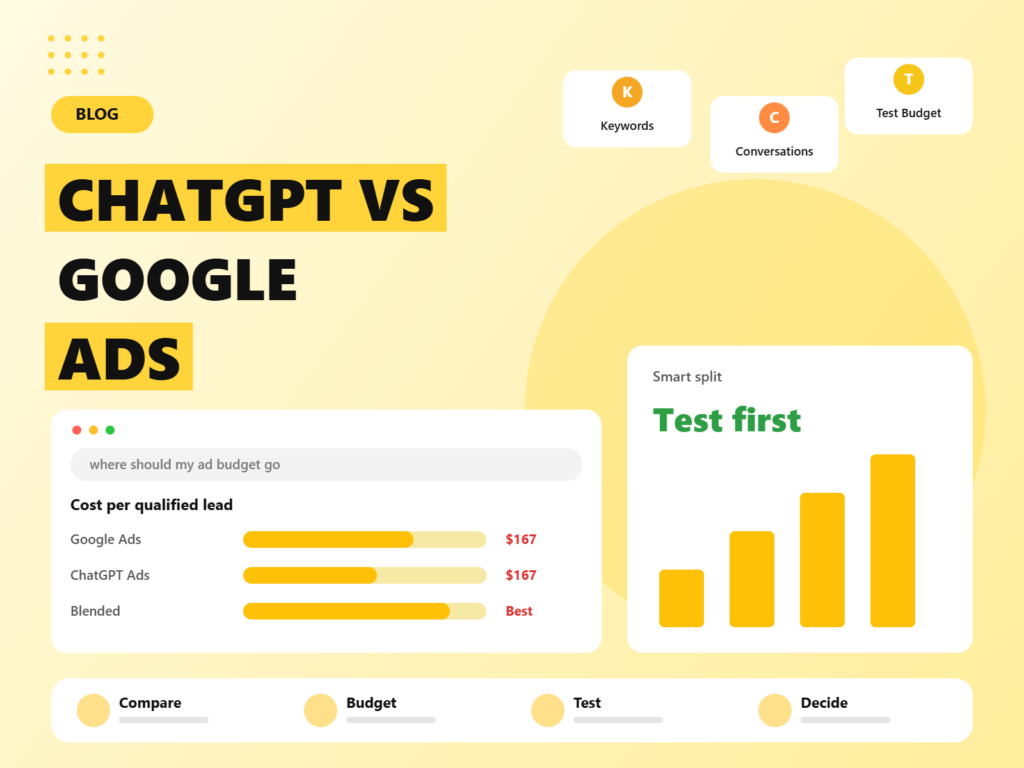
Here is an illustration with made-up numbers, not benchmarks. Suppose a Google Search campaign pays $4 per click, 6 percent of visitors become leads, and 40 percent of leads are qualified. The cost per qualified lead is $4 ÷ 0.06 ÷ 0.40, or about $167. Now suppose a ChatGPT campaign pays $5 per click, only 3 percent of visitors convert, but 60 percent of those leads are qualified because they arrive having already compared options. The cost per qualified lead is $5 ÷ 0.03 ÷ 0.60, or about $278. Google wins on that run.
Change one assumption, though, and the picture shifts. If ChatGPT visitors convert at 5 percent, the figure drops to about $167, level with Google. This is why you should not trust any single benchmark, including ours: the winner depends on your offer, your landing pages and your lead quality. It is also why you must measure down-funnel and not stop at click-through rate.
When you calculate, include these often-missed factors:
- New-customer rate: what share of conversions are people who were not already in your CRM or customer list? OpenAI has shared early examples in which a high proportion of purchases came from new customers. Check yours, because branded Google search often recaptures customers you would have won anyway.
- Assisted conversions: a ChatGPT ad may start the journey and a later branded Google search may finish it. Last-click reports will credit Google.
- Payback period and lifetime value: a more expensive customer who stays longer can still be the better buy.
- Operational cost: time spent on a new platform is a real cost during a test.
Which channel suits which business?
These are starting hypotheses, not rules. Test them against your own data.
Local services (plumbers, clinics, salons, tutors)
Google first. People search with immediate, location-based intent, and Maps and local ads are very hard to replace. ChatGPT ads may matter later for research-heavy services, but local targeting and reporting are not mature enough to prioritise. Our local SEO guide covers how to win the free listings alongside paid.
Low-ticket ecommerce
Google Shopping and Performance Max remain the engine because product feeds, price comparisons and remarketing are mature. A ChatGPT test is reasonable if your products involve advice, such as skincare routines or gear for a first-time hobby, but start small and watch margins. Our piece on product feed SEO for AI shopping explains how to prepare your catalogue for both organic and paid AI surfaces.
B2B software and services
This is the best fit for a ChatGPT test. Buyers use AI assistants to compare tools, shortlist vendors and draft requirements, often before they ever visit a vendor site. Keep Google for high-intent keywords such as “alternative to”, “pricing” and competitor terms, and use ChatGPT to catch the earlier comparison conversations.
High-consideration consumer purchases
Think travel, education, appliances, financial products where policy allows, and anything with multiple constraints. People describe their situation in detail, which is exactly what context hints are designed to match. Test ChatGPT early, alongside Google.
Regulated categories (finance, health, legal)
Proceed carefully. OpenAI restricts these categories and, per its policy, handles them case by case in the US. Google also has certification requirements. Budget time for approvals and make sure every claim is substantiated.
New businesses with small budgets
Google, unless your category is very research-led. A small budget gets more learning from a mature, well-documented platform, and ChatGPT’s reported minimums and test budgets may exceed what you can responsibly spend. Build search demand first, and revisit when the channel matures.
A budget framework you can actually use
- Protect the base. Do not cut campaigns that already deliver profitable conversions. Pulling budget from proven Google campaigns to fund an experiment is the most common way to lose revenue during a test.
- Fund the test from incremental budget. As a rough heuristic, many teams start by allocating a small share of their paid search budget, often in the range of five to fifteen percent, as a separate test line. Treat this as a starting point, not a rule. If your total is small, you may not reach a meaningful ChatGPT test at all.
- Set success criteria in advance. Decide before launch what you need: a target cost per qualified lead, a minimum new-customer rate, a threshold for assisted conversions. Write it down.
- Give it enough time. Plan for at least six to eight weeks, because auction learning and creative iteration both take time, and early weeks are rarely representative.
- Apply decision rules. If the test beats your target, scale in steps. If it is close, refine hints and landing pages for another cycle. If it misses clearly, stop and revisit in a few months.
Three illustrative scenarios
The scenarios below are hypothetical and simplified, but they show how the same framework leads to different answers.
Scenario 1: A project management SaaS with a $20,000 monthly paid budget
The company spends almost everything on Google Search, with strong returns from competitor and “alternative to” keywords. Its sales team reports that prospects increasingly arrive saying they asked an AI assistant for a shortlist. The sensible move is to leave the Google campaigns alone and add a separate ChatGPT line funded from incremental budget, with context hints built around team size, integrations and switching from a named competitor. The landing pages are comparison-style, and the success metric is cost per sales-qualified lead plus the share of new accounts. After eight weeks they have enough data to decide whether to scale.
Scenario 2: A neighbourhood dental clinic with a $1,500 monthly budget
Almost all demand comes from people searching for a dentist near them, and bookings come through a call or a form. Google Search and the Google Business Profile deliver that directly. The clinic’s category is also a restricted health service on OpenAI’s side, which adds approval time, and the budget is too small to support a meaningful test. The right answer is to invest in Google and local SEO, and revisit ChatGPT later.
Scenario 3: An online store selling beginner photography gear
Customers ask AI assistants things like “which camera should I buy as a beginner under a set budget”, then compare options. Google Shopping already captures the final purchase. The store runs a small ChatGPT test with context hints focused on first-time buyers and specific budgets, and sends traffic to buying-guide pages, not product pages. Success is measured by new-customer rate and by how many of those visitors later complete a purchase through any channel, which the team checks in Google Analytics 4 using the assisted conversions view.
Pre-launch checklist before you commit budget
- Confirm that your market and business type are eligible for ChatGPT ads and review the current minimum spend terms.
- Check that your robots.txt and firewall allow the OpenAI crawlers you need.
- Create one landing page per theme, built to continue the conversation the visitor started.
- Define a conversion event that represents a real business outcome, not a page view.
- Set up UTMs, the pixel or Conversions API, and a GA4 channel grouping for AI traffic.
- Write down success criteria, test length and decision rules.
- Brief sales or customer service so they can tag leads that mention ChatGPT or AI assistants.
- Agree who owns the test and when results will be reviewed.
What to report to leadership
Executives rarely want a platform deep dive. They want to know whether the test earned the right to more money. A one-page summary works well: the budget spent, cost per qualified lead against target, new-customer rate, assisted conversions, branded search lift, what you learned about messages and landing pages, and a clear recommendation to scale, refine or pause. Include one honest limitation, such as the early state of reporting, so the numbers are taken seriously.
How to run a fair head-to-head test
A weak test produces a confident wrong answer. Use these guardrails:
- Same offer, same conversion definition. If Google drives demo requests and ChatGPT drives newsletter sign-ups, you are not comparing like with like.
- Dedicated landing pages for each source. Match the page to the intent. A ChatGPT visitor who came through a comparison conversation needs a page that continues that conversation, not a generic product page.
- Consistent tracking. Use a clear UTM naming convention, install the OpenAI pixel or Conversions API, and ensure Google Analytics 4 receives both sources. Create a separate channel grouping for AI sources so they do not disappear inside Direct or Referral.
- Watch branded search and direct traffic. A ChatGPT ad that starts a journey often ends with a brand search. Compare branded search volume before, during and after the test.
- Use a holdout where possible. Run the ChatGPT campaign in some regions or time windows and not others, and compare total conversions, not just attributed ones. This is the nearest thing to proof of incrementality you can get on a small budget.
- Hold other variables steady. Avoid launching a new website, promotion or Google campaign during the test window.
How the two channels work together
Framing this as ChatGPT versus Google misses the best outcome, which is using each for what it does best.
- Discovery to decision. ChatGPT ads can meet people while they compare options. Google captures them when they search your brand name or a specific product later. If you only measure the second step, you will undervalue the first.
- Cross-pollinate insights. Your Google search term report shows how customers phrase needs and objections. Turn those phrases into context hints. In reverse, themes that perform well in ChatGPT conversations can become new keyword and content ideas.
- Share creative learning. Helpful, question-answering copy that wins in ChatGPT can inform responsive search ad headlines, and strong Google headlines can inspire concise ChatGPT copy.
- Align with organic. Paid is one half. Being cited and recommended by AI assistants is the other, and it works through content, structured data and authority. Our guide to tracking brand visibility across AI assistants shows how to see where you stand.
Common mistakes when choosing between the two
- Judging on click-through rate. A high CTR on a cheap, poorly matched click is not a win.
- Cutting Google to fund the test. This risks revenue for the sake of curiosity.
- Skipping the landing page work. In ChatGPT the landing page is part of the targeting signal, and in Google it drives Quality Score and conversion rate. Both reward relevance.
- Expecting identical reporting. ChatGPT reporting is less granular today. Plan to supplement it.
- Ignoring crawlability. Advertisers report that OpenAI needs to read your landing pages. Make sure your robots.txt is not blocking the relevant crawlers, as covered in our guide to managing AI crawlers.
- Quitting too early or too late. Set a test window and decision rules in advance, then honour them.
Where this is heading
The gap between the two will narrow. Google is moving ads into AI Overviews and AI Mode and pushing automation such as AI Max for Search, which targets broader intent than keywords alone. OpenAI is adding formats, measurement partners and markets. Over time, both will reward the same fundamentals: a clear offer, a relevant landing page, trustworthy measurement and creative that helps rather than shouts. That is good news, because the work you do to prepare for one transfers to the other.
If you would like a second pair of eyes on your media mix, our PPC management team can design the test, set up the tracking and read the results with you, and our LLM SEO specialists can make sure your organic presence in AI assistants supports whatever you decide to spend.
Key takeaways
- Google Ads captures demand that already exists. ChatGPT ads influence decisions that are still being made.
- Compare channels on cost per qualified lead, new-customer rate and assisted conversions, not on clicks or CPMs.
- Keep proven Google campaigns untouched and fund the ChatGPT test from incremental budget.
- Write success criteria and decision rules before you launch, and run the test for at least six to eight weeks.
- Use what you learn in one channel to improve the other, and keep investing in organic visibility inside AI assistants.
Pricing, markets and formats on ChatGPT are changing quickly, so check the current terms in Ads Manager and OpenAI’s ad policies before you plan a budget.
Frequently asked questions
Is ChatGPT advertising better than Google Ads?
Neither is better in general. Google Ads is stronger at capturing existing demand at scale with mature targeting and measurement. ChatGPT ads are a newer channel for reaching people while they compare options in conversation. Most businesses should keep Google as the base and run ChatGPT as a controlled test.
Should I move my Google Ads budget to ChatGPT?
How do I compare ChatGPT ad costs with Google Ads costs?
Which businesses benefit most from ChatGPT ads?
How long should I run a ChatGPT ads test?
Can ChatGPT ads and Google Ads work together?
We design controlled tests across Google Ads and ChatGPT, set up tracking that holds up, and tell you honestly which channel earns more budget.

Riya Bhardwaj
Leading content and growth initiatives with a focus on search visibility, audience engagement, and measurable business outcomes. Specialised in SEO, Generative Engine Optimization (GEO), AI search optimisation, and performance-driven content marketing. Passionate about transforming market insights into scalable content strategies that strengthen brand authority and drive sustainable digital growth.