

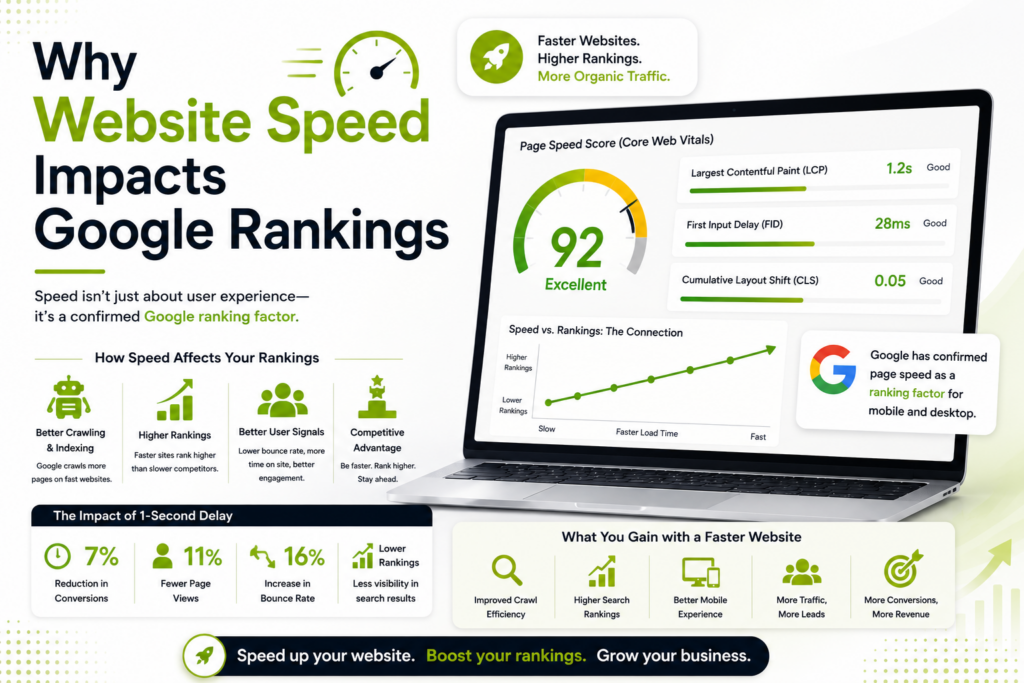
Speed is a confirmed Google ranking factor — but it’s a tiebreaker, not a magic button. Here’s exactly how it moves rankings in 2026, how much it really matters, and where it doesn’t.
Quick answer
Website speed impacts Google rankings because it’s part of Google’s Page Experience system, measured through Core Web Vitals (LCP, INP, CLS) using real Chrome-user data. It’s been a confirmed ranking factor since 2010, and the March 2026 core update increased its weight. But it’s a supporting signal, not a primary one — relevance, content quality, and links matter more, and speed mainly acts as a tiebreaker between otherwise comparable pages. It affects rankings four ways: directly through Page Experience, through mobile-first indexing (mobile speed is what’s scored), through crawl efficiency, and indirectly through engagement signals. A fast page won’t rescue weak content, but in competitive niches it’s often what separates page one from page two.
Few SEO topics are as misunderstood as speed. Some treat it as the master switch that will rocket a page to number one; others dismiss it as irrelevant next to content and links. The accurate answer sits in between, and getting it right changes how you should prioritize the work.
Is website speed actually a Google ranking factor?
Yes — and it’s been confirmed for over 15 years. Google announced speed as a desktop ranking signal in 2010, extended it to mobile in 2018, and formalized it in 2021 as part of the Page Experience system through Core Web Vitals. It is a real, measurable ranking input.
But here’s the nuance most articles skip: speed is a tiebreaker, not a top-tier signal. Google’s own guidance is clear that relevance and content quality come first. As Google frames it, when two pages address a query equally well, the one with the better page experience is more likely to rank higher. A blazing-fast page with thin content will not outrank a genuinely better page that happens to load in 2.5 seconds. So the honest model is: content and authority decide whether you can rank; speed helps decide the close races and keeps users from bouncing once they arrive.
How Google measures speed for ranking
Google doesn’t rank on a stopwatch or a lab score. It uses Core Web Vitals from real Chrome users (the Chrome User Experience Report), evaluated at the 75th percentile over a rolling 28-day window — meaning 75% of your actual visitors must hit the thresholds for a page to pass.
| Metric | Measures | "Good" threshold |
|---|---|---|
| LCP — Largest Contentful Paint | Loading speed | ≤ 2.5s |
| INP — Interaction to Next Paint | Responsiveness | ≤ 200ms |
| CLS — Cumulative Layout Shift | Visual stability | ≤ 0.1 |
INP replaced First Input Delay in March 2024 and is now the metric most sites fail — roughly 43% miss the 200ms threshold — because fixing it requires JavaScript architecture changes, not just image compression. One critical distinction: Lighthouse and PageSpeed Insights lab scores don’t directly affect rankings. They’re diagnostic tools; the field data in Search Console’s Core Web Vitals report is what Google actually uses.
The 4 ways speed affects your rankings
- Directly, through Page Experience
Core Web Vitals feed the page experience signal. Studies of tens of thousands of ranking pages consistently find that position-one results pass Core Web Vitals at a higher rate than lower-ranked results, with the gap widening in competitive verticals. When content and authority are close, the faster page takes the edge. - Through mobile-first indexing
Google primarily evaluates the mobile version of your site, so your mobile speed is what’s scored — regardless of how fast desktop feels. Because phones have slower processors and variable networks, a 1.8-second desktop LCP can balloon past 3.5 seconds on a mid-range Android over 4G. Mobile is usually the binding constraint, and with much of the mobile web failing Core Web Vitals, it’s also where the easiest competitive gains are. - Through crawl efficiency
Googlebot has a finite crawl budget per site. When it wastes that budget waiting on slow pages, it crawls and indexes fewer of your URLs — so new content gets discovered slower, or not at all. Publishing more on a slow site can ironically reduce how much of it gets indexed. AI crawlers add a second dimension: many have timeout limits, so slow pages can be skipped entirely, costing you visibility in AI Overviews and answer engines too. - Indirectly, through engagement signals
Google doesn’t use your analytics data, but it does observe behavior in its own logs — “pogo-sticking,” where a user clicks your result, bounces back to the SERP within seconds, and picks a competitor. Slow pages drive exactly that. Faster pages produce lower bounce rates and more pages per session, and that better engagement compounds the direct ranking benefit over time.
So how much does speed really move rankings?
Per URL, the direct effect is modest — Google itself has described the speed update as affecting mainly the slowest experiences. But two things make it matter more than that sounds. First, in competitive niches (ecommerce, SaaS, finance, travel), every page that already ranks has strong content and links, so speed becomes the deciding factor in a field of equals. Second, the March 2026 core update increased the weight Google places on Core Web Vitals, widening the visible gap between sites that pass and sites that don’t.
A realistic expectation: fixing Core Web Vitals typically moves rankings and engagement within about 60–90 days, and because Google uses 28 days of rolling field data, Search Console won’t reflect your fix for roughly three to four weeks after you ship it. This is also why speed is inseparable from the broader picture — if rankings are flat, work through why SEO isn’t working alongside your speed fixes.
What to do about it
Get Core Web Vitals into the green on real mobile field data, then keep them there — it’s ongoing maintenance, not a one-time audit. The specific causes and fixes (slow servers, heavy images, render-blocking scripts, layout shift) are covered in why your website is slow, and the full audit sequence lives in our technical SEO checklist for 2026. Since Core Web Vitals sit inside the technical layer, they’re core technical SEO work — the foundation covered in why businesses need technical SEO.
And remember rankings aren’t the only payoff: the same speed work drives conversions and revenue, as we break down in why website speed impacts sales. Fix the floor first — then let your content and SEO strategy do their job.
Frequently asked questions
Is page speed a Google ranking factor in 2026?
Yes — confirmed since 2010 (desktop) and 2018 (mobile), and formalized into Page Experience via Core Web Vitals in 2021. It’s a real but supporting signal: Google weighs relevance, content, and links more heavily, and speed acts as a tiebreaker between comparable pages.
How much does website speed affect Google rankings?
Modest per URL but real, and it concentrates in competitive niches where every ranking page already has strong content — there it often decides page one versus page two. Studies show position-one results pass Core Web Vitals more often than lower results, and the March 2026 core update increased the signal’s weight.
What Core Web Vitals do I need to rank well?
LCP under 2.5s, INP under 200ms, CLS under 0.1, measured on real Chrome users at the 75th percentile on mobile over a 28-day window. INP (which replaced FID in March 2024) is the metric most sites fail.
Does mobile or desktop speed matter more for ranking?
Mobile, almost always. Google uses mobile-first indexing, so your mobile version is what it evaluates. Phones’ slower processors and networks make mobile the binding constraint — a page fast on desktop can still fail on a mid-range phone.
Will making my site faster improve my rankings?
It helps most when your content is already competitive — speed wins close races and reduces the engagement problems that drag rankings down. It won’t rescue thin content. Expect movement within 60–90 days, with Search Console field data lagging the fix by three to four weeks.
Do PageSpeed Insights or Lighthouse scores affect rankings?
Not directly. Google ranks on real-user CrUX field data, not lab scores. Lab tools help you diagnose what to fix, but the field data in Search Console’s Core Web Vitals report is the source of truth.
Get a free audit and we’ll measure your Core Web Vitals on real-user data, show you which pages are failing and why, and hand you a prioritized plan to fix them — so your content finally gets to compete on a level field.

Riya Bhardwaj
Leading content and growth initiatives with a focus on search visibility, audience engagement, and measurable business outcomes. Specialised in SEO, Generative Engine Optimization (GEO), AI search optimisation, and performance-driven content marketing. Passionate about transforming market insights into scalable content strategies that strengthen brand authority and drive sustainable digital growth.