
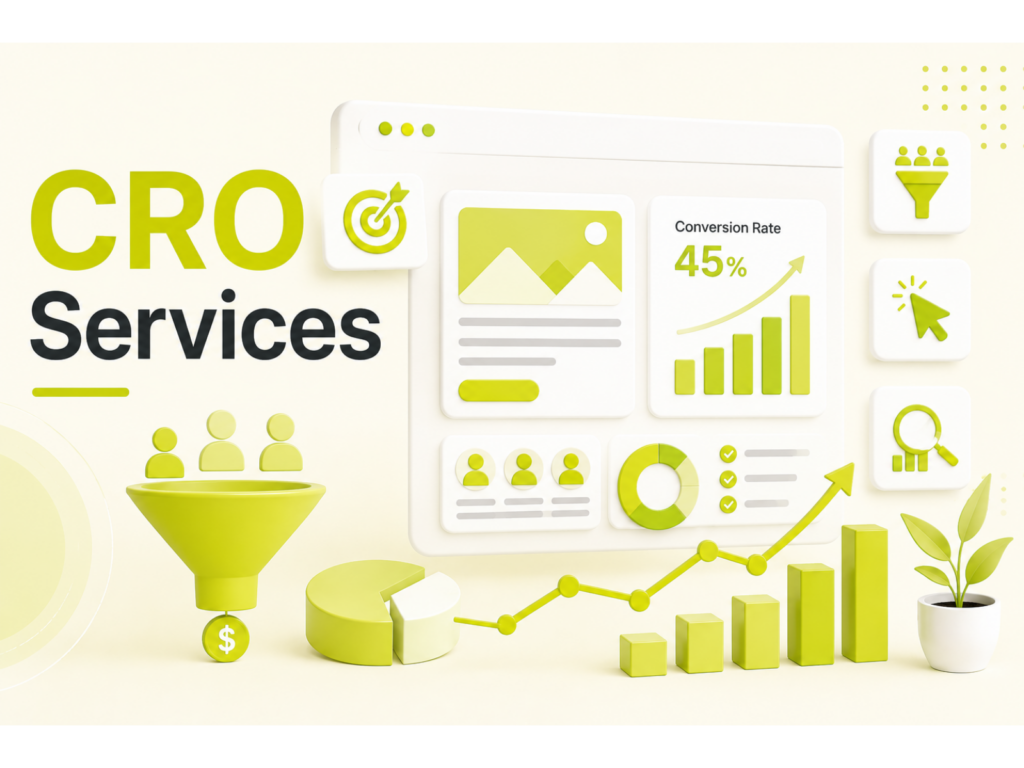
Quick answer: Conversion rate optimization services help you turn more of your existing visitors into buyers, leads or app installs. A good provider audits your tracking and funnel, researches why people drop off, ranks fixes, runs A/B tests, and reports results. Choose one by asking for their research method, test process and sample reports.
Last verified: 12 October 2026. Tool settings, store analytics and app store testing features change, so check the official pages linked below before you rely on a detail.
Key takeaways
- CRO services are a repeating cycle of research, hypotheses, testing and rollout. A one-off redesign isn’t CRO.
- Tracking comes first. If your conversion data is wrong, every test result built on it is wrong too.
- Most tests need patience: traffic, baseline conversion rate and the size of the change decide how long a test must run.
- Ecommerce, B2B, Shopify, mobile and app store CRO each need different measures, so match the provider to your model.
- Be wary of guaranteed lifts. Even Optimizely says only a minority of experiments produce a clear winner.
Conversion rate optimization services: what they are and what they aren’t
Conversion rate optimization (CRO) is the process of increasing the share of visitors who take a desired action. Optimizely’s glossary describes it as improving conversions on a website or mobile app through ideas, A/B or multivariate tests, and better user experience. CRO services are the paid version of that process, run by an agency, a consultant or a specialist team.
The word “conversion” depends on your business. For a store it’s a purchase or an add to cart. For a B2B company it’s a demo request or a qualified lead. For an app it’s an install or a sign-up. Optimizely’s own list of common goals spans exactly those: product sales for ecommerce, leads generated for B2B, booking conversions for travel, and newsletter sign-ups for media.
It helps to be clear about what CRO is not. It isn’t a prettier website. It isn’t a bag of tricks like red buttons or countdown timers. And it isn’t guaranteed uplift on a schedule. Real CRO is closer to a research program: you collect evidence about visitor behavior, form a hypothesis about what’s blocking them, test a change against the current version, and keep what works.
If you’ve searched for a “conversion rate optimization company” or a “CRO agency” and found long lists of providers, the lists rarely tell you the thing you actually need, which is how to compare them. That’s what this guide covers: what’s included, how testing works, how it differs by business model, and how to pick a team without getting burned. You can see our own scope on the conversion rate optimization services page.
What’s included in conversion rate optimization services?
Most CRO services include a tracking and analytics check, funnel analysis, qualitative research such as session recordings or surveys, a prioritized list of test ideas, A/B test design and execution, implementation of winners, and regular reporting. Scope varies, so ask for deliverables in writing.
Here’s how a complete engagement usually maps out, along with what you should receive at each step.
| Phase | What happens | What you should receive |
|---|---|---|
| 1. Measurement check | Verify that purchases, leads or sign-ups are tracked correctly | A list of tracking gaps and fixes |
| 2. Funnel analysis | Find the steps where visitors drop off, by device and traffic source | A funnel map with drop-off points |
| 3. Qualitative research | Watch recordings, review heatmaps, read surveys and support tickets | A findings document that explains the “why” |
| 4. Prioritization | Turn findings into hypotheses and rank them | A test roadmap with expected effort and impact |
| 5. Testing | Design variants, split traffic, run tests to a plan | Test plans and results, including losers |
| 6. Rollout | Ship winning changes properly | Implemented changes and a change log |
| 7. Reporting | Explain what was learned and what’s next | A regular report tied to your goal metric |
Optimizely’s glossary lays out a similar loop: identify conversion goals, analyze the current funnel, focus on high-traffic or underperforming pages, develop hypotheses, test them, implement the winners, and keep iterating. That’s a useful yardstick. If a proposal skips straight to “we’ll redesign your landing pages”, it has skipped the middle of the loop.
Two extras are worth asking about. First, speed work: slow pages cost you visitors before they see your offer, and many CRO engagements include page-speed fixes or hand them to a developer. Second, mobile checks, since a form that’s hard to complete on a phone loses conversions quietly. We cover both in the mobile section below.
What is a CRO audit, and what should it deliver?
A CRO audit is a structured review of your site or app that finds why visitors don’t convert and ranks what to fix first. It should check tracking, funnel drop-off, page experience, device differences and visitor behavior, then deliver prioritized recommendations tied to your goal metric.
If you’re shopping for “cro audit services”, these are the pieces that make an audit worth paying for:
- Tracking validation. The auditor confirms your key actions are measured once, correctly, and with revenue or lead value where relevant. Our GA4 consulting service and the guide to what a GA4 consultant does explain why this step comes first.
- Funnel analysis by segment. A blended conversion rate hides problems. Look at mobile versus desktop, new versus returning visitors, and each traffic channel.
- Behavior evidence. Session recordings, heatmaps, on-site search terms and form analytics show where people hesitate.
- Technical and speed review. Core Web Vitals, broken elements, and checkout errors.
- A ranked action list. Each item needs an expected impact, an effort estimate and a reason. “Improve trust” is not a recommendation. “Add delivery and returns info above the add-to-cart button on product pages, because search terms and chat logs show shoppers asking about it” is.
- A test plan. Some fixes are obvious bugs and should just be fixed. Others are real questions that deserve a proper test.
The difference between an audit and a checklist is evidence. A generic checklist can be produced in an hour for any site. An audit uses your own data. If a provider quotes a very low price and delivers a PDF of generic tips, you’ve bought the checklist.
How does A/B testing work in CRO, and how long should a test run?
In an A/B test, visitors are randomly split between the current page and a variant, and you compare how many take the goal action. How long it runs depends on your traffic, baseline conversion rate and the smallest improvement you want to detect. Optimizely recommends running tests for at least one business cycle, which it puts at seven days.
Testing is the part of CRO that sounds simple and goes wrong most often. These are the ideas you should understand before you buy, so you can tell whether a provider is rigorous or just running experiments for show.
Sample size, effect size and minimum detectable effect
Optimizely’s glossary says statistical significance relies on two factors: sample size and effect size. More visitors generally give more reliable results, and a bigger difference between variants is easier to detect. It also lists reasons many tests never reach significance: changes that are too small, low baseline conversion rates, and tracking too many goals at once.
The planning tool for this is the minimum detectable effect, or MDE. It’s the smallest lift you’d care about detecting. Google Play’s store listing experiments use the same concept: Google’s help page defines it as the minimum difference between variants and control required to declare which one performs better, and says a smaller difference is treated as a draw. A small MDE needs far more traffic. That’s why a site with modest traffic can’t run many tests on tiny tweaks, and why good providers pick bigger, evidence-backed changes for lower-traffic sites.
Optimizely gives a simple formula for planning duration: total visitors needed equals the sample size per variation times the number of variations, and the estimated days to run equals that total divided by your average daily visitors. Ask your provider to show this calculation before they start, not after.
Don’t peek, and don’t slice the data to death
Optimizely’s glossary describes the classical rules for valid results: set an MDE and a sample size in advance, don’t peek at results early, and don’t test too many goals or variations at once. GrowthBook’s documentation makes the same point from another angle. It says the decision to stop a test early can inflate false positives, and it warns about the multiple testing problem, where if you look at the data in enough ways, one of them will look significant by chance.
Both tools offer ways to handle this. Optimizely describes a Stats Engine that combines sequential testing and false discovery rate control so you can monitor results in real time. GrowthBook supports both Bayesian and frequentist engines, and says its frequentist engine can use sequential testing to mitigate peeking concerns. Tool choice is less important than the habit: your provider should tell you in advance when a test will be called and why.
Data quality checks that catch broken tests
GrowthBook lists several automatic checks that signal a flawed experiment. A sample ratio mismatch means the traffic split doesn’t match what you planned, for example 48/52 when you expected 50/50. Other checks include users who saw more than one variation, guardrail metrics that make sure a test isn’t hurting something like page load time, minimum data thresholds so nobody draws conclusions from 5 versus 2 conversions, and alerts for suspiciously large uplifts that likely point to a bug.
You don’t need to run these yourself. You do want to ask: “What checks do you run to make sure a test result is valid?” A confident answer that mentions traffic split, guardrails and minimum data is a good sign.
What a realistic win rate looks like
Optimizely’s CRO glossary states that only 12% of experiments run produce a winning result. That’s the vendor’s claim, not an industry-wide law, and your own numbers will differ. The useful takeaway is the framing: most tests don’t win, and a test that loses still teaches you something. Optimizely’s own text says experimentation is about learning, not only finding winners.
So when an agency pitches a “guaranteed 30% lift”, be skeptical. A serious provider will promise a process, a reporting cadence and a clear definition of success, not a number.
Ecommerce CRO services: what to expect
Ecommerce CRO services focus on the path from product discovery to purchase: product pages, search, cart, checkout and post-purchase. They rely on accurate ecommerce tracking, funnel analysis by device and source, and tests on the steps where the biggest share of shoppers leave.
The data foundation matters more here than anywhere else. In Google Analytics 4, Google’s list of recommended ecommerce events covers the whole path: view_item_list, view_item, add_to_cart, begin_checkout, add_shipping_info, add_payment_info and purchase, plus refund. Sending these events populates the Ecommerce purchases report. If your store only sends purchase, nobody can tell you where shoppers drop off.
A strong ecommerce engagement usually looks at these areas:
- Product pages. Clarity of the offer, delivery and returns information, image quality, reviews, size or variant selection, and how easy “add to cart” is on mobile.
- Search and navigation. What shoppers search for, which searches return nothing, and whether category pages help people choose.
- Cart and checkout. Number of steps, form fields, payment options, error messages, and surprise costs.
- Merchandising and offers. Product recommendations, bundles and promotions, tested carefully so you don’t just discount your way to a higher rate.
- Speed. Slow templates and heavy apps cost conversions on every page.
One trap deserves a note: conversion rate alone can mislead. A promotion can raise conversion rate while lowering profit. Good providers track revenue per visitor, average order value and margin where possible, not only the percentage. For a deeper look at what we offer in this area, see our ecommerce CRO services, and our practical list of Shopify conversion tips for ideas worth testing.
Shopify conversion rate optimization: what to measure and where
For Shopify stores, start with the built-in reports. Shopify’s Behavior reports include a Conversion rate over time report, a Conversion rate breakdown funnel, search reports, sessions by device and landing page, and web performance reports. A Shopify-focused CRO provider should work from these and explain any gaps.
Here are the details from Shopify’s own help center that matter when you evaluate a provider:
- How conversion rate is defined. Shopify’s Conversion rate over time report defines it as the percentage of sessions that resulted in a purchase. Sessions that completed checkout is the count of sessions where a customer purchased a product.
- Orders won’t always equal converted sessions. Shopify notes a customer can make multiple purchases in one session, so your order count and your completed-checkout session count may differ.
- The funnel report. The Conversion rate breakdown shows all sessions, sessions with cart additions, sessions that reached checkout and sessions that completed checkout. An open funnel counts sessions that skipped steps. A closed funnel counts only those who completed every step in order.
- Search reports. Searches by query, searches with no clicks, and searches with no results show what shoppers want and can’t find. Shopify says these reports can have a delay of up to 72 hours.
- Web performance reports. Shopify reports Largest Contentful Paint, Interaction to Next Paint and Cumulative Layout Shift by page URL or page type.
- Segmenting. Sessions by device and the human versus bot filter help you avoid drawing conclusions from the wrong traffic.
There’s also a timing caveat worth knowing about right now. Shopify’s help page says its Analytics session measurement rollout runs from September 21 to 23, 2026, and that after the update reaches a store, sessions, conversion rate and other session-based metrics might look different. Shopify states this doesn’t necessarily mean traffic, orders or customer behavior changed. If you’re comparing conversion rate before and after late September 2026, treat it as a measurement change and don’t credit or blame your optimization work for the shift. Check Shopify’s current documentation for the latest details.
Platform skills matter too. Shopify CRO involves theme code, apps and page speed on top of the usual research and testing. If you run a Shopify store, look at our Shopify conversion rate optimization services.
B2B CRO: optimizing for lead quality, not just form fills
B2B CRO focuses on turning visitors into qualified leads, demo requests and sales conversations. The main challenge is that a form fill isn’t the same as a good lead, so you need to connect website behavior to what happens in your sales process before you start testing.
Google’s recommended events for lead generation show how this can work in GA4: generate_lead for a form submission, then qualify_lead, disqualify_lead, working_lead, close_convert_lead and close_unconvert_lead as the lead moves through your pipeline. Google describes these as useful for business-to-business sales and for conversions that happen offline, and says sending them populates the Lead acquisition report.
Why this matters for testing: imagine a test that raises form submissions by 20% by removing fields, while lead quality drops and sales spends more time on poor fits. The test “won” on the wrong metric. If you can pass qualification data back to your analytics, you can judge tests on qualified leads. If you can’t yet, your provider should say so and choose a proxy honestly.
B2B sites also have low volumes. A site with a few hundred conversions a month can’t run many parallel tests, and the sample size math from earlier applies. In these cases, expect more research-led changes (clearer positioning, stronger proof, simpler forms, faster response to enquiries) and fewer pure split tests. Our B2B CRO services are built around this reality, and the sample size math above is why we plan B2B tests around the traffic you actually have.
Mobile conversion rate optimization: what’s different on a phone
Mobile conversion rate optimization means finding and fixing the specific problems phone visitors face: slow loading, hard-to-tap elements, long forms, awkward checkout and layout shifts. Start by comparing conversion rates by device, then investigate the gaps with recordings and performance data.
Segmenting by device is the first step because a blended number can hide a weak mobile experience. Shopify’s Behavior reports include a Sessions by device report, which is a good place to start on a store. If mobile traffic is large but converts far below desktop, that’s where a CRO program should look first.
Performance is the next lever. Google’s web.dev documentation on Web Vitals names three Core Web Vitals and their good thresholds: Largest Contentful Paint within 2.5 seconds, Interaction to Next Paint of 200 milliseconds or less, and Cumulative Layout Shift of 0.1 or less. Google recommends judging them at the 75th percentile of page loads, segmented across mobile and desktop. It also says lab testing is not a substitute for field measurement, because performance varies with device capability and network conditions. Our explainer on Core Web Vitals and the INP methodology change goes deeper.
A practical mobile checklist for your provider to work through:
- Thumb reach and tap targets. Primary buttons should be easy to hit, with no tiny links packed together.
- Form friction. Use the right keyboard type for each field, autofill where possible, and cut fields you don’t need.
- Sticky elements. A fixed bar can help or can cover the content. Test it rather than assume.
- Payment options. Fewer steps and familiar payment methods reduce typing on small screens.
- Speed and stability. Check LCP, INP and CLS on real devices and with field data.
Ask the provider how they test on real phones and how they handle the smaller sample sizes you get when you split traffic by device.
App store conversion rate optimization: testing your store listing
App store conversion rate optimization improves the share of store page visitors who install your app. You test icons, screenshots, previews and descriptions using the stores’ own experiment tools, Apple’s product page optimization and Google Play’s store listing experiments.
This is a different discipline from website CRO, because the conversion happens on Apple’s or Google’s page, not yours. Both platforms provide built-in testing, with different rules.
Apple: product page optimization
According to Apple’s App Store Connect help, product page optimization lets you test up to three different app icons, screenshots and previews. Each variant is randomly shown to a user group you define, can be localized in any language your app supports, and results are evaluated with App Analytics. Apple says its methodology is based on the estimated lift in conversion rate plus algorithms that provide confidence in the reliability of results. Some limits from the page: your app must be in the Ready for Distribution state, treatments show on iOS 15 and iPadOS 15 or later, releasing a new version containing tested assets can affect results, and the tests aren’t available for custom product pages or for Apple Watch and iMessage product pages.
Google Play: store listing experiments
Google’s Play Console help describes two types. A default graphics experiment tests your icon, feature graphic and screenshots in your default listing language, and you can run one at a time. Localized experiments can test graphics and descriptions in up to five languages. You can run one default graphics experiment or up to five localized ones at the same time, with up to two variants against your current listing.
The setup includes a target metric (unique user install clicks, open clicks or pre-registration clicks), an experiment audience percentage, a minimum detectable effect and a confidence level. Google says the creation page estimates how many acquisitions your test needs to reach a statistically significant result, and that results can come back as “More data needed” or a “Draw”. Experiments stop automatically after six months. Google recommends testing one asset at a time, so you know what caused any change.
What to ask an app CRO provider: how they pick what to test (research, competitor review, creative analysis), how they localize, and how they treat results that land in “More data needed”. If you’re building an app growth plan, our app CRO services cover this alongside in-app conversion work.
How do you choose a CRO agency or expert?
Choose a CRO provider by checking their process, not their logo wall. Look for a research-first approach, clear testing rules, tracking validation, relevant platform experience, honest reporting of losing tests, and a contract that gives you ownership of data and test records.
Searching for “cro experts” or “CRO agency” returns plenty of lists, but the way to choose is by testing providers against questions only a good one can answer.
- “What will you look at before you suggest any test?” Strong answer: analytics, funnel by segment, recordings, search and support data. Weak answer: “best practices”.
- “How do you decide how long a test runs?” You want sample size, MDE and a full business cycle, not “until it looks good”.
- “What do you do when a test loses?” The answer should include learning, a follow-up hypothesis and reporting the loss.
- “How do you check that tracking is right?” They should validate events before testing.
- “Which metric do you judge success on?” Revenue per visitor, qualified leads or installs should beat raw click rate.
- “Who implements winning changes?” Clarify whether you, your developers or the agency ship them, and whether that cost is in the quote.
- “What tools will you use and who owns the accounts?” You should own your testing and analytics accounts and data.
- “Can I see a sample report?” A real report shows hypotheses, results, confidence and next steps.
- “Have you worked with my platform and model?” Ecommerce, B2B, Shopify and app listings need different skills.
Treat claims you can’t verify with caution. Case studies on agency sites are marketing material, so ask for the test setup behind any headline number: baseline, sample size, duration and what was measured. A provider who can’t explain how a number was produced is giving you an anecdote.
How much do conversion rate optimization services cost?
CRO pricing varies by provider, scope and testing volume, and there’s no standard rate card. Common models are a fixed-price audit, a monthly retainer for ongoing research and testing, or a project fee for a specific funnel. Expect cost to rise with traffic, number of tests and implementation work.
We aren’t going to quote ranges, because the figures published by agencies and review sites vary and can’t be treated as a benchmark for your situation. Check each provider’s current pricing and ask for a written scope. These factors change a quote the most:
- Traffic and conversion volume. Low volume limits how many tests can reach a result, which changes the mix of work.
- Number of funnels or platforms. A single Shopify store is simpler than a store plus an app plus a B2B portal.
- Implementation. Design, development and QA work for variants may be included or billed separately.
- Tooling. Testing and behavior tools often carry their own subscriptions. Ask who pays.
- Contract length. Testing needs months to compound. Very short contracts rarely allow a full cycle of research, testing and rollout.
A useful way to judge value: estimate what a one-percent relative change in conversion rate is worth to your business per year, then compare that with the program cost. If the math only works with a large lift, the program may not suit you yet. In that case, a one-time audit plus fixes for clear problems may make more sense than a long retainer.
Agency, freelancer or in-house CRO?
An agency suits teams that need a full bench of research, design, development and analytics. A freelance expert fits focused projects. In-house works when you have enough traffic and budget for a dedicated team. Many companies combine an outside specialist with an internal owner.
| Option | Strengths | Watch-outs |
|---|---|---|
| Agency | Multiple skills under one roof, repeatable process, experience across sectors | Quality depends on who’s assigned; check the actual team |
| Freelance expert | Focused, often more direct access to the specialist | Limited capacity; design or development may need extra help |
| In-house team | Deep product knowledge, always available | Needs enough traffic, tooling and senior leadership to be effective |
| Hybrid | External rigor with internal ownership | Needs clear roles so nothing falls between teams |
Whichever route you take, make sure someone inside your company owns the conversion goal and can approve changes quickly. The most common reason good CRO programs stall isn’t the tests, it’s waiting weeks for approvals and development time.
Red flags when buying CRO services
- Guaranteed lifts. No one controls how visitors behave. Process and reporting can be guaranteed, results can’t.
- Tests with no plan. If nobody can say how long a test runs or what counts as a result, the program is guessing.
- No tracking review. Testing on top of broken analytics wastes money.
- “Best practices” as the whole strategy. They’re a starting point for hypotheses, not a substitute for your own data.
- Only winners reported. Per Optimizely’s own figure, most tests don’t win. A report full of wins deserves questions.
- Vanity metrics. Click rate and time on page don’t pay the bills.
- Lock-in. You should keep access to your analytics, test history and creative assets.
If you’d like to talk through your own funnel, you can start with our conversion rate optimization services page. It explains how we work and how to request an audit.
How CRO fits with the rest of your marketing
CRO doesn’t replace traffic work. It multiplies it. If your SEO, paid and email programs bring the right visitors, better conversion means each visit is worth more. And if your site underperforms for traffic you already have, adding more visitors just adds to the leak. Our article on increasing conversions without improving rankings explains this relationship in detail.
The simple version: fix measurement, find the biggest drop-off, test with discipline, and keep what works. Choose a provider who talks about those four things before they talk about colors and buttons.
Frequently asked questions
What are conversion rate optimization services?
They’re paid services that raise the share of your visitors who buy, enquire or install. A provider checks your tracking, finds where people drop off, researches why, proposes fixes, runs A/B tests, rolls out winners and reports results. It’s an ongoing cycle, not a one-time redesign.
How much do conversion rate optimization services cost?
Pricing depends on the provider, scope, traffic and how many tests you run. Common models are a fixed-price audit, a monthly retainer or a project fee. There’s no standard rate card, so ask for a written scope and check current pricing with each provider.
What is a CRO audit?
A CRO audit is a structured review of your site or app that explains why visitors don’t convert. It should cover tracking, funnel drop-off by device and source, visitor behavior, page experience and speed, then deliver a prioritized list of fixes and test ideas.
How long should an A/B test run?
Long enough to reach the sample size you planned, and at least one full business cycle. Optimizely puts that at seven days. Duration equals the visitors you need divided by daily traffic, so low-traffic sites need longer or bigger changes.
What is a good conversion rate for a Shopify store?
There’s no single good number, because it depends on your products, prices, traffic sources and device mix. Use Shopify’s Conversion rate over time report to see your own baseline, then compare by device and channel and track changes against that.
How can I improve my Shopify conversion rate?
Start with Shopify’s Behavior reports to find the weak step: product page, cart or checkout. Review searches with no results, mobile performance and Core Web Vitals, then test one change at a time. Fix clear bugs first, and test the judgment calls.
What is the difference between conversion rate and click-through rate?
Click-through rate measures how many people who see an ad or link click it. Conversion rate measures how many visitors complete your goal action, such as a purchase or form submission. A page can earn many clicks and still convert poorly.
How is app store conversion rate optimization different?
The conversion happens on the Apple or Google store page, so you test the listing itself. Apple’s product page optimization tests up to three icon, screenshot or preview variants. Google Play runs store listing experiments with up to two variants against your current listing.
Do CRO agencies guarantee results?
They shouldn’t. Visitor behavior can’t be guaranteed, and Optimizely says only 12% of experiments run produce a winning result. A reliable provider promises a clear process, valid testing, honest reporting of losing tests and a success metric agreed in advance.
How do I choose a CRO agency or expert?
Ask how they research before testing, how they set sample size and test length, what they do when a test loses, how they validate tracking and who owns the accounts. Request a sample report and a written scope before you sign anything.
Our team audits your tracking, finds where visitors drop off, and runs structured tests across your site, store or app. Tell us your goal and we will show you where to start.

Riya Bhardwaj
Leading content and growth initiatives with a focus on search visibility, audience engagement, and measurable business outcomes. Specialised in SEO, Generative Engine Optimization (GEO), AI search optimisation, and performance-driven content marketing. Passionate about transforming market insights into scalable content strategies that strengthen brand authority and drive sustainable digital growth.