
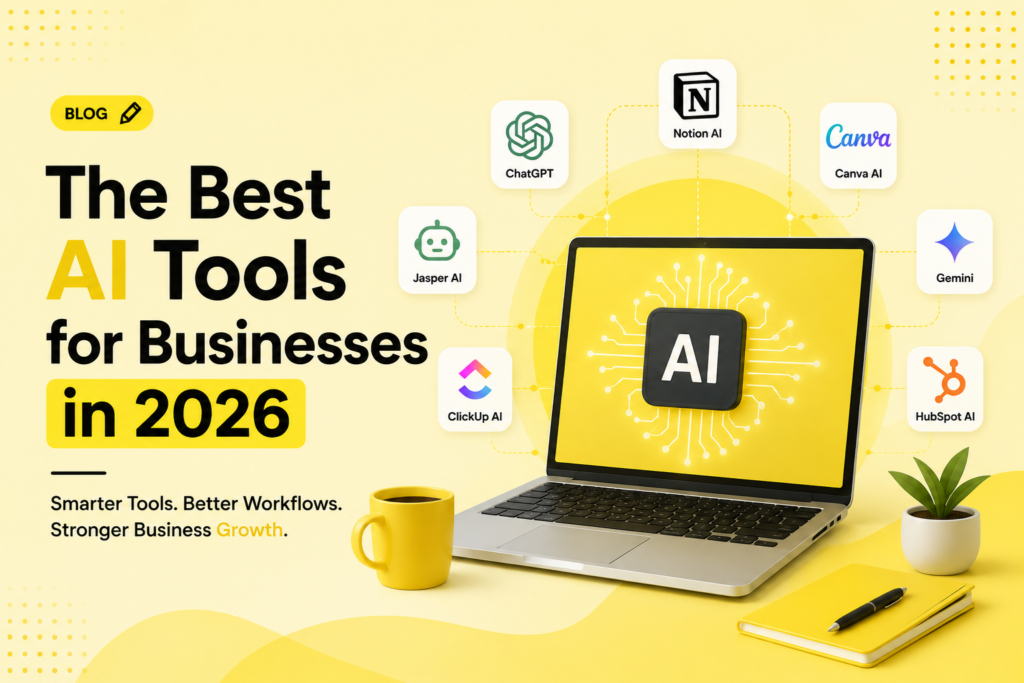
There are thousands of AI tools and a new one every week. The winning move isn’t finding “the best” — it’s matching the right tool to the task actually holding your business back. Here’s the field, by use case, with the honest bits included.
Quick answer
There’s no universal “best” AI tool — the right one depends on your bottleneck. The 2026 category leaders: general assistants — ChatGPT, Claude, Gemini, Microsoft Copilot, Perplexity (research); content — Jasper, Copy.ai (plus the foundation models); design — Canva, Adobe Firefly, Midjourney; video & voice — Synthesia, Runway, ElevenLabs; marketing & email — HubSpot, Klaviyo, Brevo; SEO — Surfer, Semrush, Ahrefs; CRM & sales — HubSpot, Salesforce, Gong; support — Intercom Fin, ManyChat; meetings — Otter, Fireflies, Fathom; automation & agents — Zapier, Make, Gumloop. Choose by the task you most need to fix, adopt on fit and integration rather than hype, watch total cost and tool sprawl, and always verify current pricing.
Every business owner hits the same wall: they know AI could help, but staring at thousands of tools, they don’t know where to start — so they either freeze or sign up for five overlapping subscriptions they never fully use. Both are expensive mistakes. The useful question isn’t “which AI tool is best?” It’s “which task is my actual bottleneck?” Answer that, and the right tool usually picks itself.
How to choose (read this before buying anything)
- Start with the bottleneck, not the tool
Identify the task costing you the most time or money — content, customer replies, reporting, design — and bring AI there first. A tool solving your real problem beats one with the longest feature list. - Prefer tools that integrate with your stack
An AI tool that plugs into your CRM, email, or workspace compounds in value. One that lives on an island creates copy-paste busywork that eats the time it was meant to save. - Count the total cost
Per-seat pricing adds up fast across a team, and “cheap” tools with usage limits get expensive at scale. Budget for the real, all-in cost — not the headline price. - Keep a human in the loop
Anything customer-facing — content, ads, replies — needs a human review. AI drafts; people approve. This is where quality and brand safety live. - Avoid tool sprawl
More tools isn’t more capability; it’s more fragmentation and cost. Consolidate where you can, and add a tool only when it clearly does something your current stack can’t.
Adopt AI tools on fit and integration — never on hype.
The best AI tools by category
| Category | Leading tools | Best for |
|---|---|---|
| General assistant & research | ChatGPT, Claude, Gemini, Copilot, Perplexity | Writing, research, analysis — the everyday workhorse |
| Content & copywriting | Jasper, Copy.ai (+ foundation models) | Marketing copy at scale, brand-consistent content |
| Design & visuals | Canva, Adobe Firefly, Midjourney | Graphics, social creative, brand assets |
| Video & voice | Synthesia, Runway, HeyGen, Descript, ElevenLabs | Explainer/avatar video, editing, voiceovers |
| SEO & content optimization | Surfer, Semrush, Ahrefs, Clearscope | Keyword, content briefs, optimization |
| Marketing, email & social | HubSpot, Klaviyo, Brevo, Mailchimp, Brand24, ManyChat | Campaigns, automation, listening, messaging |
| Sales & CRM | HubSpot, Salesforce, Apollo, Gong | Pipeline, outreach, call intelligence |
| Customer support | Intercom Fin, Zendesk AI, Gorgias, Tidio | AI chat, ticket deflection, FAQs |
| Meetings & productivity | Otter, Fireflies, Fathom, Notion AI | Transcription, notes, workspace knowledge |
| Automation & AI agents | Zapier, Make, n8n, Gumloop, Relevance AI | Connecting tools, multi-step workflows, agents |
General assistants & research
The single highest-value starting point for most businesses. ChatGPT is the flexible, easy-to-use industry leader; Claude is favored for long-form, nuanced writing and analysis; Gemini is deeply integrated with Google Workspace; Microsoft Copilot lives inside Microsoft 365; and Perplexity excels at cited, up-to-date research. One of these covers writing, research, and analysis for a modest monthly fee — start here before buying anything specialized.
Content, design & video
For marketing copy at volume, Jasper and Copy.ai add brand voice and templates on top of the raw models. For visuals, Canva (with its AI features) is the pragmatic all-rounder, Adobe Firefly the commercially-safe choice for brands, and Midjourney the quality leader for generated imagery. For video, Synthesia and HeyGen create avatar/explainer videos, Runway handles generative editing, Descript edits video like a doc, and ElevenLabs leads on realistic voice. Remember the trap from the content world: AI can produce competent assets instantly, so the differentiator is the human idea on top — the reason generic content is losing value.
Marketing, SEO & AI visibility
For email and lifecycle, HubSpot, Klaviyo, and Brevo layer AI onto automation; Brand24 handles social listening; ManyChat automates Instagram/WhatsApp/Messenger conversations. For search, Surfer and Semrush guide content optimization and Ahrefs the backlink/keyword side. One caveat worth stating plainly: SEO tools optimize your pages, but being recommended by AI answer engines is a separate discipline — see what answer engine optimization is and our GEO work. No tool buys you a place in AI answers.
Sales, support & meetings
HubSpot and Salesforce embed AI across the CRM; Gong analyzes sales calls; Apollo handles prospecting. For support, Intercom Fin and Zendesk AI resolve tickets, with Gorgias strong for ecommerce and Tidio offering a free chatbot. For meetings, Otter, Fireflies, and Fathom transcribe and summarize automatically, while Notion AI turns your workspace into a searchable knowledge base.
Automation & AI agents
This is where the pieces connect. Zapier is the most connected orchestration platform (thousands of app integrations); Make and n8n offer more visual/technical control; and Gumloop is the AI-native newcomer — think Zapier with an LLM layer for no-code AI workflows. For true agents that monitor, plan, and execute multi-step tasks, Relevance AI and Gumloop lead. This is the practical on-ramp to the agentic web — and you can start today with things like API-automated email and automated reporting.
If you run a store, the platform-specific companions are in best Shopify apps.
The honest part: cost, compliance & sprawl
A guide that only lists tools does you a disservice. Three realities to plan for:
- Costs compound. Per-seat pricing across a team, plus usage overages, can quietly dwarf the headline price. Review usage quarterly and cut what isn’t earning its keep.
- Compliance is now real. Data-privacy rules apply to how these tools handle customer data, and transparency obligations are tightening — the EU AI Act’s Article 50 disclosure requirements take effect in August 2026, and regulators are scrutinizing AI in marketing. Disclose AI use where appropriate and keep customer data governed.
- Sprawl kills ROI. The biggest 2026 shift among mature teams is consolidation — fewer, better-integrated tools. Resist the urge to add; a lean stack your team actually uses beats a long list of half-adopted subscriptions.
None of this is a reason to hesitate — adoption is near-universal and the productivity gains are real, as we cover in how AI is changing digital marketing. It’s a reason to be deliberate.
What this means for your business
The playing field has shifted: everyone has access to the same tools, so owning them is no advantage — using them well is. Pick one assistant, add a specialist tool for your single biggest bottleneck, integrate it properly, keep a human on the output, and measure whether it actually saved time or made money. For businesses in fast-adopting markets like India, that discipline is the edge: not more tools, but sharper use of a focused few — with the human strategy and creativity AI still can’t replace pointed at what matters. That’s the balance we help clients strike across SEO, GEO, social, and paid.
Frequently asked questions
What are the best AI tools for businesses in 2026?
There’s no single best — it depends on your bottleneck. Leaders by category: ChatGPT/Claude/Gemini (assistants), Jasper/Copy.ai (content), Canva/Firefly/Midjourney (design), Synthesia/ElevenLabs (video/voice), HubSpot/Salesforce (CRM), Surfer/Semrush (SEO), Intercom Fin (support), Otter/Fireflies (meetings), and Zapier/Make/Gumloop (automation).
What is the best AI tool for small businesses?
Usually a general assistant (ChatGPT, Claude, or Gemini) — it covers writing, research, and analysis in one affordable plan. Then add one specialist tool for your biggest bottleneck: Canva for visuals, Zapier for workflows, or ManyChat for customer messages. Fastest-ROI areas: content, customer communication, advertising, and reporting.
How do I choose the right AI tools?
Start with your bottleneck, not the tool. Prefer tools that integrate with your stack, count the full per-seat cost, keep a human on customer-facing output, and avoid tool sprawl by consolidating. Adopt on fit and integration, not hype.
Are AI tools worth the cost?
For most, yes — when matched to a real need. Teams report meaningful time savings and faster payback, strongest in content, personalization, and reporting. Waste comes from adopting on hype and paying for overlapping tools nobody fully uses. Value follows fit.
What's the best free AI tool for business?
ChatGPT, Claude, Gemini, and Perplexity all have capable free tiers for writing, research, and analysis; Canva has a strong free design plan; and tools like Zapier and Notion AI include free tiers. Start free to learn what helps before paying.
How many AI tools should a business use?
As few as solve real problems. Tool sprawl fragments workflows and wastes budget, and consolidation is a 2026 priority. A lean, well-integrated stack beats a long list of half-used tools. Add one only when it clearly fixes a bottleneck an existing tool doesn’t.
The right stack depends on your goals, not a top-10 list. We help businesses cut through the noise — pick the few tools that fit, integrate them properly, and point the time saved at the strategy that grows revenue. Let’s map your stack.

Riya Bhardwaj
Leading content and growth initiatives with a focus on search visibility, audience engagement, and measurable business outcomes. Specialised in SEO, Generative Engine Optimization (GEO), AI search optimisation, and performance-driven content marketing. Passionate about transforming market insights into scalable content strategies that strengthen brand authority and drive sustainable digital growth.