
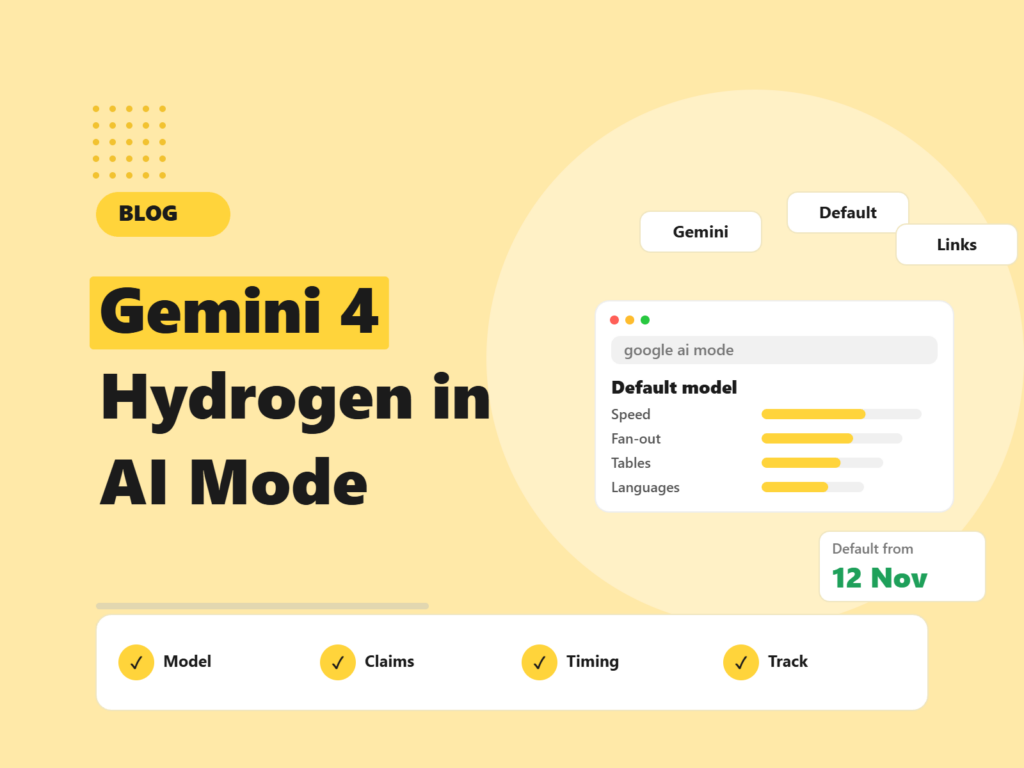
On 12 November 2026, Google made Gemini 4 Hydrogen the default model in AI Mode for all users worldwide. Search Engine Journal and Search Engine Land both covered it. For marketers, the practical issue is timing: the switch happened two days into the November core update, so any movement in your data over the coming weeks could come from either one. Here is what Google says changed, what it has not explained, and how to keep your tracking honest.
Quick answer: Gemini 4 Hydrogen is Google’s newest model in Search, described as built for speed and efficiency. It is now the default in AI Mode for all users worldwide. Google says it improves handling of multi-part queries and query fan-out, which it says surfaces a broader range of links, but gave no figures. Log 12 November as a model change in your tracking.
What is Gemini 4 Hydrogen?
According to Search Engine Journal, Gemini 4 Hydrogen is Google’s newest model in Search, built for speed and efficiency. Gemini 4 Carbon and Gemini 4 Argon are aimed at longer, deep-thinking tasks. Google’s help page lists Carbon as an option for AI Ultra subscribers and describes Hydrogen as the everyday option. The previous AI Mode default was Gemini 3.5 Flash, set in May.
We covered the earlier model in our post on Gemini 4 Argon in AI Mode.
What does Google say is better?
These are Google’s claims about AI Mode, as reported:
- Better handling of multi-part, typo-laden and highly specific queries, and closer adherence to instructions.
- Improved query fan-out, which Google says surfaces a broader range of links, including lesser-known sites. Google gave no figures.
- More visual aids, structured responses, comparison tables and customisable tools, with more nuanced answers in all supported languages.
For AI Overviews, Robby Stein, Google’s VP of Product for Search, said Hydrogen is being used for the hardest AI Overview questions. Google has not defined what counts as “hardest,” and its Search post does not mention AI Overviews.
Why does the timing matter?
The Google November 2026 core update began on 10 November and was still rolling out on 12 November when the model switch was announced. If your rankings, citations or traffic change over the next few weeks, you will not be able to say which change caused it unless you record both dates. We explain how to handle the core update in our guide to the November 2026 core update.
Will more links mean more traffic?
Google says query fan-out now surfaces a broader range of links, including lesser-known sites, but it shared no numbers. That could be good news for smaller publishers, though it is a claim, not a result. Check your own data before you plan around it.
How to track the effect on your site
- Log the dates. Write down 10 November (core update) and 12 November (model change) in your reporting notes.
- Record a baseline. Save your Search Console data and your AI citation checks from before these dates.
- Spot-check key queries in AI Mode. For your top 10 topics, note whether you are cited, and which page.
- Look for new query shapes. Long, multi-part and typo-heavy queries may appear more often. Add pages or sections that answer them.
- Separate the two changes where you can. Compare AI citation changes with classic ranking changes. A move in one but not the other points to a different cause.
What should you do with your content?
- Answer multi-part questions clearly. Use headings for each part, so each part can stand alone.
- Add comparison tables and short summaries. Google says AI Mode is showing more tables and structured answers, so structured content is easier to use.
- Cover the long tail. Specific, niche pages may have a better chance if the model reaches further into lesser-known sites.
- Keep markup tidy. See our schema markup for AI search guide.
To understand how AI models change what gets cited, our post on resetting your AI citation baseline after GPT-6 uses the same approach.
What we do not know yet
- Which AI Overview queries Hydrogen handles, since Google has not defined “hardest.”
- How much the link claims change real traffic.
- Whether Hydrogen changes which sources are cited compared with Gemini 3.5 Flash.
Final thoughts
A new default model is another moving part in an already noisy month. Record the date, keep a baseline and judge by your own data. If you want help tracking AI visibility properly, see our GEO services or request a free website audit.
Frequently asked questions
What is Gemini 4 Hydrogen?
Google’s newest model in Search, described as built for speed and efficiency. It is now the default in AI Mode for all users worldwide.
When did Gemini 4 Hydrogen become the default?
On 12 November 2026.
What did it replace?
The previous AI Mode default was Gemini 3.5 Flash, set in May, according to Search Engine Journal.
Does it affect AI Overviews?
Robby Stein said Hydrogen is used for the hardest AI Overview questions. Google has not defined that term.
How do I tell the model change from the core update?
Record both dates, 10 and 12 November, keep a baseline, and compare AI citation changes with classic ranking changes.
We set up baselines and citation tracking so you can tell which change moved your results.

Riya Bhardwaj
Leading content and growth initiatives with a focus on search visibility, audience engagement, and measurable business outcomes. Specialised in SEO, Generative Engine Optimization (GEO), AI search optimisation, and performance-driven content marketing. Passionate about transforming market insights into scalable content strategies that strengthen brand authority and drive sustainable digital growth.