
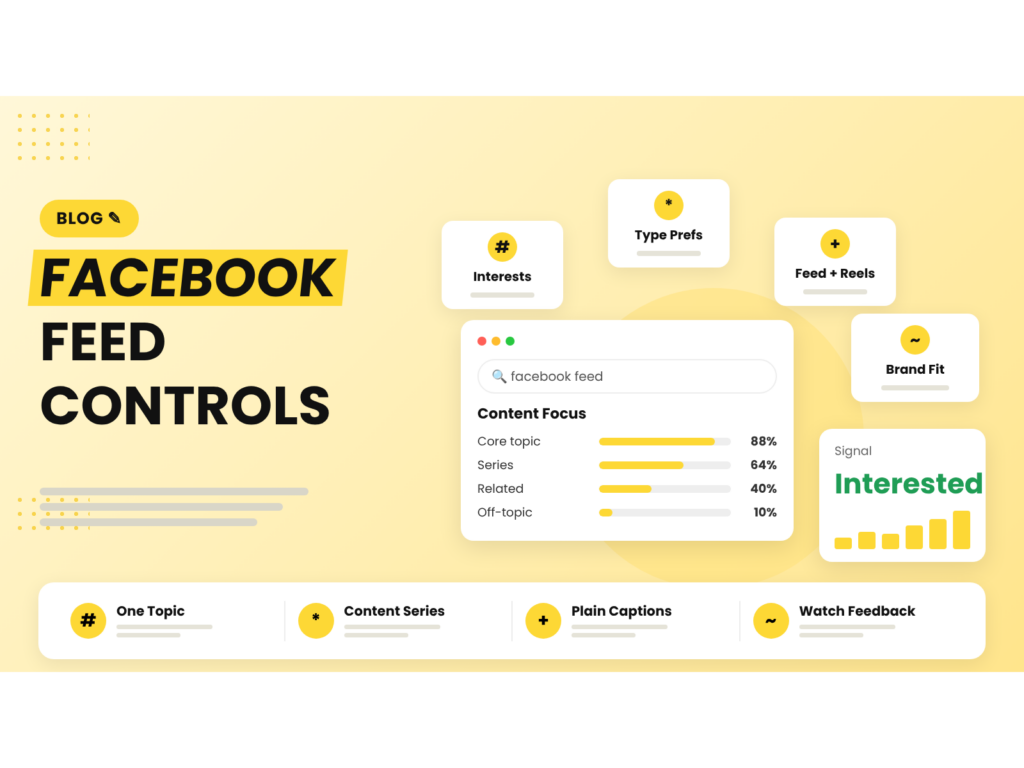
Facebook is giving users more say over what they see, in everyday words. On 13 October 2026, it was reported that users can now add or remove interests and type, in a chatbot-style prompt, what they want more or less of in their feed. The controls work in the main feed and in Reels. For brands, the message is clear: relevance is increasingly decided by the viewer, and pages that stand for one clear thing are easier to be matched with.
Quick answer: Facebook has built on its Your Algorithm tool so people can edit interests and describe what they want to see more or less of, in plain language. After a tap on Interested or Not interested, Facebook may ask why. Most users will not change settings quickly, but the update rewards focused pages. Keep each page and content series on a clear topic, and use feedback signals to guide what you post.
What changed
The update builds on Facebook’s Your Algorithm tool. People can now add or remove interests and write what they want more or less of, much like giving instructions to a chatbot. The controls apply in the main feed and in Reels. After someone taps Interested or Not interested on a post, Facebook may follow up with a question about why.
Adoption will likely be slow. Most people never visit feed settings. But the direction matters, and the follow-up question after a tap is a more visible signal than before, so it can reach many more people than a settings page would.
What it means for brands
Platforms increasingly try to match content to stated preferences, not only to behaviour. A page that posts about five unrelated things is harder to match than one that posts about a clear subject. This is not new advice, but a feed that people can edit in words makes it more important.
It also affects paid social. Ads that feel off-topic for an audience are more likely to meet a Not interested tap, and over time that can raise your costs. Our Meta ads guide explains how creative and audience signals interact in the current system.
What to do now
1. Define your page topic in one sentence
If you cannot say what the page is about in one line, the audience will not be able to either. Cut or move off-topic content.
2. Build content series
Repeating formats on one topic, such as a weekly tip or a monthly customer story, make it easier for people to say they want more of it.
3. Use clear language in captions and Reels
Say what the post is about in the first line and on screen. Plain wording helps both people and systems understand it.
4. Watch negative feedback
Check hide, unfollow and Not interested trends in your insights. A rising pattern on one content type is a reason to change it.
5. Ask your audience directly
Run a short poll or post a question: what would you like more of? Real answers beat guessing.
6. Match ads to the audience’s interests
Tighten targeting and creative so the ad fits what the audience has asked for. Test one variable at a time.
Keep expectations realistic
This is a gradual shift, not an overnight change in reach. Use it as a reason to simplify your content mix, then measure engagement quality, not just reach.
Frequently asked questions
What are Facebook's new feed controls?
Users can add or remove interests and type what they want more or less of in a chatbot-style prompt. The controls apply to the main feed and Reels.
Does Facebook ask why I tapped Not interested?
It may. After someone taps Interested or Not interested, Facebook can ask a follow-up question about the reason.
Will this reduce my page reach?
Not necessarily. Focused pages that match what people say they want should be easier to match. Off-topic content is more at risk.
How can I keep my page focused?
Describe the page’s topic in one sentence, build repeatable content series, and remove or move content that does not fit.
Does this affect Facebook ads?
It can. Ads that do not fit an audience’s interests are more likely to get negative feedback, so match creative and targeting to what the audience wants.
We design programmatic SEO systems with the data, templates and quality controls needed to grow long-tail traffic safely — without risking a scaled content penalty.

Riya Bhardwaj
Leading content and growth initiatives with a focus on search visibility, audience engagement, and measurable business outcomes. Specialised in SEO, Generative Engine Optimization (GEO), AI search optimisation, and performance-driven content marketing. Passionate about transforming market insights into scalable content strategies that strengthen brand authority and drive sustainable digital growth.