
One of the biggest complaints about automated Google Ads campaigns is simple: advertisers cannot see what the system actually did. On 13 October 2026, Search Engine Land reported a new view for AI Max for Search campaigns that starts to fix that. It connects search terms with the headlines, descriptions and landing pages used, and shows how each search was matched. It has only been seen in at least one account so far, with no confirmed rollout date, but it shows where Google is heading.
Quick answer: The AI Max search terms and ad combinations report shows which search term triggered which headline, description and landing page, plus the match source and whether the assets came from you. Use it to find mismatches, such as a broad search triggering an unrelated offer, then fix them with negatives, asset changes and landing page controls. Judge success by conversions and cost per qualified lead, not clicks.
What the report adds
Before this, search term reports and asset reports lived in separate places. You could see queries, and you could see asset performance, but not how they were paired. The new view puts them side by side and adds the match source and whether an asset was supplied by the advertiser. That helps answer a common question: why did my ad show for that?
Search Engine Land gave a telling example. A basic car wash search triggered an ad for a $699 ceramic coating. The click may be real, but the intent was far apart from the offer. This is the kind of mismatch that quietly eats budget in broad, automated campaigns. For the basics of the format, see our complete AI Max for Search guide.
Availability
As of the report, it had been seen in at least one account and Google had not confirmed a rollout date. If you do not see it in your account yet, you can still run a similar check manually using the search terms report and your landing page report.
A simple audit routine
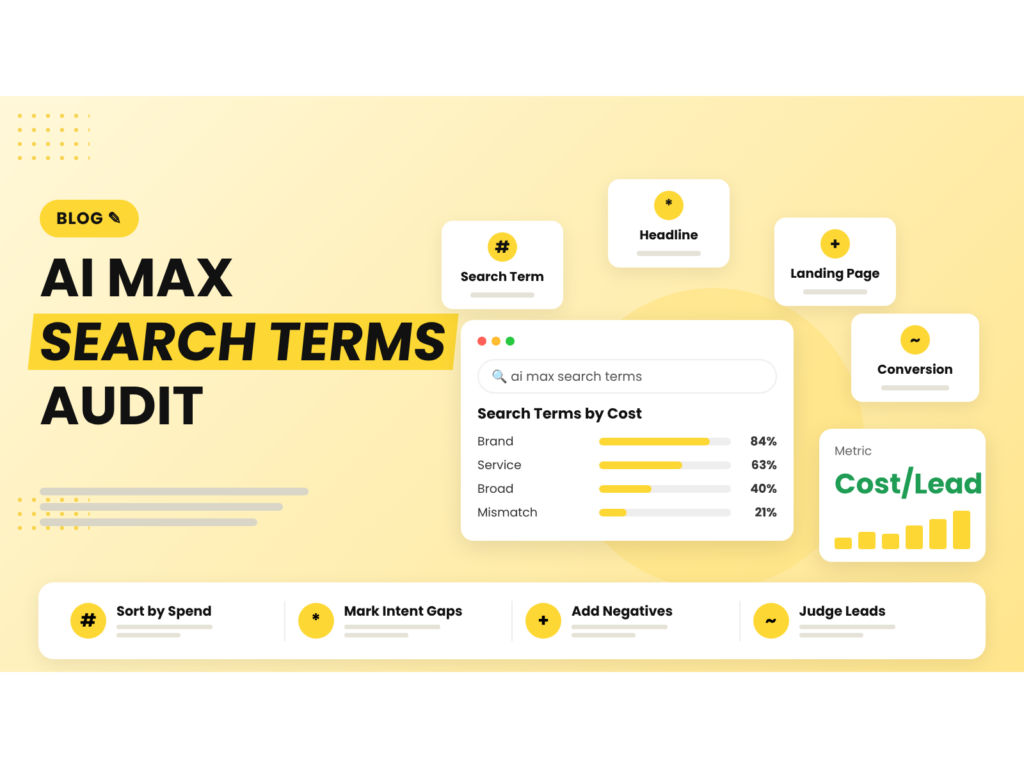
1. Start with spend, not volume
Sort search terms by cost. Review the top 50 first, because that is where money is lost.
2. Mark intent gaps
For each term, write whether the searcher wanted the same thing you are selling. Flag cases where the headline or landing page promotes a more expensive or different product.
3. Check the match source
Note which terms came from broad expansion rather than your keywords. These deserve the most scrutiny.
4. Review landing pages
If AI Max sends traffic to a page that does not fit the query, use URL exclusions or tighten the asset set. Make sure your best-fit pages exist for each service.
5. Add negatives and test
Block clearly irrelevant themes. Then compare cost per qualified lead before and after for two to four weeks.
6. Judge by outcomes
Clicks and click-through rate can rise while lead quality falls. Track conversions, lead quality and revenue, and connect them to your CRM if you can. Our Meta ads guide uses the same approach for another automated platform.
Frequently asked questions
What is the AI Max search terms and ad combinations report?
It is a new Google Ads view for AI Max for Search campaigns that links search terms to the headlines, descriptions and landing pages used, and shows the match source and whether assets came from the advertiser.
Is it available to everyone?
Not yet. Search Engine Land reported it in at least one account with no confirmed rollout date.
What should I look for in the report?
Look for mismatches between the search intent and the offer shown, high-cost terms that do not convert, and landing pages that do not fit the query.
How do I stop AI Max showing irrelevant ads?
Add negative keywords, control landing pages with URL exclusions, tighten your asset set, and review search terms on a regular schedule.
What metric should I use to judge AI Max?
Use conversions and cost per qualified lead, ideally linked to your CRM. Clicks alone can be misleading.
We design programmatic SEO systems with the data, templates and quality controls needed to grow long-tail traffic safely — without risking a scaled content penalty.

Riya Bhardwaj
Leading content and growth initiatives with a focus on search visibility, audience engagement, and measurable business outcomes. Specialised in SEO, Generative Engine Optimization (GEO), AI search optimisation, and performance-driven content marketing. Passionate about transforming market insights into scalable content strategies that strengthen brand authority and drive sustainable digital growth.