
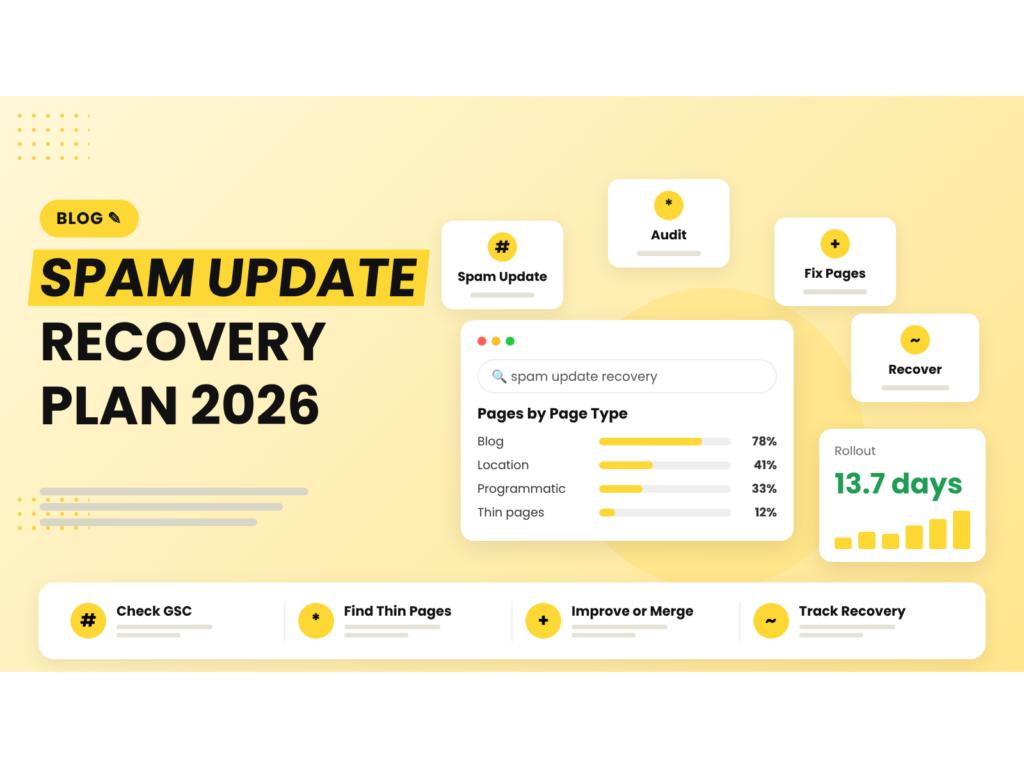
Google’s September 2026 spam update started on 24 September and finished on 8 October, a rollout of 13 days and 16 hours. That makes it the longest spam update since August 2025. Google called it “a normal spam update”, but if your traffic moved in the last few weeks, there is nothing normal about it for you. This guide explains what we know, what we do not, and the steps to take if your site was hit.
Quick answer: The September 2026 spam update applied globally and to all languages. Google has not published a list of targets, but its own recent statements point to scaled, low-effort content as the main concern. If you lost rankings, audit pages that were mass-produced, thin or built mainly to capture search traffic. Fix or remove them, then wait for the next update to see recovery. Do not rush to change things that were already working.
What happened and when
Google confirmed the update on its Search Status Dashboard. It began on 24 September and was marked complete on 8 October. Google described it as a normal spam update and said it applies to all regions and languages. Longer rollouts mean rankings can move up and down for days, so judging the result before the rollout finished would have given you a false read.
A few related signals appeared in the same weeks. At the SCL conference in Barcelona on 5 October, Google’s Gary Illyes said scaled content is now a bigger problem than link spam, and that Google is using AI to catch spam. Some consultants have also reported more manual-action requests tied to thin content and scaled content, though Google has not confirmed a wider trend. Treat these as direction, not proof.
How to tell if you were affected
Start with Google Search Console. Compare the 14 days after 8 October with the 14 days before 24 September, and filter by page, not by site. A real spam-update hit usually shows as a sharp, sustained drop on specific groups of pages, not a slow slide across everything.
Be careful with rank trackers. Some tools reported truncated results from Google between late September and early October, which can look like a ranking crash when it is really a data problem. Always confirm drops against Search Console clicks and impressions before you act. We cover that issue in a separate guide in this series.
Which pages are most at risk
Based on Google’s public comments, look at these groups first: pages generated in bulk from a template with little unique data, articles rewritten from other sources without adding experience or facts, location or product pages that differ only by a swapped keyword, and old guest-post or link-selling pages on your domain. If you run programmatic pages, our programmatic SEO guide explains the quality gates that keep them safe.
A practical recovery plan
1. Export the damage
Pull page-level clicks for the two windows above. Sort by biggest loss. Group the pages by type, such as blog, location, product or tag pages. Patterns matter more than single URLs.
2. Score each page honestly
For every dropped page ask three questions. Does it contain something a reader cannot get from the top five results? Was a person with real knowledge involved? Would you be comfortable showing it to a customer? Pages that fail all three are candidates for removal or a full rewrite.
3. Improve, merge or remove
Rewrite pages that have a real purpose. Merge overlapping pages into one stronger page and redirect the old addresses. Remove or noindex pages that exist only to catch searches. Google’s own helpful content guidance now talks about effort, originality, skill and accuracy, which is a useful checklist.
4. Fix the source of the problem
If a tool, template or freelancer produced the weak pages, change the process, not only the pages. Add a human review step, a minimum standard for unique data, and a rule that nothing is published without a fact check. Google’s updated guidance on AI content also says manual fact-checking of AI output is essential.
5. Be patient and keep records
Spam-related drops often need a later update before recovery shows. Keep a dated log of what you changed so you can link results to actions. Avoid daily edits to the same pages, because that makes it impossible to learn what worked.
What to do if you were not hit
Use the update as an audit trigger. Spam updates are becoming more frequent, and Google has said it will keep running them. A quarterly review of your weakest pages is cheaper than a recovery project. Also check that your August 2026 spam update actions are still holding.
Frequently asked questions
When did Google's September 2026 spam update run?
It began on 24 September 2026 and finished on 8 October 2026, about 13 days and 16 hours. Google said it applies globally and to all languages.
How do I know if the spam update hurt my site?
Compare Search Console clicks by page for the 14 days after 8 October against the 14 days before 24 September. A hit shows as a sharp, sustained drop on a group of similar pages, not a slow decline across the whole site.
Can I recover from a spam update?
Often yes, but it usually takes time. Improve, merge or remove weak pages, fix the process that created them, and expect recovery to appear after Google’s systems reassess your site, which may need a later update.
Is AI content penalized by spam updates?
Google’s focus is on scaled, low-value content, not on how it was made. Its guidance says AI output needs manual fact-checking before publishing, so use AI as an assistant, not as an unreviewed publisher.
Should I delete all my old blog posts?
No. Only remove or noindex pages that have no real purpose. Pages that still get traffic or serve readers should be improved, not deleted.
We design programmatic SEO systems with the data, templates and quality controls needed to grow long-tail traffic safely — without risking a scaled content penalty.

Riya Bhardwaj
Leading content and growth initiatives with a focus on search visibility, audience engagement, and measurable business outcomes. Specialised in SEO, Generative Engine Optimization (GEO), AI search optimisation, and performance-driven content marketing. Passionate about transforming market insights into scalable content strategies that strengthen brand authority and drive sustainable digital growth.