
Programmatic SEO is how travel sites, marketplaces and SaaS companies rank for hundreds of thousands of long-tail searches: one template, one structured dataset, thousands of pages. With AI and automation tools, almost any business can now do it. That is exactly why Google has tightened its scaled content abuse policies. The difference between a programmatic SEO win and a site-wide traffic collapse comes down to one question: does each page give a searcher something unique?
Quick answer: Programmatic SEO works in 2026 when every generated page is built on unique, useful data (prices, specs, locations, reviews, availability) and answers a real search intent. It fails when pages are thin AI rewrites that only swap a keyword. Start with a proven query pattern, a clean dataset, a strong template and quality gates that stop low-value pages from being indexed.
What programmatic SEO actually is
Programmatic SEO means creating many landing pages automatically from a database and a template, each targeting a specific variation of a search pattern. Classic examples include “best [software] alternatives”, “[service] in [city]”, “[currency] to [currency] converter” and “[product A] vs [product B]”.
The automation part is simple. The hard part is having data that makes each page worth visiting.
Why Google cracks down on scaled content
Google’s spam policies define scaled content abuse as generating many pages primarily to manipulate rankings rather than help users, and they apply whether the content is made by AI, humans or both. Core and spam updates through 2025 and 2026 have repeatedly hit sites with large volumes of near-duplicate, templated pages. Typical warning signs are:
- Pages that differ only by a swapped city or keyword.
- AI-generated paragraphs with no unique facts or data.
- Thousands of pages with no internal links, no engagement and no search demand.
- Location pages for areas where the business does not actually operate.
The safe programmatic SEO framework
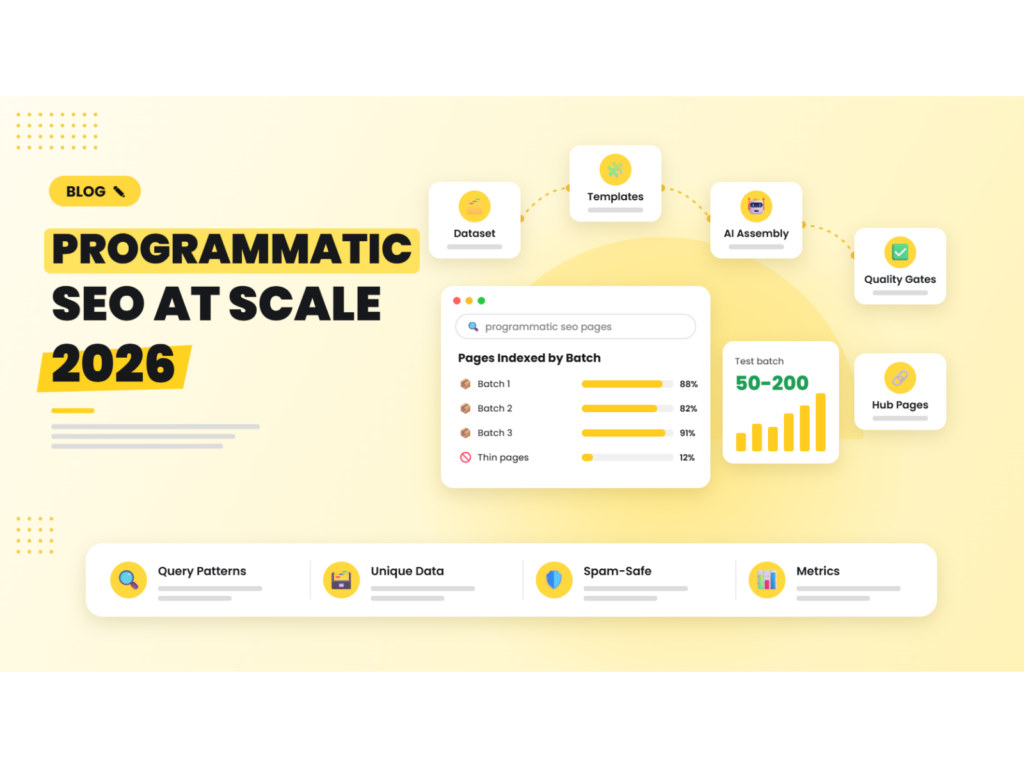
1. Validate the query pattern
Use keyword tools and Search Console to confirm that the pattern has real demand across many variations. If only 20 variations get searched, build 20 great pages by hand instead.
2. Build a unique dataset
Your data is your moat: first-party pricing, inventory, reviews, performance stats, local availability, expert notes. Public data alone is rarely enough, because competitors can use it too.
3. Design a template that answers the intent
Map what a searcher needs on each page: comparison tables, prices, FAQs, maps, images, calls to action. Use conditional blocks so pages with richer data show more sections, and pages with little data show less rather than filler.
4. Use AI carefully, for assembly not invention
AI is excellent at turning structured data into readable summaries, writing unique intros from real attributes, and generating FAQ answers grounded in your dataset. It should not invent facts, reviews or statistics. Always feed it the data and ask it to stay within it.
5. Add quality gates before indexing
Automate rules that decide whether a page is published and indexable, for example a minimum number of data points, a minimum word count of unique content, or at least one review. Pages that fail are set to noindex until the data improves.
6. Roll out in batches
Publish 50 to 200 pages first. Watch indexing rates, impressions and engagement in Search Console for four to six weeks. If Google indexes and ranks them, expand. If most sit in “Crawled – currently not indexed”, improve the template before scaling.
7. Link it all together
Generate hub pages, breadcrumbs and related-page modules automatically so every programmatic page is reachable within a few clicks and passes relevance to its neighbours.
Tools for programmatic SEO automation
- Data: Google Sheets, Airtable, a database or your product catalogue.
- Publishing: WordPress with custom fields and a builder like Elementor, Webflow CMS, or a headless CMS.
- Automation: n8n, Make or custom scripts to push rows into the CMS through its API.
- Monitoring: Search Console, the URL Inspection API and scheduled crawls to track indexing and quality.
Metrics that tell you it is working
Track the percentage of pages indexed, the share of pages receiving at least one click per month, engagement per template, and conversions from long-tail traffic. A healthy programmatic section keeps a high indexing rate as it grows; a falling rate is an early warning that quality is slipping.
Programmatic SEO is powerful, but only when paired with strong technical SEO and real data. Our enterprise SEO services team can help you plan and build it safely.
Frequently asked questions
Is programmatic SEO still safe in 2026?
Yes, when each page provides unique, useful information built on real data. It becomes risky when pages are thin, near-duplicate or created only to capture keywords, which Google treats as scaled content abuse.
Can I use AI for programmatic SEO?
Yes, as long as AI turns your real data into readable content rather than inventing facts. Ground every AI prompt in the page data and add human review for templates and samples.
How many programmatic pages should I launch at once?
Start with a test batch of 50 to 200 pages, monitor indexing and performance for a few weeks, then scale in stages. Launching tens of thousands of pages at once makes quality problems harder to catch.
What CMS is best for programmatic SEO?
WordPress with custom fields, Webflow CMS and headless CMS platforms all work well. The key is API access so your automation can create and update pages from your dataset.
What is the difference between programmatic SEO and spam?
Value. Programmatic pages that help users compare, decide or find specific information are legitimate. Pages that only swap keywords without adding information are spam, whatever tool made them.
We design programmatic SEO systems with the data, templates and quality controls needed to grow long-tail traffic safely — without risking a scaled content penalty.

Riya Bhardwaj
Leading content and growth initiatives with a focus on search visibility, audience engagement, and measurable business outcomes. Specialised in SEO, Generative Engine Optimization (GEO), AI search optimisation, and performance-driven content marketing. Passionate about transforming market insights into scalable content strategies that strengthen brand authority and drive sustainable digital growth.