
Every few years a platform appears that marketers are told they must be on, and most of the time the advice is premature. Threads is different, because the numbers have become hard to ignore. Meta has reported more than 400 million monthly users, later coverage cites around 500 million by mid-2026, and third-party estimates suggest its daily mobile audience has overtaken X. Meta also opened Threads to advertisers globally in 2026, which tells you where the company thinks it is heading.
For brands, that creates a rare moment: an audience large enough to matter, a culture that still rewards conversation over polish, and ad prices that early reports describe as lower than the older Meta platforms. This guide covers how Threads works, whether your business should be there, how to set up and grow an account, what the algorithm seems to reward, how to run Threads ads and how to measure the results. It is written for marketers who want a practical plan, not a hype cycle.
Quick answer: Threads is Meta’s text-first social network, built on Instagram accounts, with posts of up to 500 characters and a feed that rewards conversation. Brands do best by posting helpful, opinionated, conversational content three to five times a week, replying thoughtfully every day, using a single topic tag per post, and treating replies as the main goal. Threads ads are available globally through Meta Ads Manager, either automatically within Advantage+ campaigns or by selecting Threads as a placement, with text-led creative. Measure replies, profile visits, follows and tagged link clicks, not just likes.
Why Threads matters for brands in 2026
Three developments make Threads worth a serious look.
- Scale. Meta reported 400 million monthly active users in 2025, and industry coverage in mid-2026 cites roughly 500 million. Third-party estimates published in January 2026 put Threads’ daily mobile users above those of X. Treat the exact figures as approximate, since the sources differ, but the direction is clear.
- Distribution inside Meta. Threads is tied to Instagram accounts, so your existing audience can follow you across, and Meta uses its recommendation expertise to surface posts from accounts people do not yet follow.
- Ads are arriving. Meta announced global expansion of Threads ads in January 2026, with rollout over the following months. Early commentary describes lower competition and lower costs than Facebook and Instagram, while warning that prices tend to rise as advertisers pile in.
The strategic point is timing. Organic reach and cheap ads rarely last forever. Brands that learn the platform while it is still forgiving build an audience and a content habit that competitors will have to pay more to match later.
How Threads differs from X, Instagram and LinkedIn
It helps to understand the culture before you post.
- Versus X: Threads is generally described as friendlier and less news-driven, with less emphasis on real-time pile-ons and more on everyday conversation, opinions and questions. Posts can run to 500 characters, nearly double the older limit on X.
- Versus Instagram: Instagram is visual-first and polished. Threads is text-first and informal. A glossy product shot can work, but the winning posts usually have a point of view.
- Versus LinkedIn: LinkedIn rewards professional storytelling and depth. Threads rewards short, human, conversational posts. Our guide to LinkedIn’s 2026 algorithm shows how different those expectations are.
If you already create content for Instagram, our guide to what earns reach on Instagram in 2026 will help you decide what to repurpose and what to write fresh.
Is Threads right for your business?
Good fits
- Consumer and direct-to-consumer brands with a personality, a community or a product people enjoy talking about, including fashion, food, wellness, home and travel.
- Software and tech companies that can share opinions, tips and product thinking in public.
- Creators, consultants and agencies whose expertise is the product.
- Media, education and publishing brands that thrive on conversation.
Weaker fits
- Highly regulated categories where every sentence needs legal review, because Threads rewards spontaneity.
- Businesses with no capacity to reply. Conversation is the entire point.
- Brands that only want to push offers. Promotional posts tend to underperform.
Setting up a Threads account that works
- Connect it to your Instagram business account. Your handle, profile picture and followers carry across, which gives you an initial audience.
- Write a bio that says who you help and what you talk about. One clear sentence beats a slogan. Add a link to a page that matches the audience, not just your homepage.
- Decide on three to five content pillars. For example, for a project management software company: practical tips for managers, honest opinions on work culture, behind-the-scenes product decisions, customer stories and quick questions to the community.
- Choose a voice. Decide whether the account speaks as the brand, as a named person, or both. Many brands find that posts from a real team member perform better than corporate-sounding posts.
- Create a response policy. Who replies, how fast, what tone, and when to escalate. Replies are the product on Threads.
Content that earns replies
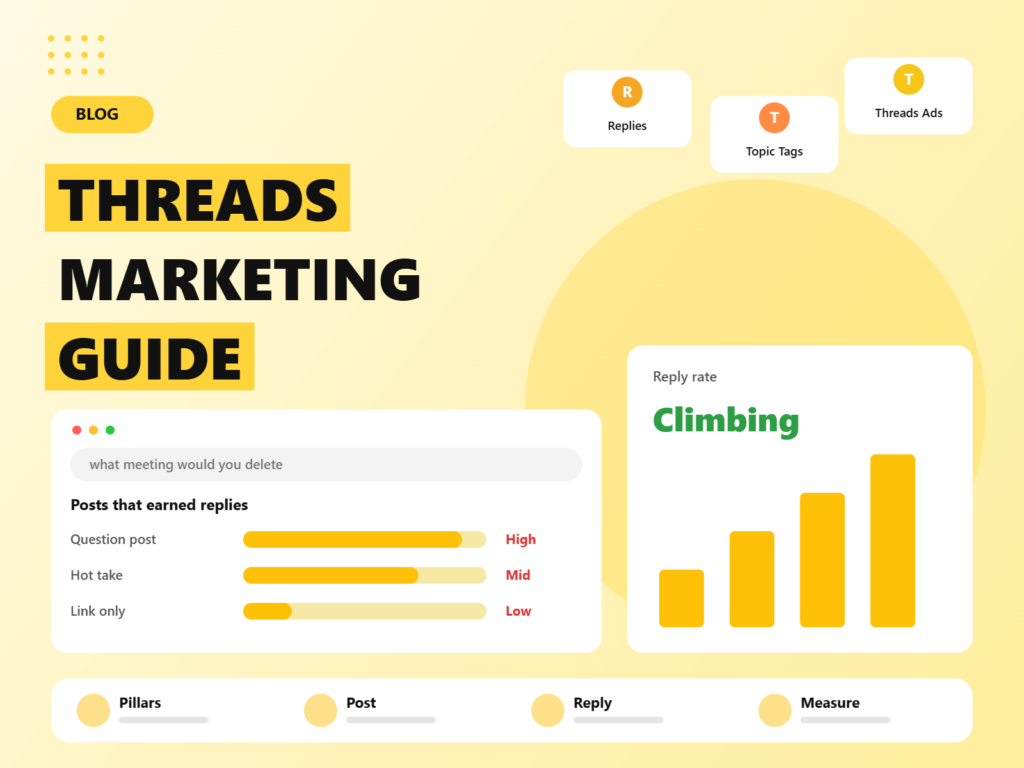
The most important thing to understand about Threads is that replies matter more than likes. Instagram head Adam Mosseri has said publicly that the combined value of replies is comparable to that of posts, and growth practitioners report that replies make up a large share of Threads views. So design every post to start a conversation.
Eight post formats that work
- The question: ask something people have a strong opinion about. “What is the one meeting you would delete from your week?”
- The hot take: a clear, defensible opinion in your field, offered with a reason.
- The mini-lesson: one practical tip in two or three sentences, with a prompt such as “What would you add?”
- The behind-the-scenes: a small decision, a mistake, a number or a moment from your work.
- The either-or: two options and a request to pick. These are easy to answer, so they invite replies.
- The customer spotlight: a real result or quote, with permission, framed as a story.
- The photo with a caption that asks something: practitioners report images outperform plain text on average, but the caption still needs to invite a response.
- The thread: a short chain of connected posts that walks through an idea, a process or a story.
Writing tips for 500 characters
- Lead with the point, not the setup.
- Write like you talk. Short sentences, plain words.
- Leave something unsaid, so there is room for people to add their view.
- Avoid link-only posts. Add a sentence of value, and put links in the profile or in a follow-up reply when appropriate.
- Use one topic tag per post, chosen to describe the subject. Threads uses topic tags without the hash symbol and, according to guidance from practitioners, one tag per post is the norm.
Video and images
Short vertical videos of around fifteen to thirty seconds with captions are commonly recommended, and carousels can work for step-by-step tutorials. Keep production values natural. Over-produced brand creative often sits oddly in a conversational feed.
What the algorithm seems to reward
Meta has not published a recipe, but statements from Meta leaders and the observations of marketers point to the same signals:
- Early engagement. The first hour after posting appears to shape how widely a post is shown, so post when your audience is online and be present to reply.
- Quality of replies. Thoughtful responses count for more than emoji reactions. Aim for exchanges, not just counts.
- Time spent and interest. Posts that people read, expand and return to tend to travel further.
- Consistency. Regular posting builds familiarity, which lifts early engagement.
- Authenticity. Commentators consistently describe conversational, personality-led content outperforming polished ads.
Posting-time advice varies. Some analyses suggest weekday mornings and evenings are strong while weekends are weak, but audiences differ, so test your own times and check your insights.
A weekly rhythm you can sustain
Consistency beats intensity. Here is a realistic starting schedule for a small team:
- Monday: a question post to start the week.
- Tuesday: a mini-lesson or tip.
- Wednesday: a behind-the-scenes or opinion post.
- Thursday: a customer story or example.
- Friday: a lighter either-or or reflection.
That is three to five posts a week, a baseline many practitioners suggest. Increase only if you can maintain quality and reply to everything. More than a few posts a day risks audience fatigue.
A 20-minute daily engagement routine
- Reply to every meaningful comment on your recent posts within the hour, if you can.
- Spend ten minutes replying to posts from people in your niche, adding something useful, not a generic compliment.
- Save any questions people ask. They are your next posts.
- Check which post got the most replies, and note why.
Replies on other people’s posts are a growth lever, because they put your name in front of audiences who do not follow you yet. Quality matters. A thoughtful two-sentence reply can bring more profile visits than a standalone post.
Using employees and founders
People trust people. A founder or subject expert posting regularly often builds more engagement than the brand account, and it lets the brand reach audiences through personal networks. Create simple guidelines on topics, confidentiality and tone, and then trust them. Support them with topic ideas, graphics and a quick review process for sensitive claims.
Threads ads: how to run them
What is available
Meta announced the global expansion of Threads ads in January 2026, with a gradual rollout, and later reports describe broad availability. Ads run through the same Meta Ads Manager you already use. In Advantage+ campaigns, Threads feed is typically included automatically, while in manual placement setups you can select Threads alongside Facebook, Instagram and other placements. Check the options in your own account, since availability can vary by market.
Formats and specifications
Reported formats include single image ads in square or four-by-five formats, video ads in a range of aspect ratios with four-by-five often recommended, and carousel ads. Guidance suggests a short primary text of roughly eighty to one hundred and sixty characters, with a short headline. Because Threads is text-first, copy matters more than on image-led placements. Always check Meta’s current specifications in Ads Manager before producing assets.
Targeting
Threads ads use Meta’s broader targeting and optimisation systems, including custom audiences, rather than anything unique to Threads. If you are using Advantage+, the system decides where to show your ads. Our guide to Meta Ads in 2026, Andromeda and Advantage+ explains how that works and why creative variety matters.
Costs and performance
Early reports describe CPMs for Threads well below those of Facebook Feed, with one analysis of Meta ad updates citing a figure around 46 percent lower, and agency write-ups citing low CPC levels. Treat all of these as early indications, because competition tends to push costs up as more advertisers arrive. Several write-ups also note that engagement rates are strong, while conversion rates can trail Instagram, which suggests starting with awareness and engagement objectives and testing conversion campaigns carefully.
Creative principles for Threads ads
- Sound like a post, not a poster. Conversational, plain language usually outperforms promotional copy.
- Lead with a question or a clear point. The first line is the hook.
- Use simple, human visuals. Real people and real products over heavy graphic design.
- Keep the call to action modest. Options may be limited, so make the landing page do the work.
- Test several concepts. As with other Meta placements, distinct ideas beat tiny variations.
Brand safety
Meta has said it works with verification partners such as DoubleVerify and Integral Ad Science for Threads, and the platform has been reported to hold Media Rating Council brand safety accreditation. If brand suitability is a concern, ask your Meta representative about current controls and review placement reports.
Ten post templates you can adapt today
Blank pages stall teams. Use these fill-in-the-blank starters, and replace the brackets with your own details.
- “Unpopular opinion in [your field]: [opinion]. Here is why: [one reason]. Agree or disagree?”
- “The one thing I wish [customers or beginners] knew about [topic]: [lesson]. What would you add?”
- “We just changed [something small] and [result]. Here is what we learned.”
- “[Option A] or [option B] for [situation]? Tell me which and why.”
- “A mistake we made in [area], so you do not have to: [mistake and fix].”
- “Quick question for [audience]: what is your biggest struggle with [topic] right now?”
- “Three signs you are ready for [next step]: [one], [two], [three].”
- “Behind the scenes: [short description of how something is made or decided], with a photo.”
- “A customer asked us [question]. Here is the honest answer.”
- “Myth: [common belief]. Reality: [correction].”
Rotate through the templates, but always finish with your own detail. Specifics make a post sound like a person wrote it.
Playbooks for different business types
B2B and SaaS
Share opinions on how your customers work, short product decisions, customer questions answered honestly, and lessons from running a team. Use founders and product people as voices. Drive interested people to a resource page, not a hard-sell demo page. Pair Threads with your LinkedIn presence, using Threads for lighter, faster conversation.
Direct-to-consumer and retail
Show products in real life, ask for opinions on new designs, share customer photos with permission, and run polls through either-or posts. Keep launches conversational: ask what people want before you announce. Test shopping tags if you qualify, but keep a healthy mix of non-promotional posts.
Services, consultants and agencies
Your expertise is the product. Share quick teardowns, checklists, common mistakes and honest answers to client questions. Reply generously to others in your field. People hire people they have seen think in public.
Publishers and educators
Post questions that lead to your content, short summaries with a point of view, and behind-the-scenes looks at how stories or lessons are made. Use threads for multi-part explanations, and invite readers to share their experiences.
Handling criticism and awkward moments
Open conversation means open disagreement. A few principles help. Reply quickly, calmly and with facts, and avoid arguing in circles. Acknowledge valid complaints publicly and move detailed support to a private channel. Do not delete or hide legitimate criticism, since that often becomes the story. Prepare a short escalation plan for serious issues, including who approves responses. And remember that a good reply to one critic is often read by hundreds of onlookers.
Social commerce and links on Threads
Meta has been testing shopping tags on Threads for select US business accounts connected to Instagram Shops, allowing up to five products to be tagged in a post, according to industry coverage in mid-2026. The tests are limited, and early observers noted that heavily tagged posts can draw fewer replies, so balance product posts with conversational content. Link behaviour has also changed over time, so check what your profile and posts currently support. A sensible approach is to treat Threads as a place to start conversations and build trust, then guide people to a landing page through your bio, pinned replies or ads. For stores, our article on TikTok Shop and social commerce in 2026 compares how different platforms handle shopping.
Meta also introduced Meta AI conversations inside Threads direct messages in July 2026, initially for individual users. It signals that the platform is moving toward more AI-assisted interaction, so watch for business features and plan how your brand would show up in them.
How to measure Threads success
Likes are the weakest signal. Use a scorecard that reflects what matters:
- Reply rate: replies divided by views. This is your best conversation indicator.
- Quality of replies: sample them. Are people asking questions, sharing experiences or showing buying intent?
- Follower growth and where it comes from: posts, replies or ads.
- Profile visits and link taps from the platform’s insights.
- Referral traffic and conversions: tag links with UTM parameters and track them in Google Analytics 4. Create a campaign name for Threads so it does not vanish into generic social traffic.
- Brand lift: branded search trends and the mentions you get in other places.
- For ads: reach, cost per thousand, click-through rate, cost per click and, where relevant, conversions and cost per result.
Review monthly. Note which pillars and formats earn the most replies, and double down on them.
Common mistakes to avoid
- Posting like a billboard. Sales messages with no value get ignored.
- Ignoring replies. If you do not respond, the algorithm and the community both lose interest.
- Copy-pasting from other platforms. A LinkedIn post or Instagram caption rarely fits.
- Overusing tags. One relevant topic tag is the norm.
- Posting in bursts and disappearing. Regular, modest posting beats sporadic floods.
- Judging by likes. Replies, follows and clicks matter more.
- Skipping brand guidelines for team posts. Make expectations clear.
- Starting ads without organic proof. Test what resonates organically, and then put budget behind the best ideas.
Your first 30 days on Threads
Week 1: connect the account, write the bio, choose pillars and voice, and draft ten posts. Follow people in your niche and reply thoughtfully to a handful each day.
Week 2: post three to five times, use the eight formats, reply to every comment and track which posts earn replies.
Week 3: repeat what worked, ask your team to start posting, and add a short thread explaining something your audience cares about.
Week 4: review results, choose your best-performing posts, and consider a small ad test using those ideas, with a clear objective and a modest budget.
Threads rewards brands that behave like good conversationalists. If you would like help building a content plan, a posting workflow or a paid test, our social media marketing team can set it up, and our content marketing team can create the posts, threads and landing pages that go with it.
Frequently asked questions
What is Threads marketing?
Threads marketing means using Meta’s text-first social network to build an audience, start conversations and drive traffic or sales, through organic posts, replies and, increasingly, paid ads. It rewards conversational, opinionated content more than polished promotion.
How many people use Threads?
Are Threads ads available?
How often should a brand post on Threads?
How do I get more reach on Threads?
Is Threads better than X or LinkedIn for business?
We plan your content pillars, write the posts, manage the conversation and test Threads ads with a modest, measurable budget.

Riya Bhardwaj
Leading content and growth initiatives with a focus on search visibility, audience engagement, and measurable business outcomes. Specialised in SEO, Generative Engine Optimization (GEO), AI search optimisation, and performance-driven content marketing. Passionate about transforming market insights into scalable content strategies that strengthen brand authority and drive sustainable digital growth.