

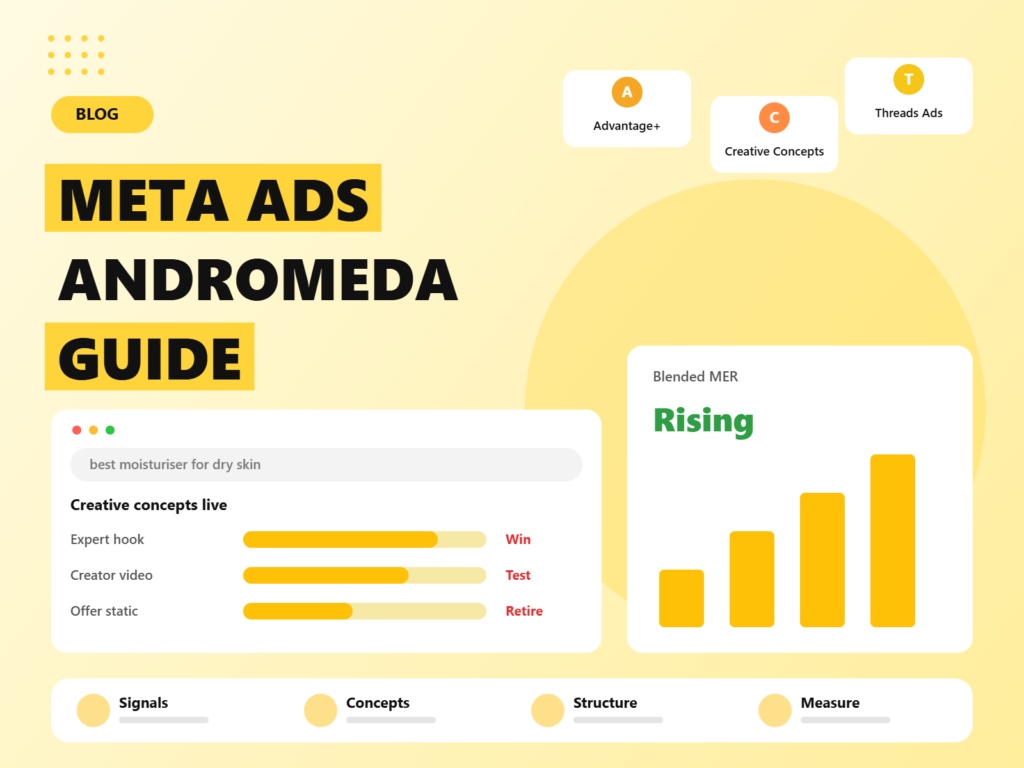
Ask a Meta advertiser what changed in the last two years and you will hear the same answer in different words: the old playbook stopped working. Detailed interest stacks, a dozen small ad sets, and weekly audience tinkering used to be the craft. In 2026 Meta’s delivery systems pick the audience for you, and the lever you control most is the creative itself.
This guide explains how Meta’s current ad system works in plain language, what Andromeda, GEM and Advantage+ mean for your day-to-day decisions, and how to build an account structure, creative process and measurement setup that fits. It is written for marketers who run Facebook and Instagram ads for ecommerce, lead generation or apps, and for founders who want to understand what their agency or freelancer is doing. Where Meta or the industry has shared numbers, we attribute them, and where practices are still debated we say so.
Quick answer: Meta now relies on AI models to find the right people for each ad, so creative and offer do most of the targeting work. Advantage+ automation is the default for sales, leads and app campaigns, detailed targeting is treated more like a suggestion, and signal quality matters more than manual controls. To perform well, give the system a diverse set of genuinely different creative concepts, consolidate your campaigns so they gather enough conversion data, send clean server-side events through the Conversions API, and judge results with blended measures such as marketing efficiency ratio, not platform ROAS alone.
From audience-led to creative-led: what changed
For most of the 2010s, Meta advertising rewarded precision targeting. You chose interests, lookalike audiences and age brackets, and you won by finding a pocket of buyers your competitors had missed. Privacy changes, especially Apple’s App Tracking Transparency, eroded the signals that made that precision work. Meta responded by investing heavily in machine learning systems that predict who will respond to which ad, using signals inside its own platforms.
The result is a different division of labour. The platform decides who sees what. You decide what the ad says, shows and offers. As one widely repeated way to put it, the creative has become the targeting. If your ad speaks clearly to a specific problem, the system finds people who respond to that problem. If your ads are all slight variations of the same idea, the system has little to work with.
Andromeda, GEM and Lattice in plain English
You will hear these names in webinars and agency pitches. You cannot configure them, but understanding them explains why the best practices have shifted.
- Andromeda is Meta’s ad retrieval system. Before any auction, it narrows millions of possible ads down to a shortlist that might suit a given person. Meta announced it in late 2024 and rolled it out through 2025, reporting gains in ad recall and ad quality. Because retrieval depends on what each ad is actually about, ads that look and sound distinct from each other give the system more options to match.
- GEM, the Generative Ads Recommendation Model, is a large ranking model. Meta has said it improved conversions on Instagram and Facebook Feed in early deployments, which is one reason Meta keeps expanding its use.
- Lattice is an architecture that consolidated many separate models into larger shared ones, so learning from one objective can inform others. Advertisers do not touch it directly, but it helps explain why fewer, larger campaigns tend to learn better.
You do not need to memorise the details. The takeaway is consistent across Meta’s own messaging and independent analysis: more data per campaign, more distinct creative, and fewer manual constraints.
Advantage+ is becoming the default
Meta has been steadily folding manual and automated setups together. Early in 2026, Advantage+ Shopping campaigns were renamed Advantage+ Sales campaigns, and Advantage+ automation became the default path for sales, leads and app campaigns, with the older manual flows narrowing. Coverage of the changes also reports that Advantage+ Audience is now the default, with detailed targeting treated as a suggestion to the system rather than a hard limit. Location and minimum age remain firm requirements. Older Advantage+ Shopping and App campaign versions have been phased out of Meta’s Marketing API, which matters if you use third-party tools or scripts.
What this means for you:
- Expect less manual control over placements, audiences and creative rotation. Some advertisers dislike that. Others find it frees time for creative work.
- Inputs matter more than settings. Product data, conversion events, creative assets and offers are the main things you control.
- Constraints still exist. Local businesses, regulated industries and special ad categories may need tighter targeting and should check Meta’s current rules.
Defaults and naming differ by region and account, and Meta changes them often. Confirm what you see in your own Ads Manager before applying any advice, including ours.
Creative is the new targeting: how to build a creative system
Make real concept variety, not cosmetic variations
Ten ads that use the same hook with different background colours count as one idea to the system and to the viewer. Aim for genuinely different concepts that speak to different motivations. For a skincare brand, one concept might be a dermatologist explaining an ingredient, another a customer routine video, another a comparison with a popular alternative, another a founder story, and another a simple offer-led static. Each attracts a different slice of your market.
Mix formats
Use short vertical video for cold audiences, carousels for products that need comparison, and static images for clear offers and retargeting. Practitioner reports suggest static images still drive a large share of conversions for many accounts, so do not abandon them in the rush to video. Include user-generated or creator-style content, because it tends to feel native in feeds and Reels. Our guide to Instagram’s 2026 algorithm and what earns reach is useful background for planning Reels-first creative.
Vary the hook, the message and the length
The first two or three seconds decide whether anyone sees the rest. Write several hooks per concept: a question, a bold claim, a surprising visual, a pain point. Vary copy length too, from one line to a longer story. Different people respond to different amounts of text.
Match creative to funnel stage, loosely
Because Advantage+ blends prospecting and retargeting, you cannot always force a funnel structure. You can still design assets for different mindsets. Educational and story-led pieces suit people meeting your brand for the first time. Proof, comparisons and offers suit people who already know you.
Use Meta’s AI creative tools with judgement
Meta has been adding generative tools, including image and video generation from product photos, background and text variations, music, translation and dubbing, virtual try-on for apparel and brand-aware generation. They can save production time and help you test more variants. Use them as accelerators, not substitutes for strategy. Review every output for accuracy, brand fit and policy compliance, and keep at least some human-made, specific creative in the mix, because audiences notice generic output.
Track creative fatigue early
Rising CPMs, falling click-through rate, declining thumb-stop or hook rate, and a sustained drop in return are the usual signs. Agencies commonly set refresh triggers, for example a sharp CTR decline or a CPM climb of a quarter or more over a week, and plan to introduce a handful of new concepts every month. Your cadence should scale with spend: small accounts might refresh monthly, larger ones weekly.
Account structure in 2026: consolidate
Fragmentation is the enemy of machine learning. When you spread a modest budget across many campaigns and ad sets, each one sees too few conversions to learn. The prevailing advice, from Meta and from independent practitioners, is to consolidate:
- Run one or two main Advantage+ sales or leads campaigns for prospecting instead of many audience-specific ones.
- Keep a small number of ad sets, often a handful rather than a dozen or more, each with multiple creative concepts.
- Use a separate retargeting or existing-customer campaign only if you have enough volume and a clear reason, for example different offers or exclusions.
- Aim for enough conversion events for stable learning. Meta has long used a guideline of roughly 50 optimisation events per week per ad set to exit the learning phase, and some practitioners suggest more for reliable optimisation. Smaller accounts can optimise for a higher-volume event, such as add to cart, if purchases are too few.
One agency case study reported cutting a sprawling account of sixteen ad sets across five campaigns down to two Advantage+ campaigns, with lower acquisition cost and identical creative. Individual results vary, but the direction of travel is consistent.
A creative brief template that works with Advantage+
Most weak Meta creative starts with a weak brief. Use a one-page template for every concept, so designers, editors and creators know exactly what they are making:
- Audience problem: the specific frustration or desire this concept speaks to, in the customer’s own words.
- Hook options: three different openings for the first three seconds, written as lines or visuals.
- Proof: the evidence that makes the claim believable, such as a review, a demonstration, a statistic you can substantiate or a before-and-after you are allowed to show.
- Offer and call to action: what the viewer should do next and why now.
- Format and length: vertical video of a given length, carousel, static, or a mix.
- Landing page: the page that continues the story. A concept about a specific problem should land on a page about that problem.
- Compliance notes: claims to avoid, required disclosures and platform policy considerations.
Store each brief and tag the resulting ads by concept name. When results come in, you can see which concepts, not just which individual ads, earn their keep, and your next batch builds on evidence.
Landing pages and offers: the half of performance people forget
If Meta is finding the right people, the page and offer decide whether they act. A few principles hold across industries. Match the message from ad to page, so a visitor who clicked a concept about sensitive skin does not land on a generic homepage. Load quickly on mobile, because much Meta traffic arrives on phones, and our guide on why website speed impacts sales shows how directly delays cost conversions. Make the offer clear above the fold, with price, shipping, returns and guarantees visible. Remove unnecessary steps from checkout or the lead form. Test one change at a time, and give each test enough traffic to be meaningful. When the post-click experience improves, every ad performs better, which matters more as Meta automates more of the targeting.
Scaling budgets without breaking learning
When a campaign works, the temptation is to double the budget overnight. That often resets learning and raises costs. More careful options include increasing budgets in moderate steps every few days, duplicating a winning setup into a new campaign instead of changing the original, and adding new creative concepts as you add spend, so the system has fresh material for the larger audience. Watch frequency, CPM and new customer share as you scale. If efficiency drops sharply, hold the budget, refresh creative and check that tracking is still healthy before pushing further.
Measurement: signals, attribution and honest reporting
Fix your signals first
Everything depends on the data you send back. Install the Meta pixel and the Conversions API, so events reach Meta from your server as well as from the browser. Browser-only tracking misses more and more activity because of blockers and privacy settings. Deduplicate events, pass as many relevant parameters as your privacy policy allows, and watch the Event Match Quality indicator in Events Manager. For ecommerce teams, product catalogue quality is part of the signal too, and our guide to Shopify conversion tips covers the store-side basics.
Know what the numbers mean
Reported coverage notes that in March 2026 Meta tightened what counts as a click-through conversion, limiting it to link clicks, with other interactions moving into a separate engagement-based window, and that Meta also lowered the video engagement threshold used for attribution. If your reporting window or definitions changed, your before-and-after comparisons may be distorted. Annotate your dashboards with the date, and compare like with like.
Look beyond platform ROAS
Platform-reported return on ad spend is useful for diagnosing campaigns, but it tends to credit Meta for conversions that might have happened anyway. Add measures that look at the whole business:
- Marketing efficiency ratio (MER): total revenue divided by total marketing spend. If you scale Meta spend and MER improves, you are probably adding value. If platform ROAS looks great while MER falls, you may be recapturing existing demand.
- New customer share: the proportion of conversions from people who have never bought before.
- Incrementality tests: geo holdouts or Meta’s own lift studies, which compare outcomes with and without ads.
- Blended cost per acquisition across all channels, trended over time.
Our article on what Google’s cookie reversal means for tracking explains why first-party data and server-side measurement remain the safest foundation whichever way browser policy moves.
New placements: Threads, Reels and shoppable formats
Meta has been broadening where ads can appear. Threads ads reached general availability in 2026, and early analysis reports lower CPMs than Facebook Feed, though audience behaviour and intent differ, so test rather than assume. Shoppable overlays in Reels are also rolling out for catalogue advertisers. With Advantage+ placements, Meta decides where to deliver, but you should still review placement reports to understand where spend goes, and prepare creative in the right shapes: vertical 9:16 for Reels and Stories, square or 4:5 for feeds.
A step-by-step plan to rebuild your Meta account for 2026
- Audit tracking. Confirm pixel and Conversions API events, deduplication, event match quality and the catalogue connection.
- Define the conversion that matters. For ecommerce it is usually purchase. For lead generation, use a qualified lead event if possible, not just form submissions, and consider sending offline conversions back to Meta.
- Audit creative. Group existing ads into concepts. If you only have two or three, plan production before you scale spend.
- Consolidate campaigns. Merge overlapping campaigns, pause dead weight, and keep a simple structure.
- Launch a creative testing campaign or ad set. Put new concepts in separately so you can see what works, then graduate winners into the main campaign.
- Set up reporting. Build a dashboard that shows platform ROAS, MER, new customer share and creative-level metrics weekly.
- Review and refresh monthly. Retire tired concepts, brief new ones based on learnings, and revisit structure each quarter.
How the advice changes by business type
Ecommerce brands
Advantage+ Sales campaigns with a clean catalogue, strong product imagery and varied creative are the centre of gravity. Pay attention to margins and returns, not just revenue. If you sell on Shopify, our Shopify SEO guide and speed guides help make sure the traffic you pay for lands on a fast, trustworthy store.
Lead generation and services
The risk is cheap, low-quality leads. Use qualified-lead signals, instant forms with friction where appropriate, and a quick follow-up process. Share lead quality back with Meta through offline events when you can. Consider messaging ads that open a conversation, which can work well for services where trust matters.
Local businesses
You may still need tighter geographic targeting, so check how Advantage+ treats location constraints for your campaign type. Creative with real people, real places and clear offers tends to perform. Combine with local search work, as covered in our local SEO guide.
App marketers
Advantage+ app campaigns lean heavily on creative variety and on solid in-app event tracking, so make sure your mobile measurement setup sends the events that represent real value, such as subscriptions or purchases, not installs alone.
B2B
Meta can work for B2B when you have strong offers and decent budgets, particularly for content that builds an audience for later retargeting. Expect to lean on creative angles and first-party lists, and compare against LinkedIn and Google for efficiency. Our write-up of LinkedIn’s 2026 algorithm shows what to expect there.
Common mistakes to avoid
- Producing variations, not concepts. The system needs real diversity.
- Fragmenting budget. Many tiny campaigns learn slowly or not at all.
- Over-restricting audiences. Heavy manual constraints fight the system, unless you have a regulatory or geographic reason.
- Ignoring signal quality. Poor event data produces poor optimisation.
- Judging by platform ROAS alone. Pair it with MER, new customer share and lift tests.
- Changing too much too often. Constant edits reset learning. Make deliberate changes and give them time.
- Letting AI tools replace thinking. Use them to scale good ideas, not to generate average ones.
Your first 30 days
Week 1: audit tracking and catalogue, record baseline metrics, and list your current creative concepts.
Week 2: consolidate campaigns, set up a creative testing structure, and brief three to five new concepts with multiple hooks each.
Week 3: launch the new concepts, monitor delivery and early indicators such as hook rate and click-through rate, and resist the urge to judge on conversions too soon.
Week 4: review concept-level performance, promote winners, retire losers, and compare MER and new customer share with your baseline. Plan the next creative batch.
Meta advertising has become less about clever settings and more about clear thinking, good creative and trustworthy data. If you want help rebuilding your structure or producing a creative testing system, our social media marketing team and PPC specialists can support you. If you are comparing channels, read our breakdown of Google AI Max for Search to see how Google is making a similar shift toward automation.
Frequently asked questions
What is Meta Andromeda?
Andromeda is Meta’s ad retrieval system. It narrows a huge pool of ads to a shortlist that could suit each person before the auction. Because it relies on what each ad is about, distinct creative concepts give it more to match, which is why creative variety has become so important.
What is Advantage+ and should I use it?
How many creatives should I run in a Meta campaign?
Do detailed interest targeting options still work?
Why does my Meta ROAS look good but my revenue is flat?
Do I need the Conversions API?
We rebuild account structure, set up clean tracking, and run a creative testing system that matches how Meta delivers ads today.

Riya Bhardwaj
Leading content and growth initiatives with a focus on search visibility, audience engagement, and measurable business outcomes. Specialised in SEO, Generative Engine Optimization (GEO), AI search optimisation, and performance-driven content marketing. Passionate about transforming market insights into scalable content strategies that strengthen brand authority and drive sustainable digital growth.