
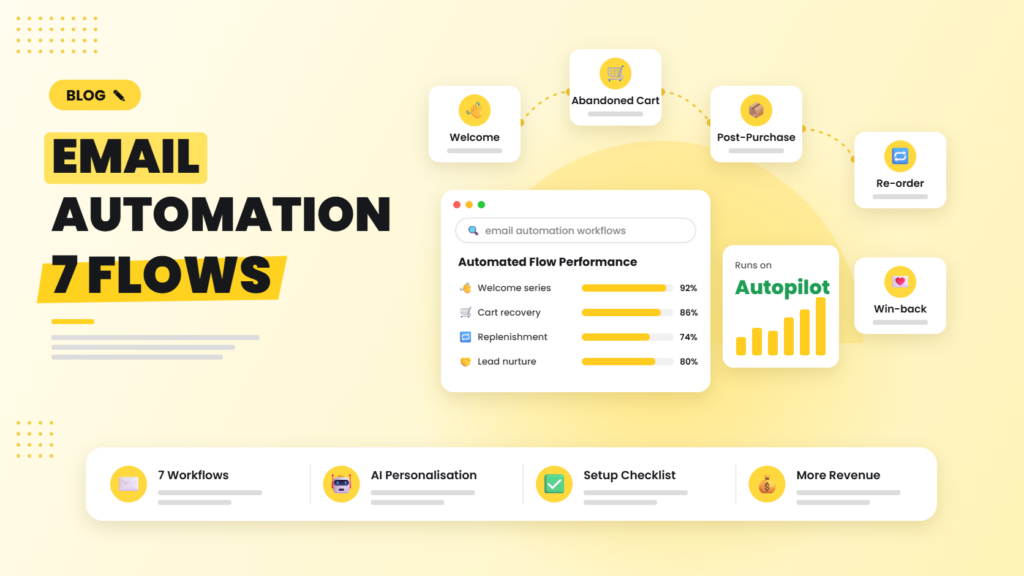
Campaign emails get the attention, but automated emails do the quiet, consistent work. A welcome series, an abandoned cart reminder or a timely re-order nudge is triggered by what a customer actually did, so it arrives exactly when it is relevant. That is why automated flows typically generate a disproportionate share of email revenue compared with their share of sends. Here are the seven workflows every business should have running in 2026.
Quick answer: The seven email automations with the highest return are: a welcome series, abandoned cart, browse abandonment, post-purchase, replenishment or re-order, win-back, and lead nurturing for B2B. Build them once in Klaviyo, Mailchimp, Brevo, HubSpot or a similar platform, trigger them from real customer behaviour, personalise with AI using first-party data, and review performance monthly.
Why automation beats batch-and-blast
Inbox providers now reward engagement and punish irrelevance. Since Gmail and Yahoo introduced stricter bulk-sender requirements in 2024, including authentication (SPF, DKIM, DMARC), easy one-click unsubscribe and low spam-complaint rates, sending the same email to everyone has become riskier. Behaviour-triggered automations naturally earn higher opens and clicks, which protects your sender reputation.
The 7 workflows every business needs
1. Welcome series
Triggered when someone subscribes. Send three to five emails over one to two weeks: deliver the promised incentive, tell your brand story, highlight best-sellers or core services, and share social proof. Welcome emails have some of the highest engagement rates of any email you will send.
2. Abandoned cart
Triggered when a known visitor adds items to the cart but does not buy. Send the first reminder within one to four hours, a second after about a day, and an optional third with an incentive. Show the exact products, price and a single clear button back to checkout.
3. Browse abandonment
Triggered when a known subscriber views products or service pages without adding to cart. Keep it helpful rather than pushy: “Still comparing? Here is a quick guide”, plus reviews and alternatives.
4. Post-purchase
Confirm the order, set delivery expectations, share how-to content, then ask for a review once the product has arrived. This flow reduces support tickets and builds the reviews that feed both SEO and conversions.
5. Replenishment and re-order
For consumables such as skincare, supplements, coffee or pet food, trigger a reminder shortly before the customer is likely to run out, based on product size or their own purchase interval. It is one of the easiest ways to lift repeat purchase rate.
6. Win-back
Triggered when a customer has not purchased or engaged for a set period, for example 90 or 120 days. Remind them what is new, offer a reason to come back, and if they still do not engage, suppress them. Removing inactive contacts protects deliverability.
7. B2B lead nurturing
For service businesses and SaaS, trigger a nurture sequence when someone downloads a guide, books a demo or requests a quote. Mix educational content, case studies and a clear next step, and use CRM lead scoring to alert sales when a lead becomes sales-ready.
Where AI fits in 2026
- Subject lines and copy variations: generate and A/B test options quickly, always with brand-voice review.
- Send-time optimisation: most major platforms now predict when each subscriber is most likely to open.
- Product recommendations: dynamic blocks based on browsing and purchase history.
- Predictive segments: likely-to-churn, likely-to-buy and predicted lifetime value segments.
- Cross-channel orchestration: move customers between email, SMS and WhatsApp depending on how they respond.
Setting up your flows: a practical checklist
- Authenticate your sending domain with SPF, DKIM and DMARC.
- Connect your store or CRM so events like viewed product, added to cart and placed order flow into the email platform.
- Build the welcome and abandoned cart flows first; they usually deliver the fastest return.
- Add exit conditions so people stop receiving a flow once they convert.
- Set frequency caps so customers in several flows are not overwhelmed.
- Review revenue per recipient, conversion rate and unsubscribe rate for each flow every month.
Common mistakes to avoid
Setting flows up once and never revisiting them, sending discounts in every flow (which trains customers to wait), ignoring mobile design and skipping plain-text versions are the most frequent problems we see. Treat each flow like a landing page: test, measure and improve.
Need help building your flows? Our email marketing services team can plan, write and automate them for you.
Frequently asked questions
What is email marketing automation?
Email marketing automation means sending emails automatically when a subscriber or customer takes a specific action, such as signing up, abandoning a cart or not purchasing for a while, instead of sending manual one-off campaigns.
Which email automation should I set up first?
Start with a welcome series and an abandoned cart flow. They are quick to build and usually deliver the fastest, most measurable return.
What are the best email automation tools in 2026?
Klaviyo is popular for ecommerce, HubSpot and ActiveCampaign for B2B and lead nurturing, and Mailchimp, Brevo and MailerLite for small businesses. The right choice depends on your store or CRM integrations and budget.
How many emails should be in a welcome series?
Three to five emails over one to two weeks works well for most brands. Give value first and introduce offers gradually.
Can AI write my automated emails?
AI can draft subject lines, copy variations and personalised blocks quickly, but every flow should be reviewed for brand voice, accuracy and compliance before it goes live.
We plan, write and build automated email flows that turn subscribers into repeat customers, with AI personalisation and reporting tied to real revenue.

Riya Bhardwaj
Leading content and growth initiatives with a focus on search visibility, audience engagement, and measurable business outcomes. Specialised in SEO, Generative Engine Optimization (GEO), AI search optimisation, and performance-driven content marketing. Passionate about transforming market insights into scalable content strategies that strengthen brand authority and drive sustainable digital growth.