

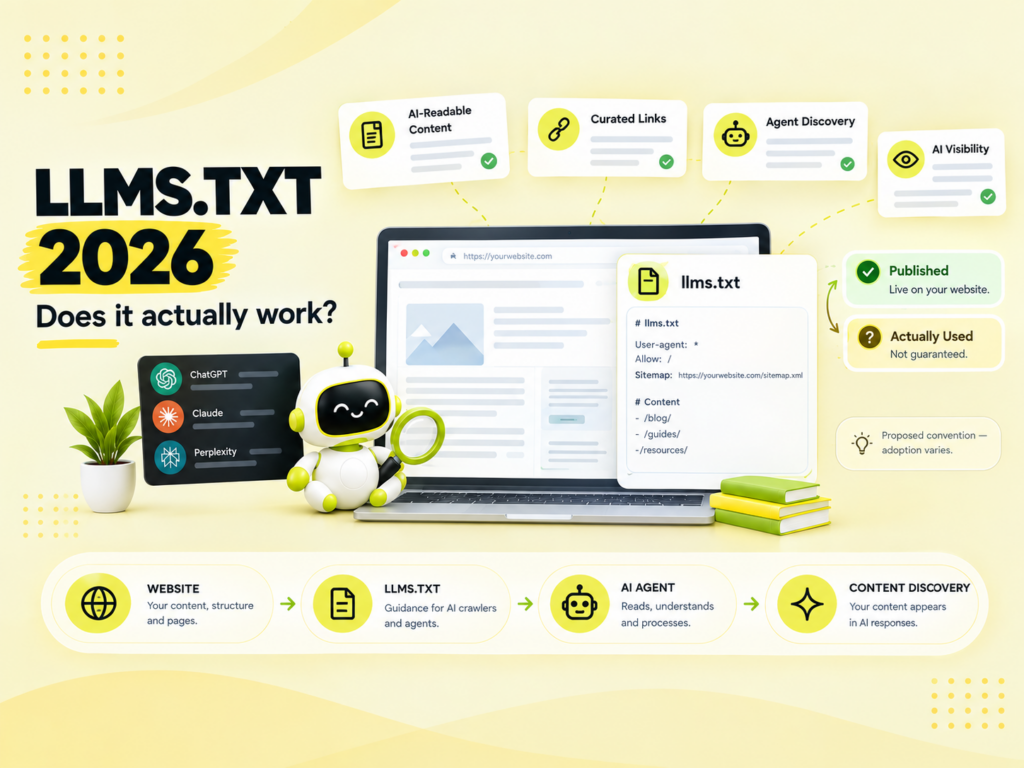
A new text file, sitting quietly at yoursite.com/llms.txt, has been pitched as the robots.txt of the AI era. In 2026, thousands of sites have added one. Far fewer AI systems are confirmed to actually read it.
The original proposal and full specification are maintained at llmstxt.org, the standard’s official reference site.
Publishing llms.txt is one piece of a wider strategy; our ChatGPT SEO services and AEO services cover the rest.
Quick answer: llms.txt is a proposed plain-text standard that summarizes a site’s key pages for large language models to read directly, instead of crawling and parsing full HTML. Adoption has grown through 2026, but it is not yet universal: several leading AI firms say they respect it, while others have not formally committed to supporting the standard at all, and there is no enforcement mechanism if they don’t. Treat it as a low-cost addition to your GEO stack, not a replacement for schema markup, clean HTML, or a properly configured robots.txt.
What llms.txt actually is
llms.txt is a Markdown file hosted at the root of your domain that gives a language model a condensed, curated summary of your site: what it does, which pages matter most, and short descriptions of each. The idea, proposed in 2024 and picked up more widely through 2025 and 2026, is that AI systems would rather read a clean, human-curated summary than crawl and parse an entire website’s HTML, navigation, and boilerplate to figure out what’s actually worth citing.
llms.txt 2026: the honest verdict on adoption vs. compliance
Here’s the gap that matters. Plenty of sites — including large publishers, SaaS companies, and documentation platforms — have published an llms.txt file. That part of adoption is genuinely happening. What’s far less settled is whether AI crawlers actually fetch and use it. Some leading AI firms have said they respect the standard, but compliance across the industry remains inconsistent, and several major search and LLM providers have not formally committed to supporting it at all. There is also no legal enforceability behind it: unlike robots.txt, which is backed by decades of crawler convention and increasingly by publisher lawsuits, llms.txt is a voluntary courtesy that a crawler can simply ignore.
llms.txt vs. robots.txt vs. schema markup
| Standard | What it does | 2026 enforcement |
|---|---|---|
| robots.txt | Tells crawlers what they may or may not access | Widely respected by major crawlers; increasingly monitored by publishers |
| Schema markup (JSON-LD) | Structures your content’s meaning for machines | Actively used to select AI Overview and chatbot citations |
| llms.txt | Summarizes your site for an LLM to read directly | Inconsistent — some providers read it, others don’t formally support it |
Of the three, schema markup has the clearest evidence of actually influencing what gets cited in AI search today. Robots.txt remains the most reliably respected access-control layer, as covered in our AI crawler management guide. llms.txt sits in a different category entirely: promising in theory, unproven in practice, and worth adding only after the fundamentals are already in place.
Should you still implement it?
Probably yes — but with the right expectations. An llms.txt file costs almost nothing to create and maintain, and for the AI systems that do read it, it’s a genuinely useful shortcut to your most important pages. The mistake would be treating it as a silver bullet or deprioritizing schema markup, structured data, and clean semantic HTML in favor of it. The most reliable 2026 GEO stack combines several layers rather than betting on any single standard.
How to write an llms.txt file that’s actually useful
- Start with an H1 and a one-line summary of what your site or business does, in plain language.
- List your most important pages as Markdown links with a short description each — not every page on your site, just the ones you’d want an AI system to read first.
- Keep it current. A stale llms.txt pointing to outdated pages is worse than none, since it can misdirect the systems that do read it.
- Don’t duplicate your sitemap. llms.txt is a curated summary, not an exhaustive index — that’s the entire point of the format.
- Pair it with solid schema markup and a disciplined robots.txt so you’re not relying on one unproven standard to carry your entire AI visibility strategy.
Frequently asked questions
Support is inconsistent and not fully confirmed across the board. Some AI providers have expressed support for the concept, but there is no universal, verified commitment from every major LLM or search provider to read and prioritize llms.txt content.
No. Sites with strong schema markup, clean structured content, and healthy AI crawler access can and do get cited in AI Overviews and chatbot answers without an llms.txt file. It’s a nice-to-have addition, not a prerequisite.
At the root of your domain, the same way robots.txt works — for example, yoursite.com/llms.txt. It should be a plain Markdown file, publicly accessible without authentication.
No — llms.txt is designed to help AI systems find and understand your content, not restrict it. If you want to block training crawlers specifically, that’s a robots.txt job, using explicit disallow rules for bots like GPTBot and ClaudeBot.
Valid schema markup, a robots.txt that deliberately allows AI answer bots, and clean, well-structured content. These have measurably more influence on AI citations today than llms.txt does, so they should come first.
Build a GEO strategy that doesn’t rely on one unproven standard
llms.txt is worth having, but it shouldn’t be the centerpiece of your AI visibility strategy while adoption is this uneven. Get a free website audit and we’ll show you exactly where your structured data, crawler access, and content structure stand today — and which of these standards will actually move the needle for your site. Ready to build a strategy that works across every AI platform? Talk to our team and we’ll take it from there.
Related Reading
- AI Crawlers in 2026: How to Manage GPTBot, ClaudeBot, and PerplexityBot Without Losing Traffic
- Google’s New AI Search Guide: What Actually Changes for SEO in 2026
- How to Optimise Your Website for ChatGPT: The Complete 2026 Guide

Riya Bhardwaj
Lead Marketing Strategist
Leading content and growth initiatives with a focus on search visibility, audience engagement, and measurable business outcomes. Specialised in SEO, Generative Engine Optimization (GEO), AI search optimisation, and performance-driven content marketing. Passionate about transforming market insights into scalable content strategies that strengthen brand authority and drive sustainable digital growth.