

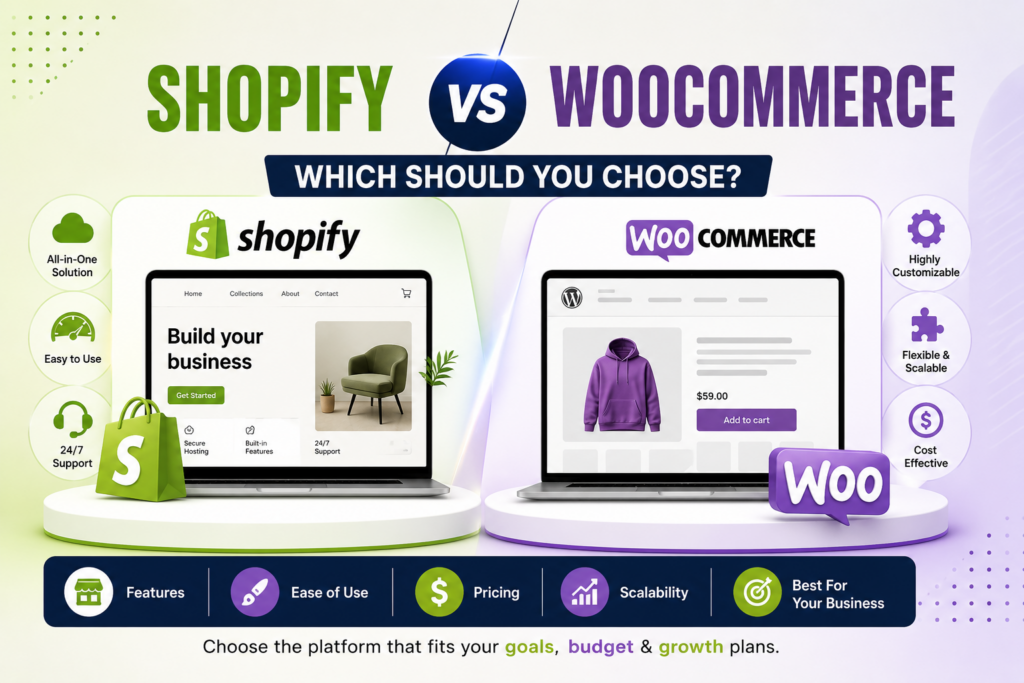
One is a managed all-in-one you rent; the other is an open-source platform you own and run. Pick wrong and you face a costly migration later. Here’s the honest 2026 comparison — real numbers, no bias toward whatever’s easiest to sell.
Quick answer
Shopify is a fully hosted, all-in-one platform — easy, fast to launch, with hosting, security, and updates handled for a predictable monthly fee (roughly $29–$399/mo), but it charges a 0.5–2% surcharge on third-party payment gateways unless you use Shopify Payments, and its URL structure is fixed. WooCommerce is a free, open-source WordPress plugin — total control and ownership, no platform transaction fees, and stronger SEO/content flexibility, but you handle hosting, security, maintenance, and the technical overhead. WooCommerce leads on raw site count (~36% of stores); Shopify leads on ease and revenue per merchant. Choose Shopify to launch fast and hands-off; choose WooCommerce for control, content-driven SEO, and lower fees at scale if you can manage the tech. Neither is universally better — compare three-year total cost at your real revenue.
Shopify and WooCommerce together power tens of millions of stores, and choosing between them is one of the most consequential decisions an ecommerce business makes — get it wrong and reversing it means months of migration and real developer cost. The good news: both are excellent. This isn’t about a winner; it’s about a trade. Let’s make the trade clear.
The core difference
Everything else flows from one distinction. Shopify is fully hosted — you rent a managed, all-in-one commerce platform and Shopify runs the infrastructure. WooCommerce is self-hosted and open-source — a free plugin on WordPress where you own and control every layer, and are responsible for every layer too. Shopify trades control for convenience. WooCommerce trades convenience for control. Almost every difference below is a downstream consequence of that.
At a glance
| Factor | Shopify | WooCommerce |
|---|---|---|
| Type | Hosted, all-in-one SaaS | Self-hosted WordPress plugin |
| Ease of use | Very easy; live in hours | Steeper; needs setup & upkeep |
| Pricing model | Predictable monthly plan | Free plugin + variable costs |
| Transaction fees | 0.5–2% on 3rd-party gateways (waived with Shopify Payments) | None (only your gateway's rate) |
| Hosting & security | Handled for you | Your responsibility |
| Customization | Within platform limits | Virtually unlimited |
| SEO / content | Solid; fixed URLs, basic blog | Stronger; full URL & CMS control |
| Scalability | Auto-scales; hands-off | Depends on your hosting |
| Ownership | You operate within Shopify | You own the whole stack |
| Best for | Fast, hands-off selling | Control, content, ownership |
Cost — the honest breakdown
Both platforms’ headline prices mislead. Here’s the real picture:
Shopify runs roughly $29–$39/month (Basic) to ~$299–$399/month (Advanced), with annual billing about 25% cheaper and Shopify Plus from around $2,300/month. Hosting, SSL, security, and PCI compliance are bundled — genuinely convenient. But the subscription is rarely the biggest line item: if you use any payment gateway other than Shopify Payments, Shopify adds a platform surcharge of about 2% (Basic), 1% (mid), or 0.5% (Advanced) on every sale. On a store doing $50,000/month on Basic, that’s ~$1,000/month in platform fees alone. Add apps (commonly $120–$300+/month) and premium themes, and the real cost climbs.
WooCommerce the plugin is free and charges no platform transaction fees — you pay only your payment gateway’s normal rate. The real costs are hosting ($5–$100/month), a theme ($0–$100), essential plugins ($100–$400/year), and developer/maintenance time (nothing if you’re technical; $100–$500/month if you hire help). A basic production store lands near $800/year; feature-rich mid-market stores run $5,000–$15,000/year.
The most expensive platform isn’t the one with a monthly fee — it’s the one that doesn’t fit how you actually operate.
The pattern: at low volume, Shopify is often cheaper once you value the hosting and upkeep you’d otherwise handle. At high volume, WooCommerce can win because it avoids per-sale platform fees that compound — but only if you (or someone) can manage the technical side. Compare the three-year total cost at your real revenue, not the month-one price. For the wider build-cost picture, see the cost of building a website in India.
Ease of use
This is the widest gap. Shopify gets a store live in a few hours with guided onboarding, a polished admin, and no server management — a non-technical owner can run it without a developer. WooCommerce needs WordPress hosting setup, plugin configuration, and ongoing maintenance, often adding many hours upfront and continuous upkeep after. If nobody on your team can safely maintain WordPress, WooCommerce’s lower plugin cost can evaporate quickly in developer bills.
SEO & content
WooCommerce has the edge for organic-growth businesses. Running on WordPress gives you full control over URL structure and the strongest content/blogging system available — a real advantage if content marketing drives your revenue. Shopify handles SEO fundamentals well and improved in 2026 (native schema, better meta control), but its fixed URL structure and more basic blog remain constraints (the ones we cover in the Shopify SEO guide and checklist). For a straightforward catalog with little content strategy, the difference is minor; for a content-led brand, it compounds year over year in WooCommerce’s favor.
Scalability & performance
Shopify auto-scales — traffic spikes from a big drop or Black Friday are absorbed by its infrastructure and global CDN with no work from you, which is a genuine “sleep factor” for founders. WooCommerce has no hard ceiling (huge stores run on it), but performance depends entirely on your hosting and optimization; growth means upgrading servers, tuning the database, and adding caching. Speed matters either way — the fixes are in Shopify speed optimization and why your website is slow.
Payments
WooCommerce supports all major gateways globally (Stripe, PayPal, and local options) with no platform fee on top. Shopify supports 100+ gateways but surcharges most of them; only Shopify Payments avoids the fee.
Customization & ownership
WooCommerce is open-source: you own your site and data outright, and can customize essentially anything through thousands of WordPress plugins and full code access. Shopify is polished and consistent but you operate within its platform limits — deeper customization means higher tiers, apps, or Shopify Plus. If owning and controlling every layer matters to you, that’s WooCommerce; if you’d rather not think about the stack at all, that’s Shopify.
Which should you choose?
Choose Shopify if…
- You want to launch fast and sell, not manage tech
- You’re non-technical or have no developer
- You value predictable, all-in monthly pricing
- You want reliability at scale, hands-off
- You can use Shopify Payments (fee-free) in your market
Choose WooCommerce if…
- You want full control and ownership of your site/data
- Content marketing and SEO drive your growth
- You’re already on WordPress
- You have technical capacity (or a developer)
- You want to avoid platform transaction fees at scale
The honest verdict
Neither platform is universally better — they’re different trades, and the right one depends on your volume, your team, and how much you want to own. Shopify is the safer, faster choice for most first-time and non-technical merchants who want to focus on selling. WooCommerce rewards businesses with technical capacity, a content strategy, and an eye on long-term ownership and margins. The costliest mistake isn’t picking the “wrong” platform — it’s picking on hype (“WooCommerce is free!” / “Shopify is easy!”) without doing the total-cost math for your store. Whichever you choose, success still comes down to speed, findability, and conversion — the reasons stores fail and the fixes in Shopify conversion tips apply on both. Build it on a solid SEO foundation from day one.
Frequently asked questions
What's the main difference between Shopify and WooCommerce?
Shopify is a fully hosted, all-in-one platform — hosting, security, and updates handled for a monthly fee. WooCommerce is a free, open-source WordPress plugin you self-host, giving total control and ownership but making you responsible for hosting, security, and maintenance. Shopify trades control for convenience; WooCommerce trades convenience for control.
Is Shopify or WooCommerce cheaper?
It depends on volume. WooCommerce’s plugin is free but hosting, themes, plugins, and dev time add up (no platform transaction fees). Shopify has predictable plans (~$29–$399/mo) but adds 0.5–2% on third-party gateways unless you use Shopify Payments. Low volume favors Shopify once you value upkeep; high volume can favor WooCommerce. Compare three-year total cost at your real revenue.
Which is better for SEO?
WooCommerce generally offers more flexibility via WordPress — full URL control and a stronger blog. Shopify handles fundamentals well and improved in 2026 (native schema, meta control) but has fixed URLs and a basic blog. For content-and-organic-driven businesses, WooCommerce has the edge; for a simple catalog, the difference is small.
Is WooCommerce or Shopify better for beginners?
Shopify — it’s fully hosted with guided setup, so a non-technical owner can launch in hours and run it without touching servers or code. WooCommerce needs WordPress hosting, plugin configuration, and ongoing maintenance, requiring more technical comfort or paid help.
Can I switch from Shopify to WooCommerce or vice versa?
Yes, in both directions via tools like LitExtension or Cart2Cart, which move products, customers, and orders. But it’s real work — custom functionality, apps/plugins, and design don’t transfer automatically. Because switching is costly, choose carefully upfront.
Which is more popular?
By raw site count, WooCommerce leads (~33–39% of ecommerce sites, often cited near 36%) versus Shopify ~26–28%. But Shopify earns higher average revenue per merchant and is stronger among larger stores. WooCommerce wins on volume, Shopify on revenue per store; figures vary by source.
The right choice depends on your revenue, your team, and your growth plan — not on which platform markets harder. We build and optimize on both, and we’ll recommend the one with the lowest total cost of ownership for your situation. Get a free consultation.

Riya Bhardwaj
Leading content and growth initiatives with a focus on search visibility, audience engagement, and measurable business outcomes. Specialised in SEO, Generative Engine Optimization (GEO), AI search optimisation, and performance-driven content marketing. Passionate about transforming market insights into scalable content strategies that strengthen brand authority and drive sustainable digital growth.