

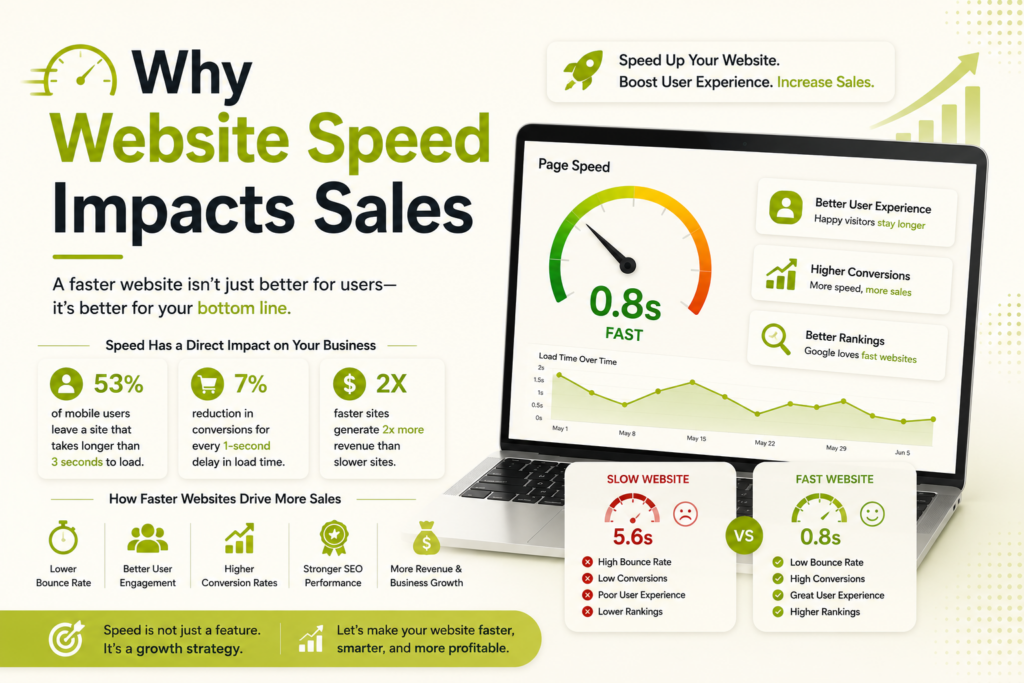
Site speed isn’t a technical vanity metric — it’s a revenue multiplier. Here’s the data behind how milliseconds turn into money, and how to value speed for your own business.
Quick answer
Website speed impacts sales because slow pages lose customers before they ever see your offer. Every additional second of load time cuts conversions by roughly 2–7%, and around 53% of mobile visitors abandon a page that takes longer than three seconds — a lost sale that usually goes straight to a faster competitor. Google and Deloitte’s “Milliseconds Make Millions” study found that a 0.1-second speed improvement lifted retail conversions by about 8% and average order value by around 9%. As a rule of thumb, every 100 milliseconds costs roughly 1% of conversions, so for a $10M/year store a half-second improvement can mean around $500,000 in recovered revenue. Speed is one of the highest-ROI growth levers available.
Most businesses treat page speed as an engineering detail. It’s actually one of the most direct, measurable levers you have on revenue — and one of the few that improves rankings, user experience, and conversions all at once. The link between milliseconds and money is not a theory; it’s one of the best-documented relationships in all of digital marketing.
How exactly does website speed affect sales?
Slow pages cost you sales through three compounding mechanisms:
- Abandonment — they leave before they see anything
A slow page loses the visitor before your product, price, or pitch ever appears. Think with Google found that 53% of mobile visits are abandoned when a page takes longer than three seconds, and the probability of a bounce climbs 32% as load time goes from one to three seconds. You can’t convert someone who already left. - Lost momentum and friction at the worst moment
Buying is a fragile chain of micro-decisions. Every lag — a slow product image, a stalling “add to cart,” a laggy checkout — breaks momentum and gives doubt a chance to creep in. Delay at the point of highest intent is where sales quietly evaporate. - Eroded trust
Speed is a proxy for quality. A slow, janky site makes shoppers question whether a business is legitimate and whether their payment is safe. Nearly 70% of consumers say page speed affects their willingness to buy from an online retailer — the hesitation is subconscious, but the lost sale is real.
What speed is actually worth in revenue
The numbers are strikingly consistent across independent studies:
- Every additional second of delay reduces conversions by roughly 2–7%, depending on sector (Akamai and aggregated WPO Stats data).
- Every 100 milliseconds costs about 1% of conversions — the finding that first surfaced when Amazon measured that 100ms of latency cost it 1% of sales.
- A 0.1-second improvement lifted retail conversions ~8% and AOV ~9% (Google + Deloitte, “Milliseconds Make Millions,” across 37 brands).
- Ecommerce conversion rates peak at a 1–2 second load and fall sharply beyond three.
Here’s how conversion typically decays as pages get slower (illustrative benchmark data — treat as directional, then measure your own):
| Page load time | Typical conversion rate |
|---|---|
| 1–2 seconds | Highest (~3%+) |
| 2.4 seconds | ~1.9% |
| 3.3 seconds | ~1.5% |
| 4.2 seconds | Below 1% |
| 5.7+ seconds | Below 0.6% |
And because conversion rate is a multiplier on all your traffic, the gains compound: lifting conversion from 2% to 3% is a 50% revenue increase from the exact same visitors — which also cuts your effective customer acquisition cost and protects the ROI of every ad you run.
Why mobile speed matters most
Mobile now drives roughly 60% of ecommerce traffic, yet pages tend to load far slower on phones than on desktop, and mobile shoppers are the least patient of all. The gap is where the money leaks: fewer than half of mobile sites pass all three Core Web Vitals. Because Google also indexes mobile-first, a slow mobile experience costs you twice — in rankings and in sales. Reducing mobile load time by even one second has been shown to lift conversions by around 6%.
The cart-abandonment and peak-traffic connection
The global cart abandonment rate sits above 70%, and slow checkout is a major, avoidable contributor — every extra second between “buy” and “confirmed” invites second thoughts. The risk spikes exactly when it’s most expensive: during sales and holidays, traffic surges can trigger slowdowns (sometimes called brownouts) that double load times right as buying intent peaks. The sale you lose to a three-second checkout on Black Friday is rarely recoverable — retargeting can’t win back a shopper who already bought from a faster competitor.
Real businesses that grew sales by getting faster
This isn’t hypothetical. Brands that measured the before-and-after saw revenue move on speed alone — no changes to product, price, or design:
| Company | What changed | Result |
|---|---|---|
| Rakuten 24 | Optimized Core Web Vitals (LCP & CLS) | +33% conversions, +53% revenue per visitor |
| Vodafone | 31% faster LCP | +8% sales, +11% cart-to-visit rate |
| COOK (UK) | Load time 3.7s → 2.1s | +7% conversions, +10% time on site |
| Amazon | Measured 100ms of added latency | −1% sales (the origin of the "speed = money" rule) |
How much is speed worth to your business?
You can estimate it in one line. Take your monthly visitors × conversion rate × average order value to get current revenue, then apply a conservative conversion lift for a one-second improvement. For a store with 50,000 monthly visits, a 2.5% conversion rate, and a ₹4,000 average order value, even a modest 10% conversion lift from faster pages adds roughly ₹5,00,000 in monthly revenue — from traffic you’re already paying to acquire. Speed optimization routinely returns several hundred percent in the first year, with payback measured in weeks for high-traffic stores. That’s why it belongs near the top of the priority list, not buried in a developer backlog.
What "fast enough" looks like — and how to get there
Aim for Google’s Core Web Vitals on real mobile visitors: LCP under 2.5s, INP under 200ms, CLS under 0.1. Hitting those targets is a different discipline from knowing why they matter — the specific causes (slow servers, heavy images, render-blocking scripts, bloated code) and their fixes are covered in why your website is slow, and the crawl-and-delivery engineering behind sustained performance is core technical SEO work — which, as we cover in why businesses need technical SEO, is the foundation the rest of your marketing stands on.
Speed is only half the sales equation, of course. A fast page that doesn’t clearly ask for the sale still won’t convert — the other half is covered in why your website isn’t generating leads, and for stores specifically, why Shopify stores fail and common eCommerce SEO mistakes. Fixing speed and conversion together is where the compounding growth lives.
Frequently asked questions
Does website speed really affect sales?
Yes, and it’s well documented. Every additional second of load time reduces conversions by roughly 2–7%, and Google and Deloitte found that a 0.1-second improvement lifted retail conversions by about 8% and average order value by around 9%. Speed is a direct revenue lever.
How much does a slow website cost in lost sales?
It scales with revenue — roughly 1% of conversions per 100ms of load time. For a site doing $10M a year, a 500ms improvement can mean around $500,000 in recovered revenue. And 53% of mobile visitors abandon a page that takes over three seconds, usually to a faster competitor.
How fast should my website load to maximize sales?
Aim for LCP under 2.5s, INP under 200ms, and CLS under 0.1 on real mobile visitors. Ecommerce conversion peaks when pages load in about one to two seconds and falls sharply beyond three.
Why does site speed matter more on mobile?
Mobile drives around 60% of ecommerce traffic, pages load slower on mobile, and mobile shoppers are less patient. Fewer than half of mobile sites pass all three Core Web Vitals, so mobile is where the lost-sales impact — and the biggest wins — concentrate.
How quickly can speed improvements increase sales?
Faster than most marketing. Conversion gains often appear within days of deployment, and documented ROI on speed work commonly runs several hundred percent in the first year, with payback measured in weeks for high-traffic ecommerce.
Get a free audit and we’ll measure your Core Web Vitals, estimate the revenue you’re losing to slow pages, and hand you a prioritized plan to recover it. Milliseconds, turned into money.

Riya Bhardwaj
Leading content and growth initiatives with a focus on search visibility, audience engagement, and measurable business outcomes. Specialised in SEO, Generative Engine Optimization (GEO), AI search optimisation, and performance-driven content marketing. Passionate about transforming market insights into scalable content strategies that strengthen brand authority and drive sustainable digital growth.