

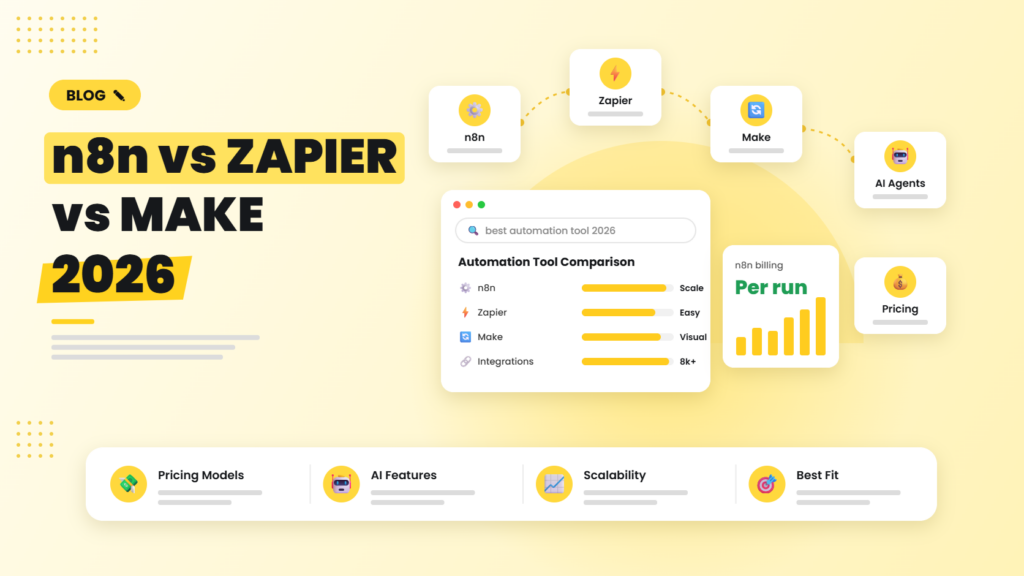
Every marketing team eventually hits the same wall: too many tools, too much copy-pasting and not enough hours. Workflow automation platforms fix that, and in 2026 three names dominate the conversation: Zapier, Make and n8n. They look similar on the surface, but they bill differently, scale differently and handle AI agents very differently. Choosing the wrong one can mean a surprise bill or a workflow your team cannot maintain.
Quick answer: Choose Zapier if you want the fastest setup and the largest app library with no technical help. Choose Make if you need visual, multi-branch workflows at a lower cost per step. Choose n8n if you run high-volume or AI-heavy workflows, want to self-host for data control, or need custom code; it becomes the cheapest option at scale because it bills per workflow run rather than per step.
How the three tools differ at a glance
Zapier is the most beginner-friendly. It connects thousands of apps, uses a simple trigger-then-action model and now includes AI features such as Zapier Agents and an AI copilot for building Zaps from plain-language prompts. Pricing is based on tasks, so every action step that runs counts toward your plan.
Make (formerly Integromat) uses a visual canvas where you drag modules and draw branches, routers and loops. It is more flexible than Zapier for complex logic and usually cheaper per step, but it has a steeper learning curve. Billing is based on the operations or credits each module consumes.
n8n is a fair-code, node-based platform you can self-host or use in the cloud. It supports JavaScript and Python code nodes, has native AI agent and LangChain-style nodes, and bills cloud customers per workflow execution rather than per step. The self-hosted Community Edition is free to run on your own server.
Pricing model: the difference that matters most
List prices change often, so focus on how each tool counts usage:
- Zapier: a 10-step Zap that runs 1,000 times can use up to 10,000 tasks.
- Make: the same workflow uses operations for each module, but at a lower price per unit.
- n8n: the same workflow counts as 1,000 executions, however many steps it has.
For simple two-step automations, the difference is small. For long SEO or reporting workflows with loops over hundreds of URLs, n8n is often several times cheaper, and self-hosting removes per-run costs altogether.
AI agents and LLM workflows
All three now support AI steps, but they approach it differently. Zapier focuses on packaged AI actions and no-code agents. Make offers AI modules and agent features inside its visual builder. n8n gives the most control: you can wire an AI agent to memory, tools, vector stores and any API, and choose your own model provider. For teams building custom AI SEO or content workflows, that flexibility is a big advantage.
Side-by-side comparison for marketing teams
| Factor | Zapier | Make | n8n |
|---|---|---|---|
| Ease of use | Easiest | Moderate | Moderate to technical |
| App integrations | Largest library | Large library | Smaller library, but any API via HTTP node |
| Billing unit | Per task (step) | Per operation or credit | Per workflow execution |
| Self-hosting | No | No | Yes |
| Custom code | Limited | Limited | Full JavaScript and Python |
| Best for | Quick wins, non-technical teams | Complex visual workflows | High volume, AI agents, data control |
Which one should you choose?
Pick Zapier if…
Your team is non-technical, you need automations live this week, and most workflows are short: form to CRM, new lead to Slack, new post to social scheduler. The time saved on setup often outweighs the higher cost per task.
Pick Make if…
You run multi-branch campaigns, need routers, filters and iterators, and want to see the whole flow visually. Agencies managing client onboarding, content approvals and multi-channel publishing often land here.
Pick n8n if…
You automate SEO data pulls, crawl processing, AI content workflows or anything that loops over large datasets. It is also the natural choice when client data must stay on your own infrastructure, which matters for regulated industries and data-privacy commitments.
Real marketing workflows to start with
- Daily Google Search Console pull to Sheets with an AI summary to Slack.
- New lead from website form to CRM, enrichment, then a personalised WhatsApp or email follow-up.
- Blog published in WordPress, then social posts drafted by AI and queued for approval.
- Weekly ad spend and GA4 conversions merged into one Looker Studio report.
- Review monitoring that alerts your team to new one-star reviews within minutes.
Many teams end up using two tools: Zapier for quick, low-volume automations and n8n for heavy data and AI workflows. That is a perfectly sensible setup. If you want help designing it, our agentic AI digital marketing team can map your workflows and build them properly.
Frequently asked questions
Is n8n cheaper than Zapier?
At scale, usually yes. n8n cloud bills per workflow execution, not per step, and the self-hosted Community Edition is free to run. For short, low-volume automations the difference is small; for long, high-volume workflows n8n is often much cheaper.
Is Make easier than n8n?
For most non-developers, Make is easier because of its polished visual builder and large library of pre-built modules. n8n is also visual, but it rewards some technical comfort with APIs, JSON and code nodes.
Can Zapier, Make and n8n run AI agents?
Yes. All three support AI steps and agent features in 2026. n8n gives the most control over models, memory and tools, Zapier is the simplest to set up, and Make sits in between.
Which tool is best for SEO automation?
n8n is generally the best fit for SEO automation because SEO workflows loop over many URLs and queries, which is expensive on per-step pricing. It also connects easily to the Search Console, GA4 and PageSpeed Insights APIs.
Can I switch from Zapier to n8n later?
Yes, but workflows must be rebuilt, not imported. Start by migrating your highest-volume or most expensive Zaps first, since those deliver the biggest savings.
We audit your tools and build the right automation layer, whether that is Zapier, Make or n8n, with the workflows, alerts and documentation your team needs to run it.

Riya Bhardwaj
Leading content and growth initiatives with a focus on search visibility, audience engagement, and measurable business outcomes. Specialised in SEO, Generative Engine Optimization (GEO), AI search optimisation, and performance-driven content marketing. Passionate about transforming market insights into scalable content strategies that strengthen brand authority and drive sustainable digital growth.