
On 1 October 2026, Google updated its guidance on generative AI content with a clear message: check the facts yourself before you publish. It also explained why. Generative models predict likely word sequences, they do not look facts up. For any team using AI to speed up content, this is the most practical guidance Google has given so far, and it is easy to turn into a routine.
Quick answer: Google’s updated documentation says manual fact-checking of AI output is essential before publishing. AI text that sounds confident can still be wrong. The safest workflow is to let AI draft or outline, then have a person verify every claim, number, name and source, add first-hand experience, and sign off before anything goes live.
What Google actually changed
Google’s generative AI content page now spells out two ideas. First, AI systems generate text by predicting what words are likely to come next, so they can produce statements that read well but are not true. Second, the person publishing the content is responsible for its accuracy. Google also kept its long-standing position that using AI is not against its rules, but publishing low-value content at scale is.
Around the same time, Google’s helpful content guidance was reported to describe main content in terms of effort, originality, talent or skill, and accuracy. Put together, the message is simple: AI is a tool, and quality is judged on the result. Our earlier article on whether Google can tell if content is AI-written covers the detection question in detail.
Why this matters for your brand
A wrong statistic, an invented quote or an outdated price does more than lose a reader. It can be copied into AI answers and repeated. It also weakens trust signals for the whole site, and the September spam update showed Google is paying closer attention to low-quality content at scale.
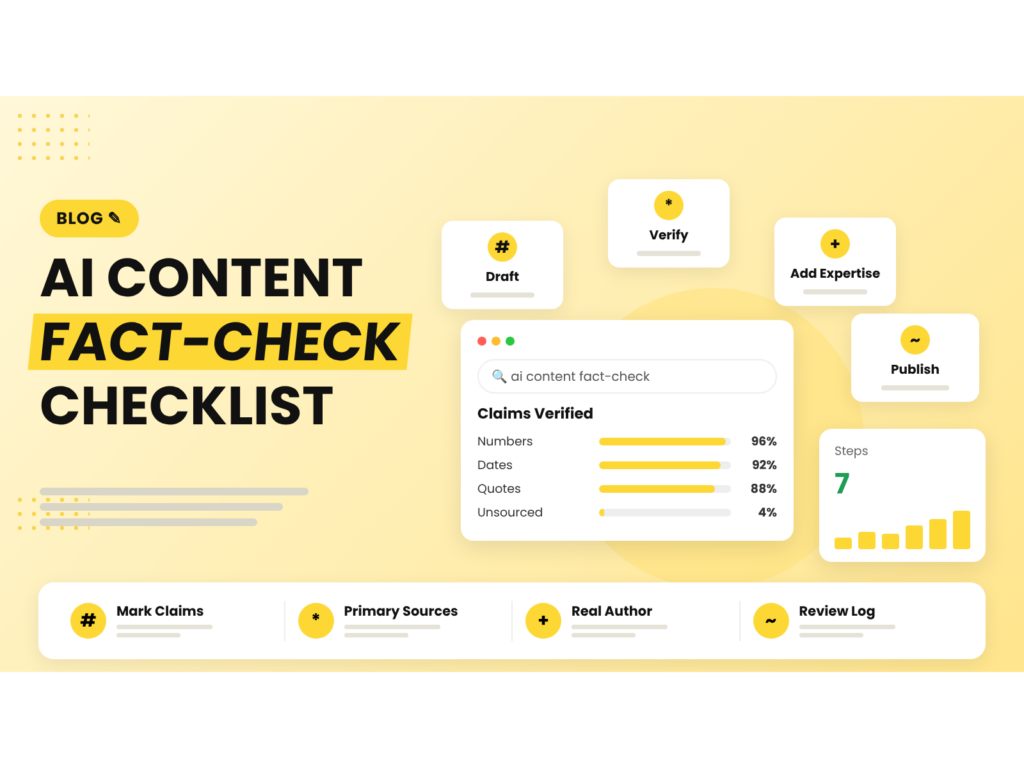
A 7-step pre-publish checklist
1. Mark every claim
Highlight each number, date, name, law, price and quote in the draft. If it can be checked, it must be checked.
2. Trace each claim to a primary source
Use the original report, official page or dataset, not a blog that repeated it. Write the source next to the claim in your working copy.
3. Check dates and versions
AI tools often mix old and new information. Confirm that features, prices and policies are current as of the publish date.
4. Remove what you cannot verify
If a claim has no source, delete it or soften it honestly. Do not leave a confident sentence that nobody checked.
5. Add something only you can say
Include a real example, a screenshot, client learning (with permission) or your own data. This is what separates useful content from a rewrite.
6. Use a real author with a real profile
Name the person who reviewed the piece. Do not invent authors. See our guide on author entity SEO for how to do it properly.
7. Keep a review log
Record who checked what and when. If a claim is challenged later, you can show your process and fix it fast.
Where AI helps most
AI is strong at outlines, summaries of material you supply, reformatting, and spotting gaps in a draft. It is weak at fresh facts, niche numbers and anything that changed recently. Use it where it is strong and put human time where it is weak.
Frequently asked questions
What did Google change about AI content on 1 October 2026?
Google updated its generative AI content documentation to say manual fact-checking of AI output is essential before publishing, and to explain that models predict likely word sequences rather than retrieve facts.
Does Google ban AI-written content?
No. Google’s position is that AI can be used, but content is judged on quality, accuracy and usefulness. Low-value content published at scale is the problem, whatever tool made it.
Who is responsible if AI content has errors?
The publisher. Google’s guidance puts the responsibility for accuracy on the people who publish the content, which is why a human review step matters.
How long does fact-checking take?
For a typical 1,500-word article, plan 30 to 60 minutes. Marking claims first and checking against primary sources keeps it quick.
Can I use AI to fact-check AI?
It can help flag claims to check, but it should not be the final check. Verify against original sources yourself.
We design programmatic SEO systems with the data, templates and quality controls needed to grow long-tail traffic safely — without risking a scaled content penalty.

Riya Bhardwaj
Leading content and growth initiatives with a focus on search visibility, audience engagement, and measurable business outcomes. Specialised in SEO, Generative Engine Optimization (GEO), AI search optimisation, and performance-driven content marketing. Passionate about transforming market insights into scalable content strategies that strengthen brand authority and drive sustainable digital growth.