

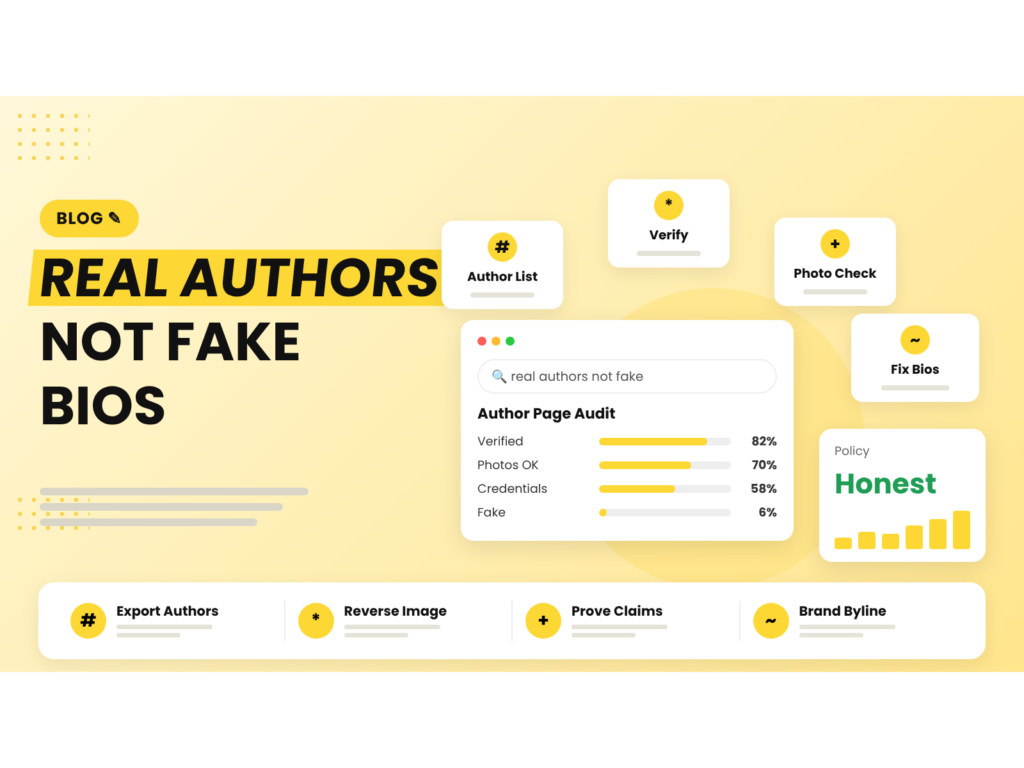
For years, some sites have published articles under made-up names with stock or AI-generated headshots and impressive-sounding credentials. On 6 October 2026, it was reported that Google’s documentation now treats this kind of deceptive authorship as deception. Search Engine Roundtable noted that this reverses Google’s earlier stance. If your site, or an agency you hired, uses invented authors, this is the time to clean it up.
Quick answer: Google’s updated guidance describes deceptive authorship, such as AI-generated headshots, invented names and false credentials, as deception. The fix is to show real people with real experience, or to publish under the brand name with no made-up profile. Audit every author page, remove anything you cannot prove, and keep evidence of your authors’ credentials.
What changed
According to reports on 6 October, Google’s documentation now places deceptive authorship in the same group as other forms of misleading content. The examples named include AI-generated headshots, invented author names and false credentials. Google’s earlier position had been less direct, and many sites assumed an author box was harmless decoration.
This lines up with Google’s wider push on quality. It said at SCL Barcelona that scaled content is now a bigger problem than link spam, and its updated AI content guidance calls for manual fact-checking. Honest authorship is part of the same package. Our guide to author entity SEO covers how to build real author signals.
Why it matters beyond Google
Trust matters for AI answers too. Systems that choose sources look for clear signs of who wrote something and why they can be trusted. A fake profile might pass at a glance, but it can be exposed by a reverse image search, a failed LinkedIn lookup or a single customer complaint, and the damage to brand trust is far greater than any ranking gain.
How to audit your author pages
1. List every author name on your site
Crawl your blog and export the author field. Include guest posts, old contributors and generic names like Admin or Editorial Team.
2. Verify each one
For every named person, check that they exist, that they agree to be named, and that the bio is accurate. Look for a real photo, a real profile elsewhere and examples of their work.
3. Check the photos
Run a reverse image search. If the image is stock, AI-generated or taken from someone else, replace it with a real photo or remove it.
4. Check the credentials
Every degree, job title, year of experience and award should be true and provable. Remove vague or inflated claims.
5. Choose an honest alternative where needed
If no real expert wrote the piece, publish it under the company name, or have a real subject-matter expert review and be credited. A brand byline is better than a fake person.
6. Update schema and bios
Make sure structured data matches what is visible on the page. Our guide to schema markup shows how to mark up authors correctly.
Ground rules going forward
Write down a simple policy: authors must be real, consenting and accurately described, and agencies working for you must follow it too. Ask your content vendors in writing how they handle bylines.
Frequently asked questions
What did Google say about fake authors?
Reports on 6 October 2026 said Google’s documentation now treats deceptive authorship, including AI-generated headshots, invented names and false credentials, as deception.
Can I publish under my company name instead of a person?
Yes. A clear brand byline is a safer choice than a made-up person. Better still, have a real expert review and be credited.
Is using a stock photo for an author bad?
It can look deceptive if the photo is presented as the author. Use real photos, or no photo, and never use AI-generated faces to imply a real person.
How do I check my existing author profiles?
Export all author names, verify each person exists and agrees, run reverse image searches on photos, and prove every credential you list.
Will fixing this improve rankings?
It removes a trust risk and supports quality signals, but it is not a ranking trick. Treat it as protection and good practice.
We design programmatic SEO systems with the data, templates and quality controls needed to grow long-tail traffic safely — without risking a scaled content penalty.

Riya Bhardwaj
Leading content and growth initiatives with a focus on search visibility, audience engagement, and measurable business outcomes. Specialised in SEO, Generative Engine Optimization (GEO), AI search optimisation, and performance-driven content marketing. Passionate about transforming market insights into scalable content strategies that strengthen brand authority and drive sustainable digital growth.