
Searching for a company by name used to be the safest kind of search for that company. You would see its website, its profiles and its reviews. That is changing. Late September studies found AI Overviews on a very high share of branded queries, which means Google’s summary of your brand now sits above your own website. If you have not checked what it says, you should.
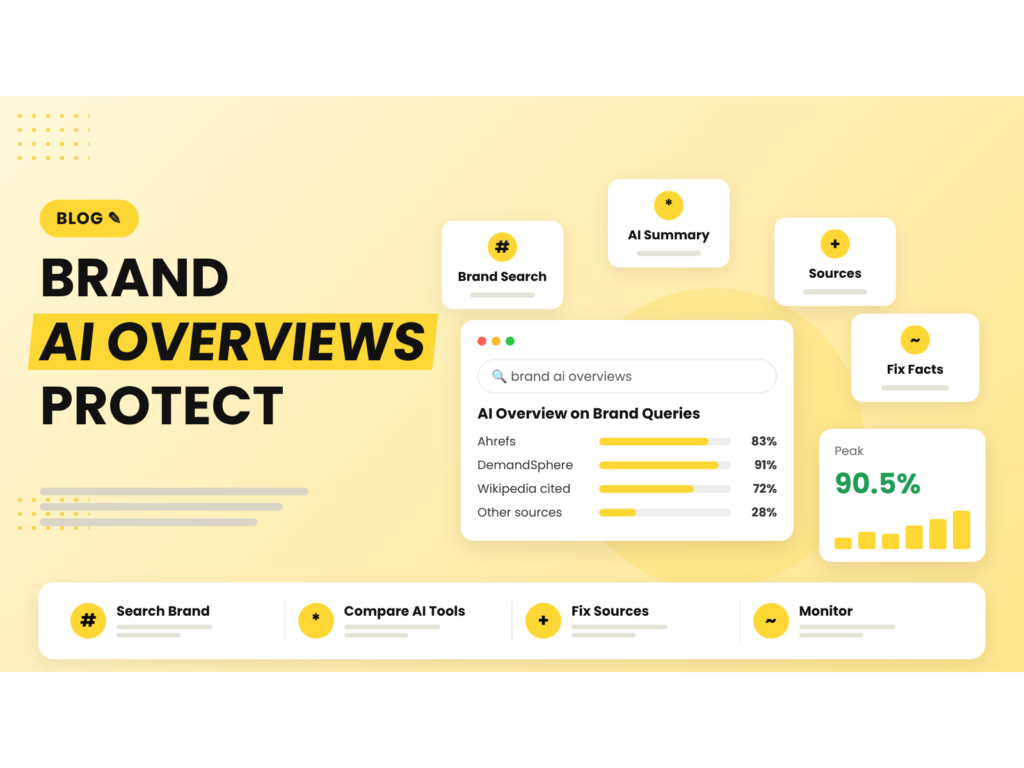
Quick answer: DemandSphere measured AI Overviews on up to 90.5% of branded queries on 27 September, and Ahrefs measured 82.91% on 29 September. In brand answers, Wikipedia was cited in 71.9% of cases. Check what Google and other AI tools say about your brand, fix wrong facts at the source, strengthen your own pages and profiles, and monitor monthly.
What the data says
Two industry studies reported in early October looked at how often AI Overviews appear for brand-name searches. DemandSphere found a peak of 90.5% on 27 September. Ahrefs measured 82.91% on 29 September. The two tools measure different keyword sets, so the numbers differ, but both point the same way: for branded searches, an AI summary is now the norm, not the exception.
The same research found Wikipedia cited in 71.9% of brand AI Overviews. For many companies that is a problem, because they have no Wikipedia page, or the page is outdated, or the facts come from third-party sites they do not control.
Why brand AI summaries matter
People search your name when they are close to a decision: checking reviews, pricing, legitimacy or alternatives. If the summary gets your services, pricing, location or reputation wrong, you lose trust before the click. And if a rival is mentioned in your own brand summary, you may lose the lead without ever seeing it in your analytics.
How to audit and improve your brand results
1. Search your brand like a customer
Try your brand name, brand plus reviews, brand plus pricing, brand plus alternatives, and brand plus a main service. Take screenshots with dates.
2. Check other AI tools too
Ask the same questions in ChatGPT, Gemini and Perplexity. Compare facts such as founding year, services, locations and leadership.
3. Find where wrong facts come from
Click the cited sources. Common culprits are old directory listings, third-party review sites and outdated press. Fix what you control and request updates where you do not.
4. Strengthen your own source pages
Create a clear About page, a services overview, a pricing or process page and an FAQ with short factual answers. Add Organization schema; our schema markup guide explains what to include.
5. Keep profiles consistent
Use the same name, description, address and links on your Google Business Profile, LinkedIn, directories and social channels. For local firms, see our piece on Google Business Profile.
6. Earn credible mentions
Press, industry lists and real reviews matter more than ever. A notable company may qualify for a Wikipedia article, but only if it meets Wikipedia’s rules, and you should never try to write one for yourself in secret.
7. Monitor monthly
Repeat the checks and save the results. Our guide on tracking AI search visibility shows how to automate part of it.
Frequently asked questions
How often do AI Overviews appear on branded searches?
Late September 2026 studies measured 90.5% (DemandSphere, 27 September) and 82.91% (Ahrefs, 29 September). Methods differ, but both show high presence.
Why does Wikipedia appear so often in brand answers?
Wikipedia was cited in 71.9% of brand AI Overviews in the research. It is a widely trusted, well-structured source that AI systems favour.
Can I remove a wrong statement about my brand?
Not directly from the AI summary. Fix the source pages that contain the wrong fact, strengthen your own pages, and use Google’s feedback options to report inaccuracies.
Do I need a Wikipedia page?
Only if your company genuinely meets Wikipedia’s notability rules. Do not create or edit a page in a promotional or hidden way.
What should I track each month?
Your brand AI summary text, cited sources, competitor mentions, and whether key facts such as services and location are correct.
We design programmatic SEO systems with the data, templates and quality controls needed to grow long-tail traffic safely — without risking a scaled content penalty.

Riya Bhardwaj
Leading content and growth initiatives with a focus on search visibility, audience engagement, and measurable business outcomes. Specialised in SEO, Generative Engine Optimization (GEO), AI search optimisation, and performance-driven content marketing. Passionate about transforming market insights into scalable content strategies that strengthen brand authority and drive sustainable digital growth.