
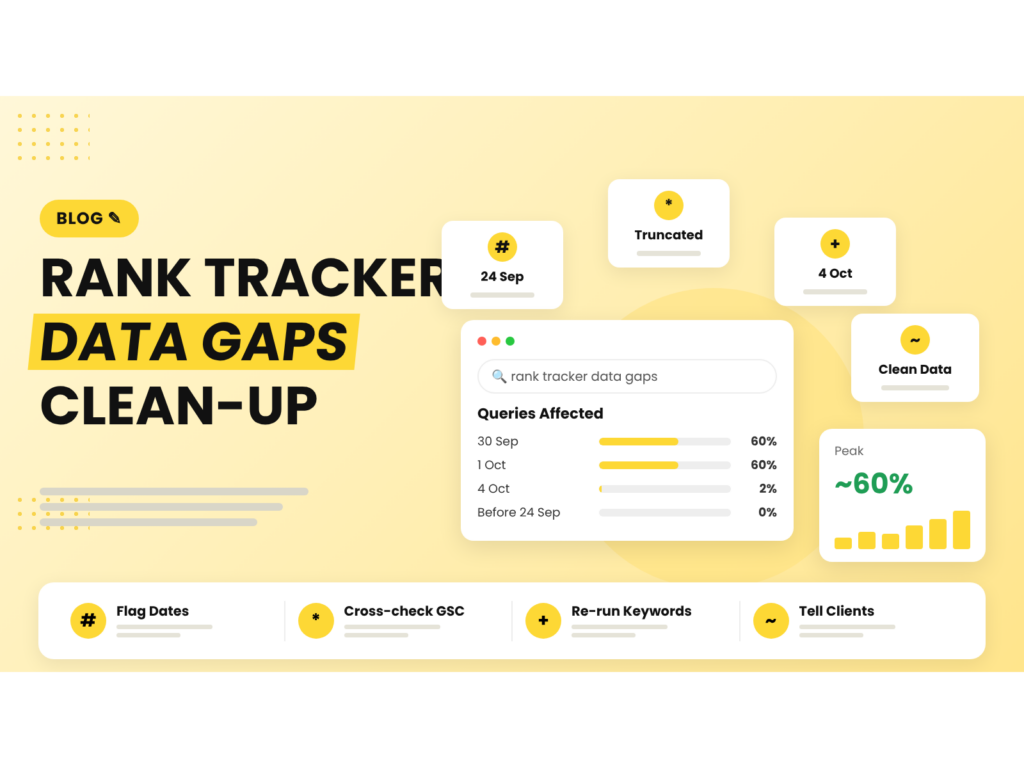
If your rank tracker showed a sudden crash in late September, check before you panic. Morningscore reported on 8 October that from 24 September, Google returned truncated results to automated trackers. At the peak, on 30 September and 1 October, about 60% of queries were affected. By 4 October the share had fallen to 1 to 2%. That overlaps with the September spam update, which makes it easy to blame the wrong cause.
Quick answer: Some ranking drops in late September and early October may be data problems, not real ranking losses. Compare tracker data with Search Console clicks and impressions, mark the affected dates in your reports, re-run key keywords after 4 October, and tell clients clearly which numbers are reliable.
What happened to the data
According to Morningscore, from 24 September Google began returning truncated results to automated rank trackers. Truncated means fewer results per page than expected, so a page ranking in a lower position could appear to vanish. The reported impact grew over the week, peaking at about 60% of queries on 30 September and 1 October, then dropping to 1 to 2% by 4 October.
These figures come from one tool vendor’s analysis, so treat them as a guide to the pattern rather than a precise measurement for your own keywords. Different trackers and locations may have been affected differently.
Why this is a reporting risk
The window also overlaps with Google’s September 2026 spam update, which ran from 24 September to 8 October. A genuine ranking drop and a data glitch can look the same in a dashboard. Teams that react to the chart alone may rewrite good pages, or tell a client that a penalty hit when it did not. We explain the real update in our guide to the September 2026 spam update.
How to clean your reports
1. Mark the affected dates
Add a clear note to your charts for 24 September to 4 October. Do not delete the data, but flag it.
2. Cross-check with Search Console
Compare clicks and impressions for the same pages. If traffic held steady while the tracker showed a crash, the tracker is the problem. For larger sites, pulling data through our Search Console BigQuery workflow makes this easier.
3. Re-run key keywords
Ask your tool to refresh your top 50 keywords after 4 October, or check a sample by hand in a clean browser window with location set correctly.
4. Compare like with like
Use a consistent baseline, for example the average of 1 to 20 September against 5 to 25 October, and skip the affected days.
5. Ask your tool vendor
Ask whether they flagged affected data and whether they have corrected historical records. Keep their answer for your records.
6. Explain it to clients simply
Say what happened, which dates are unreliable, what you used instead, and what you will do next. Short, honest notes build trust.
7. Add data checks to your process
Set an alert when more than a set percentage of keywords drop at once. That pattern is often a data issue. Our guide to automated technical SEO audits has more checks you can add.
Frequently asked questions
What happened to rank trackers in late September 2026?
Morningscore reported that from 24 September Google returned truncated results to automated trackers. About 60% of queries were affected at the peak on 30 September and 1 October.
When did the data issue end?
The reported share of affected queries fell to 1 to 2% by 4 October 2026.
How do I know if my drop is real?
Compare the tracker with Search Console clicks and impressions for the same pages. If real traffic did not fall, the drop is likely a data issue.
Should I fix pages that appeared to drop?
Not until you confirm the drop is real. Check Search Console first, then re-run rankings after 4 October.
Do I need to tell clients?
Yes, briefly. Explain the affected dates, which data you trust, and how you checked it.
We design programmatic SEO systems with the data, templates and quality controls needed to grow long-tail traffic safely — without risking a scaled content penalty.

Riya Bhardwaj
Leading content and growth initiatives with a focus on search visibility, audience engagement, and measurable business outcomes. Specialised in SEO, Generative Engine Optimization (GEO), AI search optimisation, and performance-driven content marketing. Passionate about transforming market insights into scalable content strategies that strengthen brand authority and drive sustainable digital growth.