
Most marketers still have no good way to see where their brand is cited in AI answers. On 13 October 2026, Bing added a step in that direction: a beta report called Topics Portfolio, inside the AI Performance section of Bing Webmaster Tools. It groups the queries that cite your site into broader topics and shows where competitors are cited and you are not. It is imperfect, but it is a free, first-party view that is worth ten minutes a month.
Quick answer: Topics Portfolio shows, for each topic, its size, the number of sites cited, the number of distinct queries, and a list of top opportunity queries where others are cited and you are not. Use the opportunity list to plan new or improved pages. Remember the limits: counts are shown as ranges, topic names are AI-generated, there is no click data, and smaller sites may see little.
What the report shows
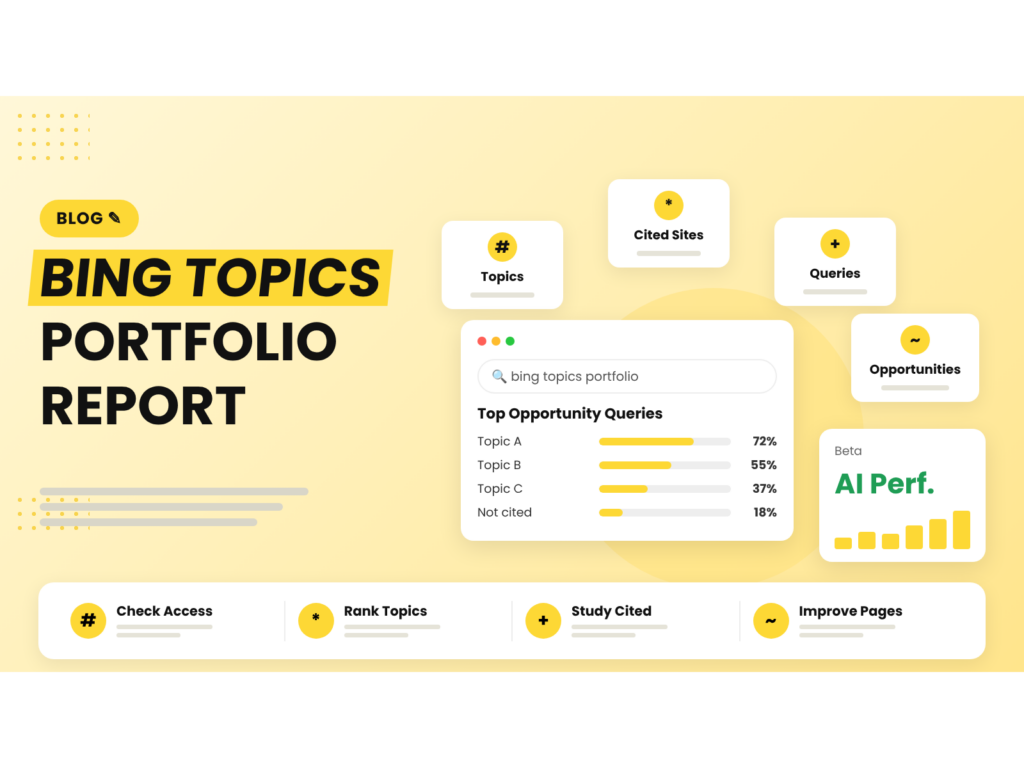
Inside Bing Webmaster Tools, the AI Performance area now includes a Topics Portfolio beta. For each topic it lists Topic Size, Sites Cited, the number of distinct Queries, and a Top Opportunity Queries list. The last one is the most useful part: it points to questions where Bing’s AI answers cite competitors but not you.
It joins the data you may already use from Google Search Console’s AI performance reporting. Together they give a rough view of two engines instead of none.
Limits you should know
This is a beta, and it has clear gaps. Citation counts appear as approximate ranges rather than exact numbers. Topic labels are generated by AI and can be wrong or oddly grouped. There is no click data, so you cannot tie citations to visits. And smaller or newer sites may see little or nothing. Treat it as a map of where to look, not a score to chase.
How to use it in five steps
1. Check access
Log in to Bing Webmaster Tools, open AI Performance and look for Topics Portfolio. If your site is small, you may see empty reports. In that case, keep verifying your site and check again after the next update.
2. Sort topics by business value
Ignore topics that do not match what you sell. Mark the three to five topics closest to revenue.
3. Read the opportunity queries
For each key topic, copy the opportunity queries into a sheet. Next to each, note whether you have a page, whether it answers the question directly, and who is being cited instead.
4. Study the cited pages
Open two or three cited competitors. Look at structure, depth, freshness, proof and format. Do not copy; find what they answer that you do not.
5. Improve, then re-check
Update an existing page first, because it is faster than writing a new one. Add a direct answer near the top, a clear heading, supporting data and a short FAQ. Check the report again in four to six weeks.
Where this fits in your routine
Add Bing’s report to your monthly SEO review next to Search Console, and consider automating the exports with the ideas in our guide to tracking AI search visibility.
Frequently asked questions
What is the Bing Topics Portfolio report?
It is a beta report in the AI Performance section of Bing Webmaster Tools. It groups queries that cite your site into topics and shows opportunity queries where competitors are cited and you are not.
Does it show clicks?
No. It shows citation information only, with counts given as approximate ranges, so you cannot connect it directly to traffic.
Why is my report empty?
Smaller or newer sites may see little or no data in the beta. Make sure your site is verified and check again later.
Are the topic names reliable?
Not always. They are generated by AI and may be wrong or overly broad, so check the underlying queries.
How often should I check it?
Monthly is enough for most sites. Pair it with Search Console data and a simple log of the changes you make.
We design programmatic SEO systems with the data, templates and quality controls needed to grow long-tail traffic safely — without risking a scaled content penalty.

Riya Bhardwaj
Leading content and growth initiatives with a focus on search visibility, audience engagement, and measurable business outcomes. Specialised in SEO, Generative Engine Optimization (GEO), AI search optimisation, and performance-driven content marketing. Passionate about transforming market insights into scalable content strategies that strengthen brand authority and drive sustainable digital growth.