
On 13 October 2026, Google began offering its new Gemini 4 Argon model in AI Mode and the Gemini app. For now it is limited to Google AI Pro and Ultra subscribers, who choose it from the model menu, and developers can use it through the API. Google says it is better at multi-step tasks and follow-up questions. That second point matters most to marketers, because it changes what a good page looks like.
Quick answer: AI Mode is built for conversations, not single searches. A better model for follow-ups means people can keep asking until they get what they need, and brands that answer the next question on the page are more likely to be named. Test your top customer questions in AI Mode, note which brands appear, and add clear answers to the follow-ups your pages miss.
What is new
Gemini 4 Argon is Google’s latest model and is now selectable in AI Mode for paying Google AI subscribers. Google claims it leads the Vals Index benchmark, which is a vendor claim and worth treating as such. What is not in doubt is the direction: Google wants AI Mode to handle longer, multi-step questions such as comparing options, narrowing by budget, and then asking what to check before buying.
Access is limited today, so most of your customers will not see it yet. But features that start with paid tiers tend to widen, and the way people use AI Mode today shows the habits you will need to serve later. For the bigger picture on how AI tools are splitting search traffic, see our look at AI search market share.
Why follow-up questions change content strategy
In classic search, a page won if it answered one query. In a conversation, the user asks a second and third question, and the system looks for sources that can support each step. If your page answers only the headline question, another source may be used for the follow-up, and the brand mentioned at the end of the chain is often the one that answered the last step.
How to prepare your content
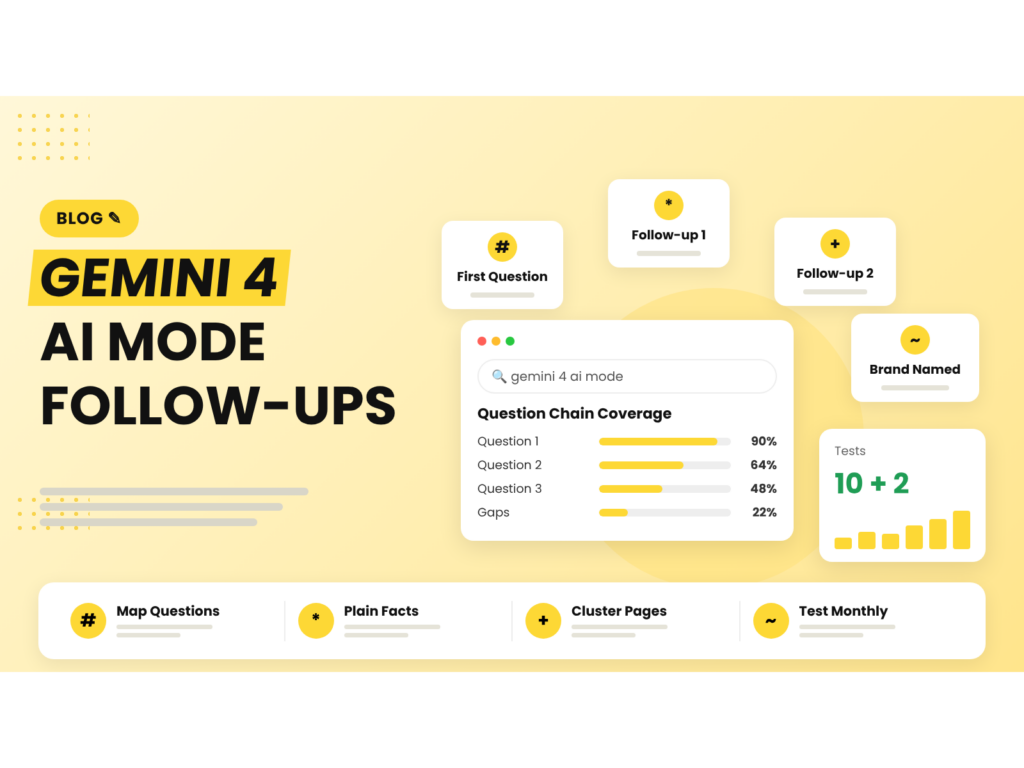
1. Map the question chain
For each money page, write the first question, then the next three a real customer would ask. For a software page it might be: what does it do, how much does it cost, how does it compare with a rival, how long does setup take.
2. Answer the chain on one page or in a tight cluster
Add short, direct answers under clear headings, and link to deeper pages. A cluster approach also builds topical authority.
3. Put facts in plain text
Prices, limits, timelines and requirements should be written in sentences or simple tables, not hidden in images or pop-ups.
4. Test in AI Mode
Take your top ten customer questions, ask them in AI Mode, and then ask two follow-ups each. Record which brands are named and which pages are cited. Repeat monthly.
5. Track what you can
Use Search Console and your analytics for referral clues, and keep a simple log of AI-mode tests. Measurement is still rough, so combine tools with manual checks.
What not to do
Do not rewrite every page for one model. Models change quickly, and Google’s own advice stays the same: helpful, accurate, people-first content. Use this update to find gaps, not to chase a feature.
Frequently asked questions
What is Gemini 4 Argon?
It is Google’s newest Gemini model, released on 13 October 2026. It is available in AI Mode and the Gemini app for Google AI Pro and Ultra subscribers, and to developers through the API.
Who can use it in AI Mode right now?
Subscribers to Google AI Pro and Ultra can select it from the model menu. It is not yet the default for everyone.
How does it affect SEO?
Google says it handles multi-step tasks and follow-up questions better. That rewards pages that answer the next question as well as the first one.
How do I check if my brand appears in AI Mode?
Ask your top customer questions in AI Mode, add two follow-up questions, and record which brands and pages are cited. Do this on a regular schedule.
Should I change my whole content plan?
No. Use it to find gaps in your answers. Core quality principles have not changed.
We design programmatic SEO systems with the data, templates and quality controls needed to grow long-tail traffic safely — without risking a scaled content penalty.

Riya Bhardwaj
Leading content and growth initiatives with a focus on search visibility, audience engagement, and measurable business outcomes. Specialised in SEO, Generative Engine Optimization (GEO), AI search optimisation, and performance-driven content marketing. Passionate about transforming market insights into scalable content strategies that strengthen brand authority and drive sustainable digital growth.