

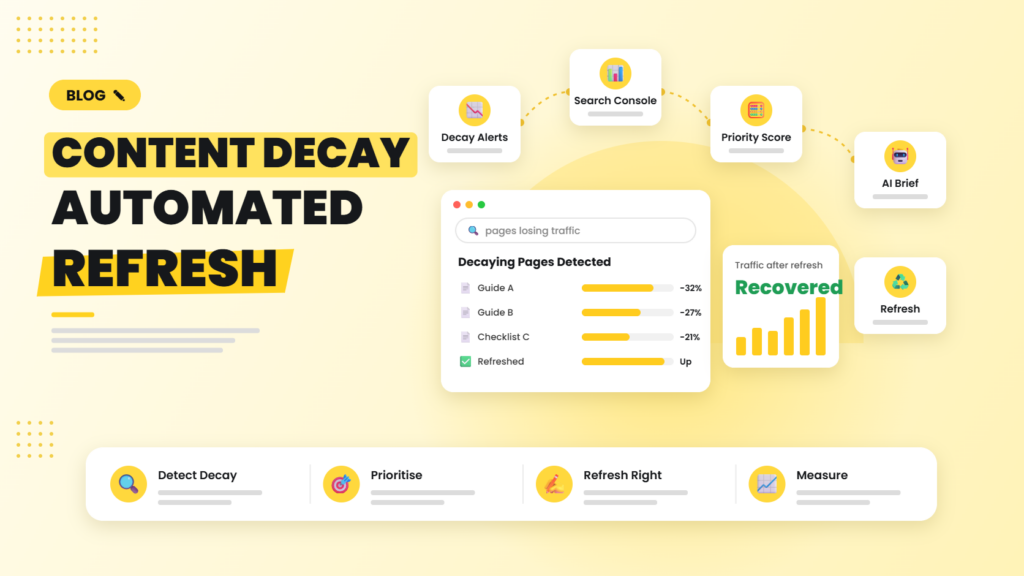
Publishing new content gets all the attention, but for most established websites, the fastest traffic wins are hiding in pages you already have. Articles that ranked well a year ago slowly slip as competitors publish fresher versions, facts go out of date and AI Overviews start answering the basic question. This is content decay, and it is quietly draining traffic from almost every blog. The fix is not a yearly clean-up; it is an automated system that spots decay early and tells you exactly what to refresh.
Quick answer: Content decay is a gradual, sustained drop in a page’s clicks and rankings. To automate content refresh, pull page-level Search Console data monthly, flag URLs with a consistent decline over three or more months, score them by past traffic, business value and ranking position, then refresh the top candidates with updated facts, better answers, new sections and improved titles. AI can speed up the audit and drafting, but experts should make the final updates.
Why content decays
- Competitors publish better or fresher content on the same topic.
- Search intent shifts: a query that wanted a guide now wants a tool, a comparison or a video.
- Facts go stale: prices, statistics, screenshots and year references age quickly.
- SERP features take clicks: AI Overviews, featured snippets and video carousels absorb attention.
- Cannibalisation: newer posts on your own site compete with the original.
- Lost links: backlinks disappear over time and internal links get buried.
Step 1: Collect the right data automatically
Set up a monthly workflow (or use the Search Console BigQuery export) that stores clicks, impressions, CTR and average position by URL for each month. You need at least six months of history, ideally 12 or more, to separate real decay from seasonality.
Step 2: Define what decay looks like
A reliable rule of thumb is to flag a page when:
- clicks have fallen for three consecutive months, or
- clicks are down more than 25–30% compared with the same period last year, and
- the page previously had meaningful traffic (for example, at least 100 clicks a month).
Also flag pages whose impressions are stable but CTR is falling. That usually means an AI Overview or a stronger competitor snippet is taking the click, and the title and intro need work rather than the whole article.
Step 3: Prioritise with a simple score
Not every decaying page deserves attention. Score each candidate on peak traffic, current average position (positions 4–15 are the easiest to recover), conversions or business value, and how outdated the content is. Refresh the highest scores first.
Step 4: Speed up the audit with AI
For each priority page, an automated workflow can fetch the page, pull the top queries it ranks for, and send both to an AI model with a clear brief: identify outdated facts, missing subtopics compared with the queries, weak headings, and opportunities for a clearer direct answer near the top. The output becomes a refresh brief for your writer or subject expert.
Step 5: Refresh properly, not cosmetically
Changing the date and adding a sentence does not work, and misleading freshness signals can backfire. A real refresh usually includes:
- Updated statistics, prices, screenshots and examples.
- A concise answer at the top for the main query, which also helps AI Overviews and AI assistants cite you.
- New sections covering questions from Search Console and People Also Ask.
- A stronger title tag and meta description aimed at CTR.
- Updated internal links to and from newer related content.
- Refreshed FAQ and structured data where relevant.
- Clear authorship and a visible “last updated” date that reflects a genuine update.
Step 6: Consolidate or retire when needed
If two posts compete for the same queries, merge them into one stronger page and 301 redirect the weaker URL. If a page has no traffic, no links and no business value, consider removing or noindexing it so crawlers focus on your best content.
Step 7: Measure the results
Log every refresh with its date in your tracking sheet. Your automation can then compare clicks and positions 30, 60 and 90 days after the update, showing which types of refresh work best for your site. Many teams find a steady refresh programme delivers more traffic per hour than publishing new posts.
This workflow builds on the same data pipeline as our guides to automating daily SEO tasks and Search Console BigQuery reporting. If you would like help, our content marketing services team can run the audit and refreshes for you.
Frequently asked questions
What is content decay in SEO?
Content decay is a gradual, sustained decline in a page’s organic traffic and rankings over months, usually caused by fresher competitor content, changing search intent, outdated information or new SERP features.
How often should I refresh old content?
Review performance monthly and refresh pages when they show a sustained decline. High-value, fast-changing topics may need updates every three to six months, while evergreen guides may only need a yearly review.
Does updating the published date help SEO?
Only when the content has genuinely been updated. Changing the date without meaningful changes does not improve rankings and can mislead readers.
How do I find decaying content in Google Search Console?
Compare page-level clicks over the last three to six months with previous periods and the same period last year. Pages with consistent declines and stable or falling impressions are decay candidates. Automating this with the API or BigQuery export saves hours.
Is it better to refresh old content or write new posts?
Both matter, but refreshing pages that already have rankings, links and history is often faster and cheaper. A balanced content plan includes a regular refresh programme alongside new content.
We find your decaying pages, prioritise the ones with the biggest upside and refresh them with updated, expert content that wins back rankings and AI citations.

Riya Bhardwaj
Leading content and growth initiatives with a focus on search visibility, audience engagement, and measurable business outcomes. Specialised in SEO, Generative Engine Optimization (GEO), AI search optimisation, and performance-driven content marketing. Passionate about transforming market insights into scalable content strategies that strengthen brand authority and drive sustainable digital growth.