

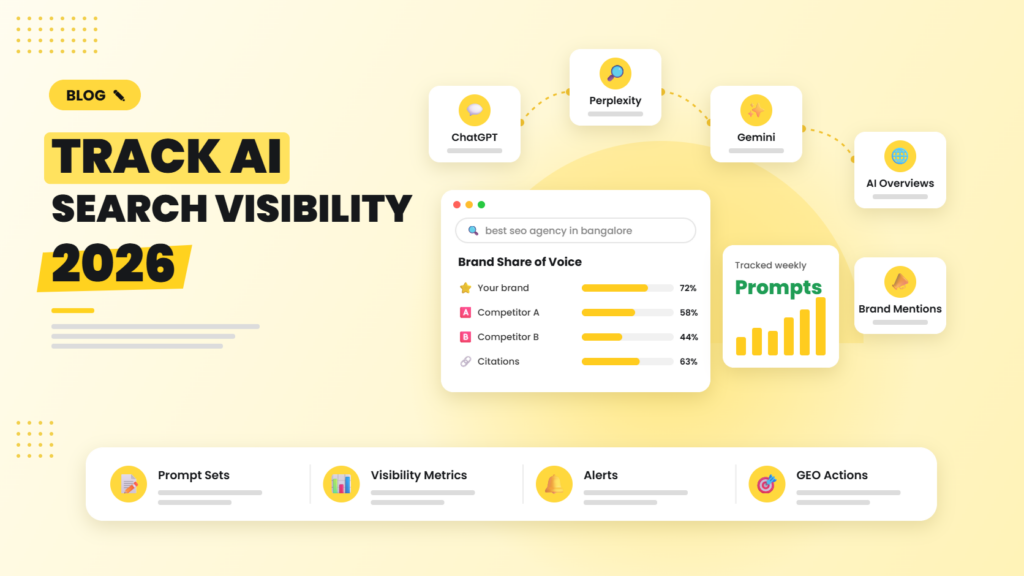
Your rank tracker says you are number two for your most important keyword. But when a prospect asks ChatGPT or Perplexity for the best provider in your category, are you even mentioned? For a growing share of buyers, AI answers are the first shortlist. Traditional rank tracking does not measure that, which is why AI visibility tracking has become a core part of SEO reporting in 2026. The good news: most of it can be automated.
Quick answer: To track AI search visibility automatically, build a list of prompts your customers actually ask, run them on a schedule across ChatGPT, Perplexity, Gemini, Google AI Mode and AI Overviews using a dedicated tool (such as Semrush, Ahrefs Brand Radar, Profound, Peec AI or Otterly.ai) or APIs, then record brand mentions, citations, sentiment and competitor share of voice. Review trends weekly, not individual answers, because AI outputs vary from run to run.
Why rankings are no longer the full picture
AI Overviews and AI Mode sit above traditional results for many queries, and standalone assistants like ChatGPT, Perplexity, Gemini and Copilot answer questions without showing a list of ten links at all. Visibility now has three layers:
- Mentions: does the AI name your brand in its answer?
- Citations: does it link to or cite your website as a source?
- Recommendation and sentiment: is your brand recommended, compared positively, or described inaccurately?
Step 1: Build your prompt set
AI visibility tracking starts with prompts, not keywords. Create 50 to 200 prompts across the buyer journey:
- Category discovery: “What are the best SEO agencies in Bangalore?”
- Problem-led: “How can I fix falling organic traffic on my Shopify store?”
- Comparison: “[Your brand] vs [competitor]: which is better for B2B SEO?”
- Brand questions: “Is [your brand] good? What do reviews say?”
Pull ideas from Search Console queries phrased as questions, sales call notes, People Also Ask, Reddit threads and customer support tickets.
Step 2: Choose how to collect answers
Dedicated tools such as Semrush’s AI visibility features, Ahrefs Brand Radar, Profound, Peec AI and Otterly.ai run your prompts on a schedule across multiple AI platforms and report mentions, citations and share of voice. This is the fastest route for most teams.
A custom workflow in n8n or Python can call model APIs with web search enabled, store every answer, and parse it for brand and competitor mentions. It is cheaper at scale and fully customisable, but API responses can differ from what users see in consumer apps, so treat it as a directional signal.
Step 3: Define the metrics you report
- Mention rate: percentage of prompts where your brand appears.
- Citation rate: percentage of answers that cite your domain.
- Share of voice: your mentions compared with named competitors.
- Average position in lists: are you first, third or tenth when the AI lists options?
- Sentiment and accuracy: is the description positive and factually correct?
- Top cited sources: which third-party pages, forums and review sites the AI relies on.
Step 4: Automate the schedule and alerts
Run your prompt set weekly (daily for your top 20 prompts). Store results in Google Sheets or BigQuery, and set alerts when your mention rate drops, a competitor appears in answers where it previously did not, or an AI describes your brand inaccurately.
Step 5: Connect visibility to traffic
In GA4, create a channel group or segment for AI referrals (chatgpt.com, perplexity.ai, gemini.google.com, copilot.microsoft.com and similar). Compare AI referral sessions and conversions with your visibility trend. AI traffic is still smaller than organic search for most sites, but it often converts well because visitors arrive with a clear intent.
Step 6: Turn insights into actions
The “top cited sources” report is your GEO roadmap. If AI answers keep citing a comparison article, a Reddit thread or a directory where you are missing, that is where you need a presence. Strengthen your own pages with clear answers, structured data, up-to-date facts and expert authorship, and earn mentions on the third-party sources AI already trusts.
Accept the variability
AI answers change between runs, locations and even phrasing. Do not panic over a single answer. Track trends over weeks, use a large prompt set and compare against competitors to get a reliable picture.
Want to go deeper? Our GEO services and ChatGPT SEO services teams help brands measure and grow their AI search presence.
Frequently asked questions
How do I check if ChatGPT mentions my brand?
Ask ChatGPT the questions your customers ask, with search enabled, and note whether your brand is mentioned or cited. For consistent tracking, use an AI visibility tool or an automated workflow that runs a fixed prompt set on a schedule.
What are the best AI visibility tracking tools?
Popular options in 2026 include Semrush AI visibility features, Ahrefs Brand Radar, Profound, Peec AI and Otterly.ai. The best choice depends on which AI platforms you need to cover, your prompt volume and budget.
Can I track Google AI Overviews automatically?
Yes. Many rank trackers and AI visibility tools now record whether an AI Overview appears for a keyword and which domains it cites, including yours.
Why do AI answers about my brand change every time?
AI models generate answers dynamically and may use different sources on each run. That is why visibility should be measured as a percentage across many prompts and runs rather than from a single answer.
How do I improve my brand visibility in AI search?
Publish clear, factual answers to customer questions, keep brand information consistent across the web, earn mentions on trusted third-party sites, use structured data and show real expertise. Tracking cited sources shows where to focus.
We track your visibility across ChatGPT, Perplexity, Gemini and Google AI Overviews, and build the GEO strategy that gets your brand cited and recommended.

Riya Bhardwaj
Leading content and growth initiatives with a focus on search visibility, audience engagement, and measurable business outcomes. Specialised in SEO, Generative Engine Optimization (GEO), AI search optimisation, and performance-driven content marketing. Passionate about transforming market insights into scalable content strategies that strengthen brand authority and drive sustainable digital growth.